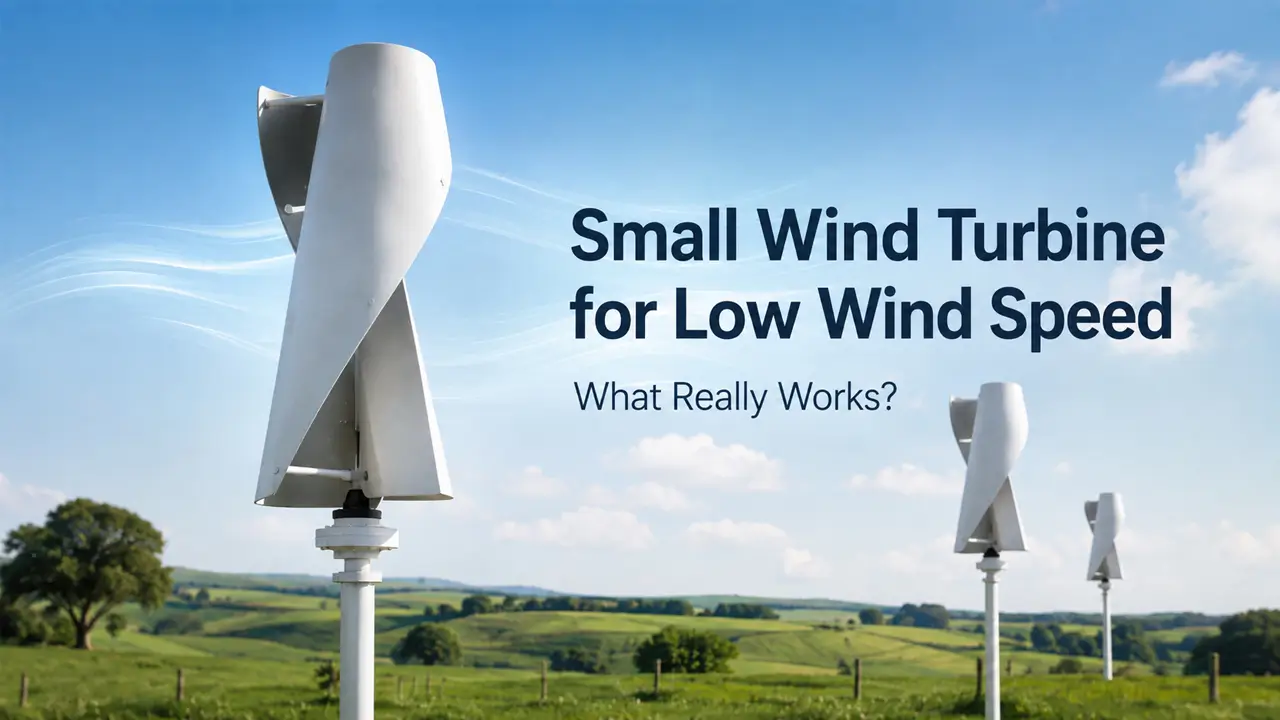
Choosing a small wind turbine for low wind speed conditions is not as simple as finding the model with the lowest start-up wind speed.
A turbine may begin turning in a light breeze while producing little useful electricity. What matters more is when it reaches cut-in speed, how output changes as wind speed rises, and whether your site provides enough clean and consistent wind over time.
If you are considering a small wind turbine for a home, farm, cabin, remote site, commercial property, or off-grid system, this guide explains what really matters in low-wind conditions and how to avoid choosing a turbine based on one attractive specification.
Can a Small Wind Turbine Work in Low Wind?
Yes, but you need to define what “work” means.
A wind turbine can begin rotating before it starts producing useful electrical power. It may also generate electricity long before it reaches its rated output.
This happens because the energy available in wind increases rapidly as wind speed rises. In simplified terms:
A relatively small increase in wind speed can therefore create a much larger increase in available wind energy.
That is why the important question is not:
A better question is:
What Wind Speed Does a Small Wind Turbine Need?
When comparing small wind turbines for low-wind areas, you should understand three different specifications: start-up wind speed, cut-in wind speed, and rated wind speed.
Start-Up Wind Speed
Start-up wind speed is the point at which the rotor can begin moving.
A low start-up speed shows that the rotor and generator can respond to relatively light wind, but it does not tell you how much electricity is being generated.
Cut-In Wind Speed
Cut-in wind speed is the point where the turbine begins entering its electrical generation range.
For a low-wind project, this number is often more useful than start-up speed.
If most of the available wind remains below cut-in speed, seeing the rotor turn frequently does not necessarily mean the system is producing useful energy.
Rated Wind Speed
Rated wind speed is the wind speed at which the turbine is designed to reach its rated power.
A 1000W turbine rated at 10 m/s does not produce 1000W whenever the rotor is spinning. It reaches approximately its rated output when wind conditions reach the specified rated range.
Why a 1.3 m/s Start-Up Speed Needs Context
The ELEGE EV vertical axis wind turbine illustrates the difference clearly.
The current EV Series specifications are:
- Start-up wind speed: 1.3 m/s
- Cut-in wind speed: 3.5 m/s
- Rated wind speed: 10–11 m/s
- Rated power: 500W–2000W
At about 1.3 m/s, the rotor can begin turning.
At about 3.5 m/s, the turbine reaches its specified cut-in wind speed.
As wind speed continues to increase, electrical output rises toward the rated operating range. The EV 500W and 1000W models are rated at 10 m/s, while the 1500W and 2000W models are rated at 11 m/s.
When comparing turbines, look beyond the lowest number on the specification sheet.
What Makes a Small Wind Turbine Better for Low Wind?
Low-wind performance depends on the complete turbine design rather than one specification.
Low Starting Resistance
Bearing resistance, generator resistance, rotor mass, and aerodynamic design all influence how easily a turbine begins rotating.
Lower starting resistance helps the rotor respond when lighter wind becomes available. The practical benefit is that the turbine can begin operating sooner as wind conditions improve. Useful electrical generation, however, still depends on reaching the required operating range.
Rotor Aerodynamics
Blade shape and rotor geometry determine how efficiently moving air is converted into rotation.
A turbine that starts easily but performs poorly at the wind speeds that occur most often at your site may still produce disappointing results. Blade design, rotor size, and operating characteristics should therefore be evaluated together.
Swept Area
Swept area determines how much moving air the rotor can intercept.
Two turbines with the same rated power can behave differently if their rotor geometry and swept areas are different. Rated wattage should never be the only comparison point.
Generator Design
The generator converts mechanical rotation into electricity.
For small wind turbines, excessive generator resistance can make low-speed start-up more difficult. The EV Series uses a three-phase AC generator designed for low starting resistance, helping the rotor respond to changing wind conditions more easily.
Power Curve
A reliable power curve shows how turbine output changes as wind speed increases.
It is much more useful than rated wattage alone when estimating real performance.
If tested power-curve data are available, they should be combined with local wind-speed data when estimating annual energy production. If such data are unavailable, do not assume an exact output at 4, 5, or 6 m/s from rated power alone.
Is Your Site Suitable for a Small Wind Turbine?
Site quality can matter as much as turbine design, especially where wind resources are limited.
| Site Condition | General Assessment |
|---|---|
| Open land with clean, steady wind | Good candidate |
| Farm or remote site with few obstacles | Good candidate |
| Useful wind but strong seasonal variation | Consider wind + solar |
| Rooftop with relatively clean airflow | Site evaluation recommended |
| Surrounded by taller buildings | Turbulence risk |
| Rotor below nearby trees | Poor location |
| Wind usually below cut-in speed | Wind power may not be practical |
Buildings, trees, walls, roof edges, and terrain can disturb airflow and create turbulence. In a low-wind area, losing additional wind speed because of poor placement can significantly reduce useful generation.
Rooftop vs Ground-Mounted Installation
Rooftop installation can provide additional height without requiring a tall standalone tower, but a high roof does not automatically mean good wind.
Parapets, neighboring buildings, HVAC equipment, and roof geometry can create turbulent zones.
Ground-mounted systems often provide more freedom to position the turbine away from obstacles and adjust the tower design according to site conditions.
There is also no single ideal installation height for every project. The correct height depends on obstacles, terrain, wind conditions, structural requirements, foundation design, transportation, installation cost, and local regulations.
For a more detailed comparison, see our guide to rooftop vs ground-mounted wind turbines.
The objective is not simply to install the turbine as high as possible. It is to give the rotor access to the cleanest and most consistent airflow reasonably available.
VAWT vs HAWT for Low Wind Speed
Both vertical-axis wind turbines and horizontal-axis wind turbines can work in small wind systems.
A horizontal-axis wind turbine can perform well in open areas with clean airflow and a relatively consistent wind direction, particularly when installed on a suitable tower.
A vertical-axis wind turbine can be attractive where wind direction changes more frequently because it can accept wind from different horizontal directions.
For some residential, farm, commercial, and remote applications, this can simplify operation in variable wind conditions.
ELEGE EV Series for Low-Wind Applications
For projects where a compact vertical-axis design is suitable, the ELEGE EV Series is available from 500W to 2000W.
| Model | Rated Power | Max Power | Voltage | Start-Up | Cut-In | Rated Wind |
|---|---|---|---|---|---|---|
| EL-EV-500W | 500W | 550W | 12/24V | 1.3 m/s | 3.5 m/s | 10 m/s |
| EL-EV-1000W | 1000W | 1100W | 12/24V | 1.3 m/s | 3.5 m/s | 10 m/s |
| EL-EV-1500W | 1500W | 1650W | 12/24/48V | 1.3 m/s | 3.5 m/s | 11 m/s |
| EL-EV-2000W | 2000W | 2200W | 24–220V | 1.3 m/s | 3.5 m/s | 11 m/s |
The EV Series also uses:
- two-blade vertical-axis construction,
- composite blade materials,
- three-phase AC generator,
- electromagnetic control,
- self-lubricating structure,
- an operating temperature range of -40°C to +80°C,
- and rotational speed control below 300 rpm.
For low and variable wind applications, the useful combination is not simply the 1.3 m/s start-up figure.
It is the combination of low starting resistance, 3.5 m/s cut-in speed, vertical-axis operation, and multiple system voltage options.
Which EV Size Should You Choose?
The largest turbine is not automatically the best option.
EV 500W can be considered for auxiliary battery charging, lighting, monitoring equipment, and small remote systems.
EV 1000W can suit cabins, smaller off-grid systems, farm auxiliary loads, residential renewable systems, and hybrid applications.
EV 1500W and 2000W are better suited to applications with higher energy demand, larger battery systems, or a greater contribution from wind power.
These are application guidelines rather than guaranteed energy outputs.
A larger turbine installed at a poor site can produce less useful annual energy than a smaller turbine installed in better wind.
How to Choose the Right System for a Low-Wind Site
A useful turbine recommendation should begin with the project rather than the product catalog.
Before selecting a model, check:
- project location,
- long-term local wind conditions,
- nearby buildings and trees,
- rooftop or ground installation,
- daily electricity demand in kWh,
- battery voltage,
- inverter capacity,
- and whether solar power is already installed.
These factors help determine not only turbine size, but also controller, battery, inverter, cabling, protection, and system configuration.
When Wind and Solar Work Better Together
A location may have useful wind during certain hours or seasons but experience long calm periods.
In this situation, increasing turbine size may not solve the underlying problem.
A wind-solar hybrid system can reduce dependence on a single renewable resource.
Solar usually performs best during daylight hours, while wind may remain available at night, during cloudy weather, or during seasons when solar production is lower.
Solar can then be integrated through a compatible hybrid controller or separate solar charging system.
For marginal wind sites, combining renewable sources can be more practical than relying entirely on wind.
Common Mistakes When Choosing a Low-Wind Turbine
Looking Only at Start-Up Speed
A low start-up figure tells you when the rotor can begin moving. It does not tell you how much electricity will be produced.
Treating Rated Power as Normal Output
A 1000W turbine does not generate 1000W continuously. Rated output requires rated wind conditions.
Ignoring the Installation Site
Trees, buildings, walls, and rooftop structures can create turbulence and reduce usable wind.
Buying a Larger Turbine to Compensate for Poor Wind
More rated wattage cannot create more wind.
Improving turbine placement can sometimes be more valuable than increasing turbine size.
Estimating Annual Output from Rated Wattage
Do not calculate:
and treat the result as expected annual generation. Wind speed changes continuously, so real annual energy production depends on the wind resource and turbine performance across the full operating range.
Frequently Asked Questions
Do small wind turbines need batteries?
Not always. Off-grid wind systems normally use batteries to store variable wind energy for later use, while some grid-connected systems can operate without battery storage. The correct design depends on whether the project is off-grid, grid-connected, or hybrid.
Does a larger battery help a wind turbine generate more power?
No. A larger battery can store more energy, but it cannot increase the energy available from the wind. Battery capacity should be matched to turbine output, daily electricity consumption, charging sources, and the required backup time.
Can I add a small wind turbine to an existing solar system?
Yes, in many cases. The wind turbine needs a compatible wind or hybrid controller, and the system voltage, battery bank, inverter, protection devices, and dump-load requirements must be checked before integration.
Does an off-grid wind turbine need a dump load?
Many off-grid wind systems use a dump load or diversion load to safely absorb excess energy when the batteries are full. Whether one is required depends on the turbine controller and overall system design.
How long should I measure wind before choosing a turbine?
Longer-term wind data provides a more reliable picture than a few days of measurements. When possible, use historical local wind data together with on-site observations or measurements at a height relevant to the proposed turbine position. Seasonal variation should also be considered.
Final Thoughts
The best small wind turbine for low wind speed conditions is not simply the turbine with the lowest start-up number.
Start-up wind speed tells you when the rotor can move.
Cut-in wind speed tells you when electrical generation begins.
Rated wind speed tells you when the turbine reaches its rated operating range.
Actual energy production will still depend on local wind conditions, turbine placement, airflow quality, system design, and energy demand.
Need Help Choosing a Small Wind Turbine?
If you are planning a residential, farm, cabin, commercial, remote, or off-grid project, send ELEGE your:
- project location,
- local wind conditions,
- daily energy demand,
- battery voltage,
- installation environment,
- and whether solar is included.
ELEGE can help you select a suitable wind turbine and match the controller, inverter, battery, and other system components for your application.