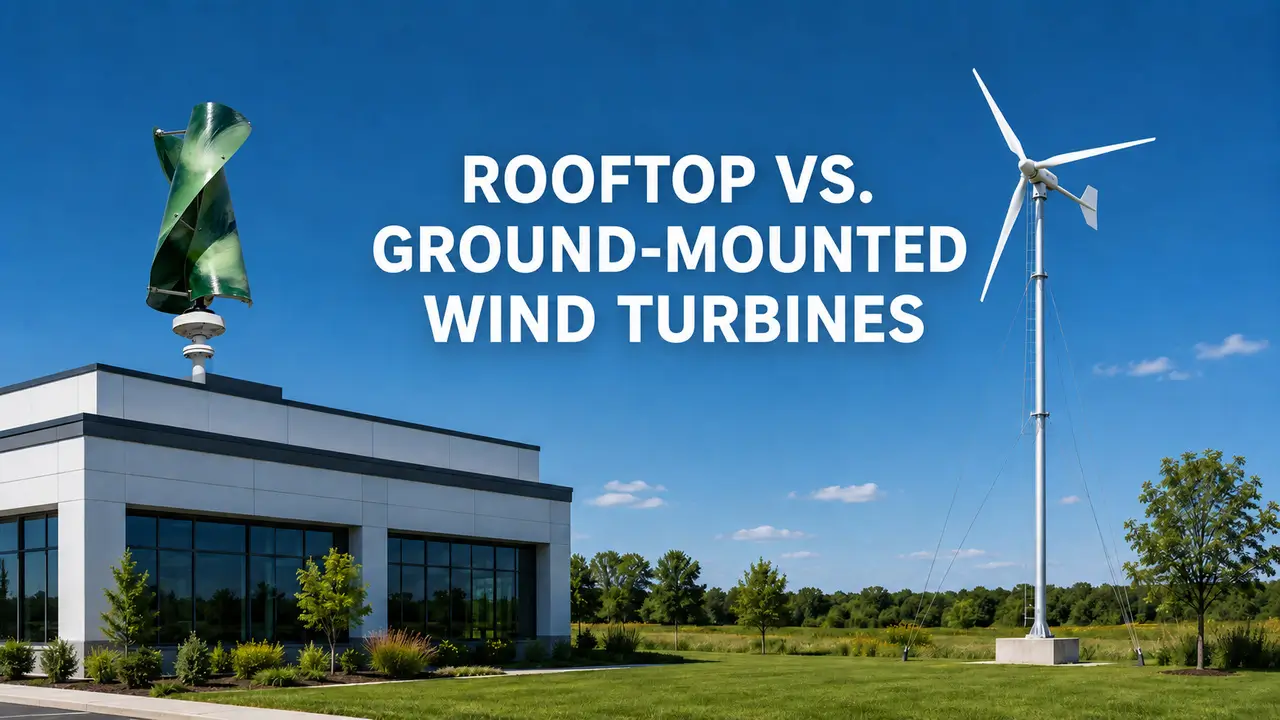
Choosing between a rooftop and a ground-mounted wind turbine affects energy output, installation cost, noise, maintenance, and long-term reliability.
A rooftop turbine saves ground space and uses the existing height of a building. A ground-mounted turbine gives you more freedom to select the tower position and height. It is also easier to place the rotor away from trees and buildings that disturb the wind.
Neither method suits every property. Your wind conditions, available space, roof design, required power, and budget should guide the decision.
Quick answer: Consider rooftop installation if you have limited land and a large, open roof with suitable mounting conditions. Ground-mounted installation is usually more practical when you have enough space and need greater flexibility in turbine position, tower height, and maintenance. Always assess the wind at the proposed location before choosing either option.
Two Common Ways to Install a Small Wind Turbine
Rooftop and ground-mounted systems are two installation methods. They are not separate types of wind turbines. You can install either a vertical-axis or horizontal-axis wind turbine, depending on the site.
Rooftop Installation
A rooftop wind turbine is mounted on a house, warehouse, factory, commercial building, or another suitable structure.
This installation method uses the height of the building and does not require a separate tower foundation on the ground. It can be useful in urban or industrial locations where land is limited.
Rooftop installation does not always mean using a very small turbine. A large, flat roof with enough space and suitable mounting conditions may accommodate a larger model. A small or sloped roof will usually suit a lighter, more compact wind turbine.
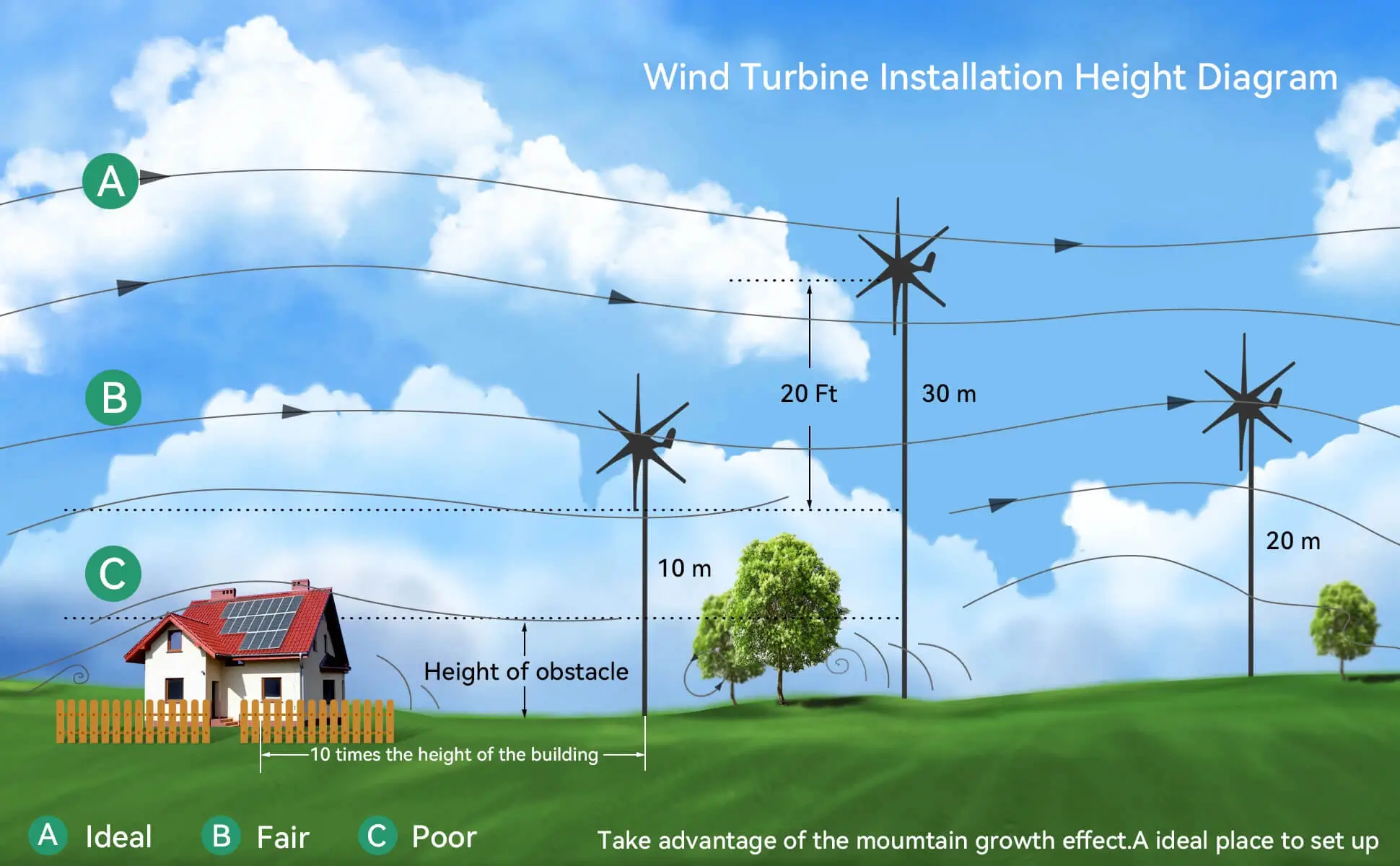
The height of a roof does not guarantee good wind. Parapet walls, air-conditioning equipment, nearby buildings, and trees can all disturb the airflow around the rotor.
Ground-Mounted Installation
A ground-mounted wind turbine uses an independent tower secured to a foundation. It can be installed near a house, on a farm, beside a factory, or on other open land.
This method gives you more freedom to choose the turbine position and tower height. It is often easier to move the rotor away from obstacles and reach steadier airflow.
ELEGE can supply freestanding towers in different heights. Taller towers may improve wind exposure, but they also increase manufacturing, freight, foundation, lifting, and installation costs.
Rooftop vs. Ground-Mounted Wind Turbines: Quick Comparison
| Factor | Rooftop Installation | Ground-Mounted Installation |
|---|---|---|
| Land requirement | Uses existing roof space | Requires space for a tower and foundation |
| Turbine size | Depends on roof area and mounting conditions | Usually offers more freedom for larger turbines |
| Wind quality | More likely to be affected by roof edges and nearby buildings | Easier to position in open airflow |
| Installation height | Uses the building height but has limited adjustment | Can use different tower heights |
| Main structure | Requires a suitable rooftop mounting frame | Requires a tower and ground foundation |
| Noise and vibration | Vibration may enter the building structure | Turbine remains separate from the building |
| Maintenance | Requires safe rooftop access | Usually provides easier access around the tower |
| Main cost factors | Mounting, lifting, sealing, access, and possible structural work | Tower, foundation, freight, lifting, and construction |
| Typical sites | Houses, factories, warehouses, and properties with limited land | Homes, farms, factories, and open sites |
Wind Quality, Obstacles, and Installation Height
Wind quality often matters more than whether the turbine is installed on a roof or on the ground.
Buildings, trees, walls, and terrain can change wind speed and direction. When wind passes over a roof or around the edge of a building, it may become turbulent. The rotor then receives rapidly changing wind loads instead of clean, steady airflow.
Excessive turbulence can cause:
- Unstable power output
- Additional vibration
- Higher mechanical stress
- More noticeable noise
- Faster wear on some components
Rooftop turbines are more likely to operate close to objects that disturb the wind. A turbine mounted behind a parapet wall or near a rooftop equipment room may turn, but its actual output can still be poor.
Ground-mounted installation makes it easier to adjust the turbine position and tower height. This can help move the rotor away from nearby obstacles. Trees, surrounding buildings, and terrain may still affect a ground-mounted turbine, so site assessment remains necessary.
Do Not Select a Site by Start-Up Wind Speed
A low start-up wind speed does not mean a turbine will generate useful electricity in every location.
Start-up wind speed only indicates when the rotor begins to move under specified conditions. It does not show how much electricity the turbine will produce over a day, month, or year.
Site selection tip: Assess or measure the wind at the proposed rotor position. Long-term wind speed, wind direction, turbulence, seasonal changes, and the turbine power curve provide more useful information than start-up speed alone.
Is a Taller Tower Always Better?
A taller tower can help the rotor reach faster and steadier wind in some locations. However, increasing tower height also increases project costs.
A taller freestanding tower may require:
- More tower material
- Larger export packaging and more container space
- Higher freight costs
- A larger foundation and more lifting equipment
- Longer electrical cables
- More complex maintenance access
Tower freight can represent a significant part of an international project. Choose the tower height after reviewing the surrounding obstacles, expected wind improvement, freight limitations, and installation budget.
How Roof Conditions Affect Turbine Selection
Roof area and roof shape influence the size of the turbine, the mounting arrangement, and the space available for maintenance.
Large Flat Roofs
A large, flat roof normally provides more installation options. It may offer enough room for a larger supporting frame, suitable rotor clearance, and a safe maintenance area.
If the installation conditions and wind resource are suitable, a large flat roof may accommodate a higher-power turbine. Review:
- Available installation area
- Roof height and layout
- Parapet walls and rooftop equipment
- Possible mounting locations
- Access for lifting and maintenance
- Rotor clearance
- Vibration transfer into the building
Small or Sloped Roofs
A sloped roof usually places more limits on the mounting frame and available working area. The installer must match the support to the roof angle and material while protecting the roof covering.
A compact and lightweight turbine is generally more practical for a small or sloped roof. The final model should still match the mounting points, available clearance, wind conditions, and required output.
Vertical-Axis or Horizontal-Axis Wind Turbine?
You can use vertical-axis and horizontal-axis turbines for rooftop or ground installation, but the two designs have different site requirements.
Vertical-Axis Wind Turbines for Rooftops
A vertical-axis wind turbine can accept wind from different directions without using a tail vane to turn the rotor into the wind. Its rotational area may also be easier to accommodate within a defined rooftop space.
For these reasons, ELEGE often recommends evaluating a vertical-axis model first for rooftop projects.
However, the vertical-axis design does not remove turbulence created by the building. If the turbine is hidden behind a parapet or surrounded by rooftop equipment, changing wind direction may still reduce performance.
Horizontal-Axis Wind Turbines
Horizontal-axis turbines need adequate blade clearance and enough space to align with the incoming wind. They can work well on open ground where the prevailing wind is relatively clear.
Some rooftops can also accommodate a horizontal-axis turbine, but the site needs sufficient clearance and good wind exposure. Compare the rotor swept area, power curve, rated wind speed, turbine dimensions, tower height, and actual site conditions before choosing a design.
Cost, Noise, and Maintenance
The least expensive-looking installation is not always the least expensive completed project. Compare the full cost of each option.
Rooftop Installation Costs
A rooftop project may require a custom mounting frame, lifting equipment, roof access, sealing work, vibration control, and high-level safety equipment. A large turbine may need a crane to move it onto the building.
A rooftop installation avoids a separate freestanding tower, but complex access or mounting work can offset part of that saving.
Ground-Mounted Installation Costs
A ground-mounted project usually includes a tower, concrete foundation, freight, lifting, assembly, electrical cabling, grounding, and site construction.
Tower height has a direct effect on manufacturing and transport costs. The expected improvement in wind exposure should justify the extra tower and installation expense.
Noise and Vibration
Wind turbines produce aerodynamic noise as the blades move through the air. The rotor, generator, bearings, frame, or loose fasteners may also create mechanical vibration.
A rooftop mounting frame connects the turbine to the building. Vibration can travel through the roof, beams, floors, or walls if the mounting arrangement does not control it effectively.
A ground-mounted turbine operates on a separate tower and foundation. This separation generally makes it easier to limit vibration inside a house, office, or factory.
Maintenance
Ground-mounted turbines usually offer easier access around the tower and foundation. Rooftop systems require a safe route to the equipment and may need additional fall-protection measures.
ELEGE recommends a basic inspection every six months. Check:
- Blades for damage or deformation
- Bolts and mounting parts for looseness
- Metal parts for corrosion
- Cables for wear or damaged insulation
- Electrical connections
- The turbine for unusual noise or vibration
Inspect the turbine again after severe storms, heavy snow, or other extreme weather.
Under suitable installation and normal maintenance conditions, the expected service life can reach approximately 20 years. ELEGE provides a one-year product warranty. The exact warranty scope depends on the product and contract terms.
Portugal EV 5kW Rooftop Installation
An ELEGE EV 5kW vertical-axis wind turbine has been installed on a rooftop in Portugal and received positive feedback.
The project shows that rooftop wind turbines are not limited to small models of only a few hundred watts. A roof with sufficient space and suitable installation conditions may accommodate a 5kW-class vertical-axis wind turbine.
However, one successful installation should not be copied directly to another building. Roof design, mounting conditions, surrounding obstacles, and wind resources vary between projects. ELEGE reviews each site before recommending a turbine size and installation method.
Which Installation Should You Choose?
Use the following table as a starting point:
| Your Site Conditions | Option to Consider |
|---|---|
| Large, open, flat roof with limited ground space | Rooftop installation |
| Small or sloped roof | Compact rooftop turbine or ground mounting |
| Open land with sufficient space | Ground-mounted installation |
| Buildings or trees disturb the wind near the property | Ground mounting with a suitable tower height |
| You want to reduce vibration inside the building | Ground-mounted installation |
| You need a larger turbine | Ground mounting is usually more practical |
| The tower would be expensive to transport | Compare a suitable rooftop option with a shorter tower |
| Rooftop maintenance access is difficult | Ground-mounted installation |
This table provides initial guidance rather than a final project decision. The wind resource and site layout can change the recommendation.
Choose Rooftop Installation When
Rooftop installation may suit your project when ground space is limited, the roof provides enough clearance, and the proposed location receives suitable wind.
A large flat roof normally offers more flexibility than a small sloped roof. You should also consider mounting access, vibration, surrounding obstacles, and future maintenance.
Choose Ground-Mounted Installation When
Ground mounting is often more practical when you have enough land, want to adjust the turbine position or height, or plan to install a larger model.
It may also be a better choice when you want to separate turbine vibration from the building or make maintenance access easier.
Information Needed for Wind Turbine Selection
Before requesting a recommendation, prepare:
- Project location
- Photographs of the proposed installation area
- Nearby buildings, trees, and other obstacles
- Available roof or ground dimensions
- Desired turbine power
- Any available wind-speed data
For a rooftop project, also provide the building height, roof type, and proposed mounting area. For a ground-mounted project, include the available land area and any limits on tower transport or installation.
Get a Wind Turbine Recommendation from ELEGE
ELEGE supplies vertical-axis and horizontal-axis wind turbines for rooftop and ground-mounted projects.
We evaluate the actual site instead of recommending a product by rated power alone. For rooftop installations, we consider the roof area, slope, clearance, nearby obstacles, wind conditions, and mounting location. For ground-mounted installations, we also consider tower height, foundation space, freight, and maintenance access.
Send ELEGE your project location, site photographs, available space, wind information, and target power to receive a customized turbine selection proposal.
Frequently Asked Questions
Can a rooftop wind turbine power an entire house?
It depends on your electricity use, wind resource, turbine size, and installation position. Rated power is not continuous output. Actual production changes with wind speed and seasonal conditions. Compare the expected energy production with your daily and annual electricity consumption before deciding whether one turbine can cover the full load.
Is a flat roof always better for a wind turbine?
A flat roof usually provides more mounting and maintenance space. However, parapet walls, rooftop equipment, or taller neighboring buildings can still create turbulent airflow. A suitable sloped roof may accommodate a compact turbine when the mounting and wind conditions allow it.
Does a low start-up wind speed mean the turbine will work at my property?
No. Start-up wind speed only indicates when the rotor begins moving under specified conditions. It does not represent useful or continuous electricity production. Assess the long-term wind conditions and review the turbine power curve before choosing a model.
How tall should a ground-mounted wind turbine tower be?
Tower height depends on nearby obstacles, terrain, turbine dimensions, wind conditions, freight restrictions, and the installation budget. A taller tower may provide better wind exposure, but it also increases the cost of the tower, foundation, transport, lifting, and maintenance.
What information should I provide before requesting a quotation?
Provide the project address, site photographs, nearby obstacles, available installation space, required power, and any measured wind data. For a rooftop project, also include the building height, roof shape, and proposed installation area.
Conclusion
Rooftop installation works best when land is limited and the roof offers suitable space, wind exposure, and mounting conditions. A large flat roof may accommodate a larger turbine, while a small or sloped roof will usually require a more compact model.
Ground-mounted installation requires a tower and foundation, but it gives you more freedom to choose the turbine position and height. It can also reduce vibration inside the building and make maintenance easier.
Assess the wind before deciding between rooftop and ground-mounted wind turbines. Then compare the available space, turbine dimensions, installation work, freight, and long-term maintenance. ELEGE can use your project information to recommend a suitable turbine and installation method.