When you choose a small wind turbine, you may see two common generator terms: Permanent Magnet Generator and Maglev Generator.
At first, they may sound like two completely different technologies. But for your wind power project, the real question is not simply “Which one is better?”
The better question is:
Which generator design is better for your wind condition, installation site, power system, and target market?
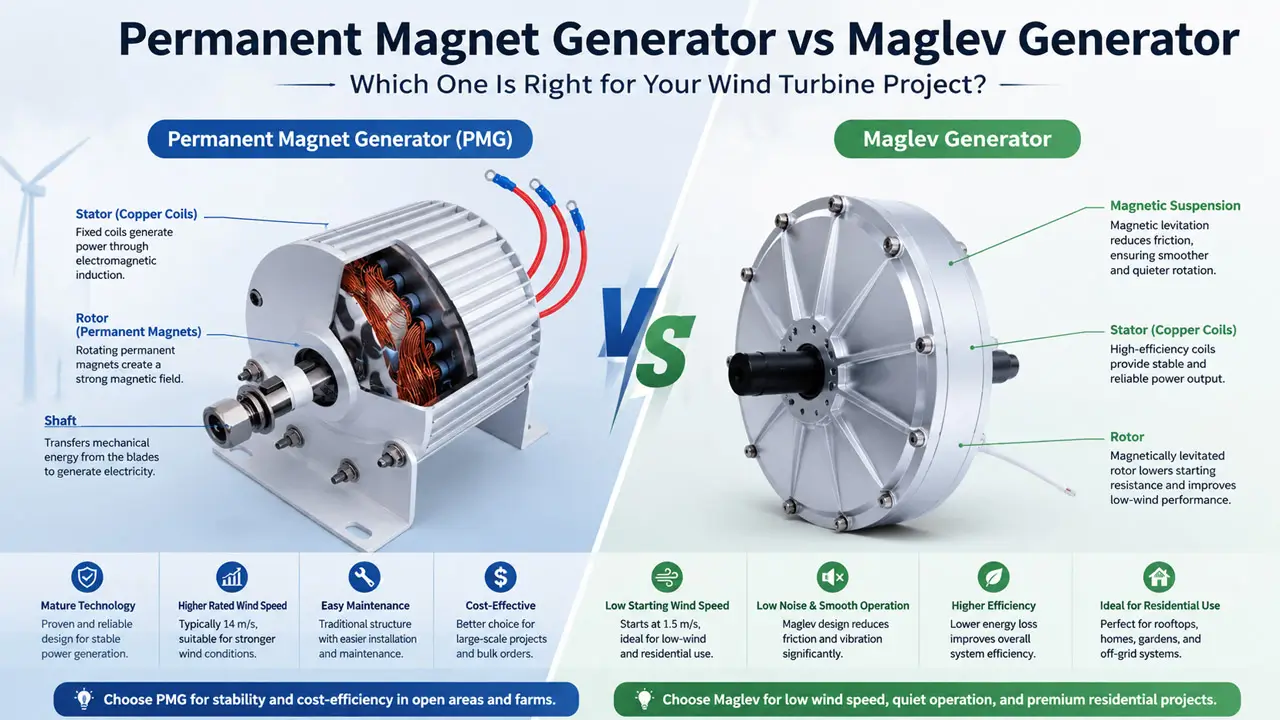
A Permanent Magnet Generator is usually a mature and stable choice for home, farm, off-grid, and commercial wind power projects. A Maglev Generator is more focused on low friction, low noise, and easier starting in lower wind conditions.
If you want a stable wind turbine for open areas, farms, or off-grid systems, a permanent magnet generator wind turbine is often a practical choice. If you want a quiet, modern, and low-wind wind turbine for rooftops, homes, gardens, or premium residential projects, a maglev generator wind turbine may be more suitable.
Quick Comparison: Permanent Magnet Generator vs Maglev Generator
| Comparison Point | Permanent Magnet Generator | Maglev Generator |
|---|---|---|
| Main meaning | A mature generator type | A low-friction generator design |
| Main benefit | Stable power generation | Lower friction and smoother rotation |
| Suitable product | Horizontal Axis Wind Turbine | Liam F1 Wind Turbine |
| Start-up wind speed | 3 m/s | 1.5 m/s |
| Rated wind speed | 14 m/s | 11 m/s |
| Best for | Farms, open areas, off-grid systems | Rooftops, homes, gardens, low-noise projects |
| Buyer value | Easy to configure and buy in bulk | Better for premium and low-wind markets |
| Custom options | Blades, voltage, power, color, package | Voltage, power, color, logo, package |
If your buyers care more about stable output, cost control, and bulk orders, you can focus on a Permanent Magnet Generator solution.
If your buyers care more about low noise, light-wind starting, modern design, and home installation, you can focus on a Maglev Generator solution.
What Is a Permanent Magnet Generator?
A Permanent Magnet Generator, also called a PMG, creates electricity by using rotating permanent magnets instead of powered electromagnets to create a magnetic field.
When the rotor spins, the permanent magnets move past the stationary copper coils, also called the stator. This changing magnetic field creates electrical current through electromagnetic induction.
In simple words, a Permanent Magnet Generator converts rotating energy into electrical energy by using permanent magnets and copper coils.
What Is a Maglev Generator?
A Maglev Generator uses magnetic levitation or magnetic support to reduce physical contact and friction during rotation.
Instead of only using traditional mechanical bearings to support the rotor, a maglev design uses magnetic force to help the rotor spin more smoothly with less resistance.
In simple words, a Maglev Generator is designed to reduce friction, lower starting resistance, and make rotation smoother. In wind turbines, this can help improve light-wind starting and quieter operation.
The Core Difference Is Not Just the Name
You should not compare these two terms only as technical labels.
A Permanent Magnet Generator mainly answers this question:
How does the wind turbine generate electricity?
A Maglev Generator mainly answers this question:
How does the wind turbine reduce friction and start more easily?
That means they are not always opposite technologies. In some wind turbine designs, a generator can use permanent magnets and also include a low-friction or maglev-style structure.
For your project, the real point is simple.
If you need a mature wind turbine for farms, open areas, off-grid power, and bulk orders, a Horizontal Axis Wind Turbine with a permanent magnet generator is usually easier to sell and configure.
If you need a quiet, stylish, and low-wind turbine for homes, rooftops, gardens, and premium buyers, the Liam F1 Wind Turbine with a maglev generator direction is a better product choice.
Start-up Wind Speed: Why It Matters for Your Project
Start-up wind speed is one of the first details your buyers will check.
The Liam F1 Wind Turbine starts at 1.5 m/s, with a rated wind speed of 11 m/s. This makes it more suitable for low-wind, residential, rooftop, and garden projects.
The Horizontal Axis Wind Turbine starts at 3 m/s, with a rated wind speed of 14 m/s. It is more suitable for open areas, farms, rural homes, and regular off-grid systems.
But you should not judge a wind turbine only by start-up wind speed.
You also need to look at your local average wind speed, installation height, nearby buildings or trees, blade design, controller matching, and battery system.
For example, if your customer only asks, “Is it maglev?” you can guide them to a better question: What is your average wind speed, where will you install the turbine, and what power system do you need?
Noise: Important for Homes, Rooftops, and Gardens
Noise matters a lot when your buyer wants to install a wind turbine near a house.
For rooftop, garden, villa, and urban projects, your customer may care more about comfort than maximum power. In this case, the Liam F1 Wind Turbine is easier to recommend.
Liam F1 is designed for residential, rooftop, garden, and urban use. Its spiral blade design helps reduce noise, vibration, and visual disturbance. Based on the noise testing data, the tested wind turbine sample recorded a Leq noise level of 30 dB(A) under the test conditions.
When you write this in English, it is better to be careful. Do not say it is always 30 dB(A) in every wind condition. A safer sentence is:
In third-party noise testing, the wind turbine sample recorded a Leq noise level of 30 dB(A) under the tested conditions.
If your buyer is sensitive to noise, Liam F1 is a strong product direction. If your buyer installs the turbine on a farm, in an open field, or in a remote off-grid site, the stable power and wider configuration range of the horizontal axis wind turbine may be more important.
Power Output Depends on the Whole System
Some buyers may think a Maglev Generator always produces more electricity than a Permanent Magnet Generator.
That is not always true.
A maglev design can help reduce friction, but power output also depends on wind speed, blade size, blade shape, generator matching, controller efficiency, battery capacity, inverter efficiency, and installation height.
So, when you explain this to your customer, you can keep it simple.
If your customer needs a mature and stable wind turbine for farms, off-grid systems, and bulk orders, choose a Horizontal Axis Wind Turbine.
If your customer cares more about low wind speed, quiet operation, and modern residential design, choose a Liam F1 Wind Turbine.
Product Selection Guide
| Your Project Need | Better Product Direction | Why It Fits |
|---|---|---|
| You need a stable standard wind turbine | Horizontal Axis Wind Turbine | Good for open areas, farms, off-grid systems, and commercial projects |
| You need low wind speed and low noise | Liam F1 Wind Turbine | Starts at 1.5 m/s and fits homes, rooftops, and gardens |
| You need bulk orders or distribution | Horizontal Axis Wind Turbine | Wide power range and flexible blade options |
| You need a premium product line | Liam F1 Wind Turbine | Modern appearance, quiet running, and better residential appeal |
| You need a low-wind vertical axis option | EV Vertical Axis Wind Turbine | Useful for changing wind directions and low-wind areas |
If you are an importer or distributor, you can use the Horizontal Axis Wind Turbine as your standard product line. It is practical, easy to explain, and suitable for many common projects.
You can use the Liam F1 Wind Turbine as your premium residential product line. It is easier to promote for rooftops, gardens, villas, and modern homes.
Buyer Checklist Before Choosing a Wind Turbine Generator
| What You Should Check | Why It Matters |
|---|---|
| Your average local wind speed | It decides whether the turbine can work well in real use |
| Your installation site | Buildings, trees, and walls can reduce wind speed |
| Your required power | It affects turbine size, controller, battery, and inverter selection |
| Your required voltage | Voltage must match the controller, battery, and inverter |
| Off-grid or grid-connected system | It decides whether you need batteries and what inverter type you need |
| Solar panel requirement | Wind and solar can be combined into a hybrid system |
| Complete system requirement | You may need a turbine, controller, inverter, battery, and solar panels together |
| Custom needs | Color, logo, package, voltage, power, and OEM/ODM can be customized |
| Certification need | CE certification is available for market entry and buyer confidence |
This table helps your customer move from “I want to know the difference” to “I am ready to ask for a quote.” That is important for SEO and sales conversion.
Common Misunderstanding: Is a Maglev Generator Always Better?
No, a Maglev Generator is not always better.
If your buyer wants a turbine for a rooftop, garden, villa, or quiet home project, a maglev generator wind turbine can be very attractive. It has strong selling points such as low start-up wind speed, low noise, and smooth rotation.
But if your buyer needs a wind turbine for a farm, rural home, open field, or commercial off-grid project, a Permanent Magnet Generator solution may be more practical.
It is mature, stable, easier to configure, and better for standard product sales. So you should not choose only by one technical word. You should choose by wind condition, budget, installation site, power demand, and customer expectations.
Final Verdict: Which One Should You Choose?
Choose a Permanent Magnet Generator wind turbine if you need a mature, stable, and easy-to-configure solution.
It is better for farms, rural homes, off-grid systems, commercial projects, open areas, and bulk orders.
Choose a Maglev Generator wind turbine if you need low wind speed, low noise, smooth running, and a modern look.
It is better for rooftops, homes, gardens, villas, urban projects, and premium residential markets.
For your regular product line, the Horizontal Axis Wind Turbine is a practical choice.
For your premium low-noise product line, the Liam F1 Wind Turbine is a stronger choice.
If you also want to cover low-wind and changing wind direction areas, the EV Vertical Axis Wind Turbine can be used as a supporting product.
Get a Custom Wind Turbine Solution
If you are not sure whether you should choose a Permanent Magnet Generator or a Maglev Generator, you can send us your project details.
You only need to share your required power, local average wind speed, installation site, system type, voltage requirement, and whether you need solar panels, batteries, a controller, or an inverter.
We can help you match the right wind turbine model and complete system configuration.
ELEGE can provide complete wind power and wind-solar hybrid solutions. We also support custom color, logo, package, voltage, power, and OEM/ODM service. CE certification is available for your market needs.
Send your project details and get a custom wind turbine solution with turbine, controller, inverter, battery, and wind-solar hybrid system options.
FAQ
Can the generator voltage be customized?
Yes. The generator voltage can be customized based on your wind turbine power, battery system, controller, and inverter. For different projects, the voltage should be matched with the full system, not selected alone.
Do you need a battery for a wind turbine system?
If you need an off-grid system, you usually need a battery to store the power. If you need a grid-connected system, the configuration is different and should follow local grid and inverter requirements.
Can the blade color and logo be customized?
Yes. For importers, distributors, and project buyers, blade color, logo, package, voltage, power, and OEM/ODM options can be customized based on your target market.
What information should you provide before asking for a quote?
You should provide your required power, average wind speed, installation site, system type, voltage requirement, and whether you need batteries, an inverter, a controller, or solar panels. This helps us give you a more accurate solution and price.
Is CE certification available?
Yes. CE certification is available. It can help importers, distributors, and project buyers prepare for market entry and reduce communication time during supplier selection.