What Is an Off-Grid Wind Power System?
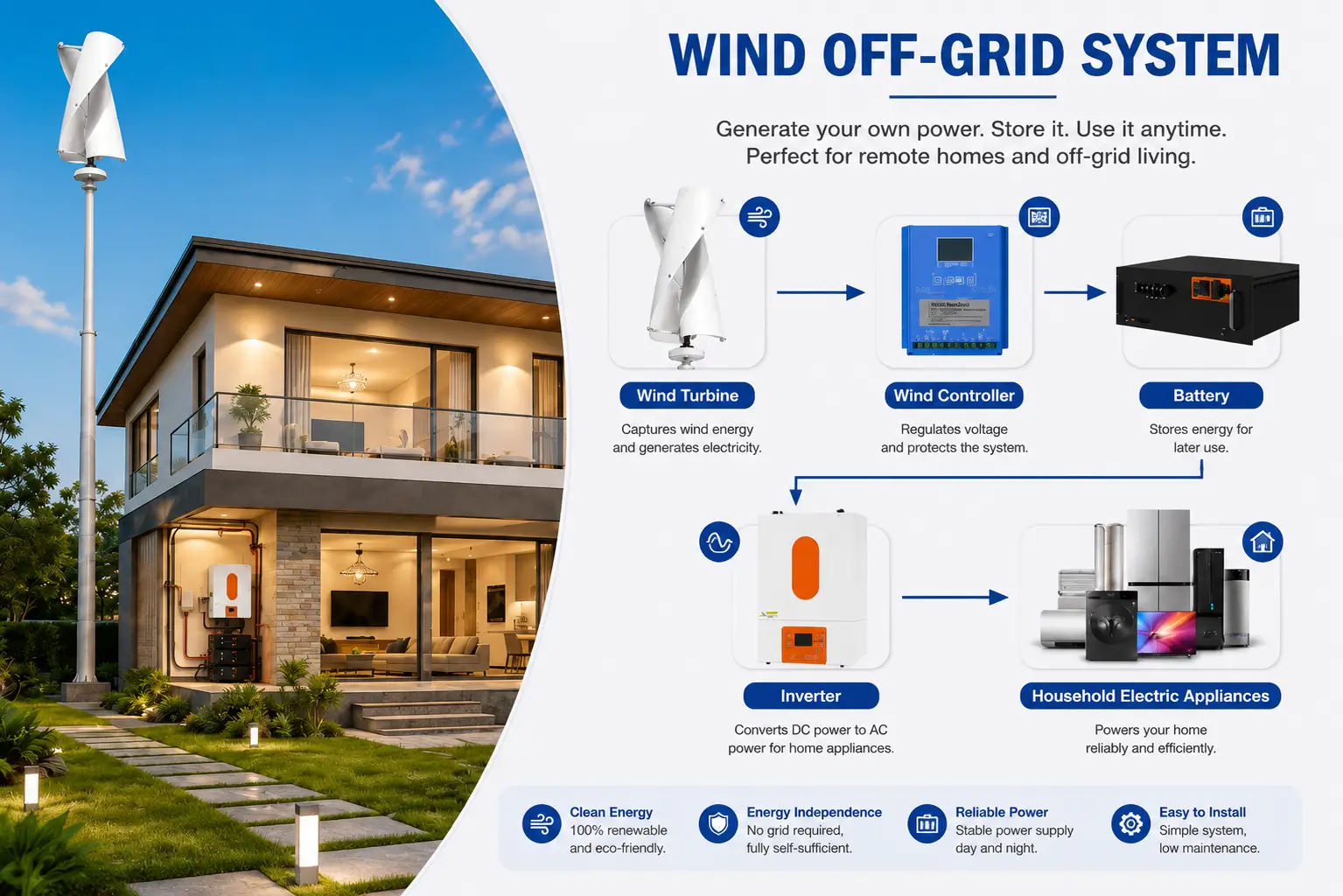
An off-grid wind power system operates without a connection to the public grid. It can independently supply electricity to remote homes, farms, islands, communication stations, and agricultural equipment.
Typical operating process:
The wind turbine generates electricity, and the controller regulates its variable output. The electricity is then stored in batteries. An off-grid inverter converts the stored DC electricity into AC power for appliances and other equipment.
Why Does an Off-Grid System Need Batteries?
Wind speed changes throughout the day, so turbine output is not constant.
Batteries store excess energy when wind conditions are good and supply electricity during periods of low wind or no wind. They help maintain a stable power supply and reduce interruptions.
Battery capacity should be calculated according to daily electricity consumption, required backup time, allowable depth of discharge, system losses, and local wind conditions.
What Is a Grid-Tied Wind Power System?
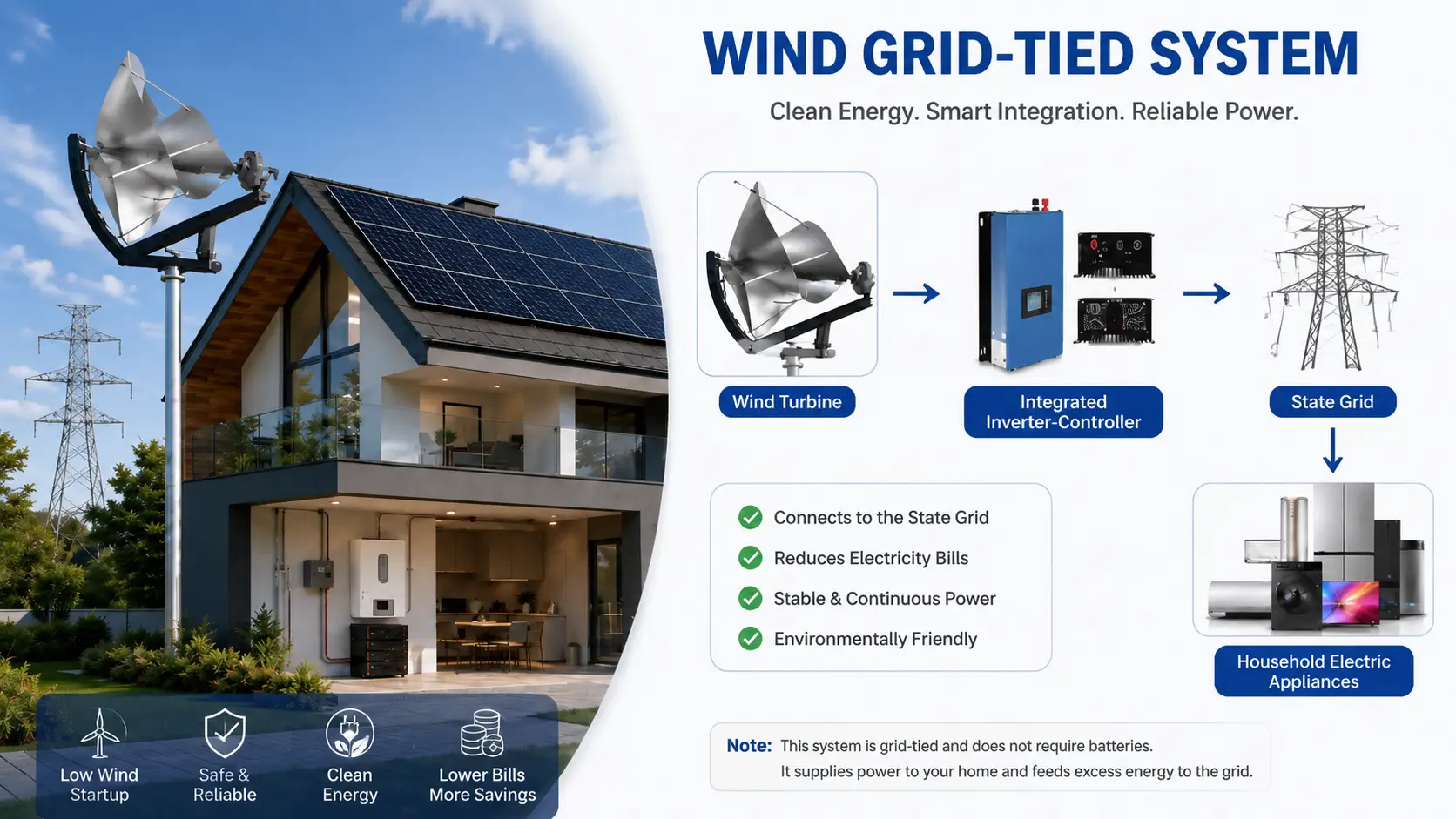
A grid-tied wind power system is connected to the public utility grid. It can supply electricity to a home, farm, factory, or commercial building.
Typical operating process:
The grid-tied inverter converts the turbine’s output into AC electricity that matches the grid voltage, frequency, and phase.
When wind generation is lower than the building’s electricity demand, the grid supplies the difference. When the turbine produces more electricity than the building uses, the excess power may be exported to the grid if local regulations allow it.
Does a Grid-Tied System Need Batteries?
A standard grid-tied wind power system normally does not require a large battery bank. The public grid balances the difference between electricity generation and consumption.
However, the inverter and other equipment must comply with local grid standards. Exporting electricity may also require utility approval, certified equipment, and a bidirectional meter.
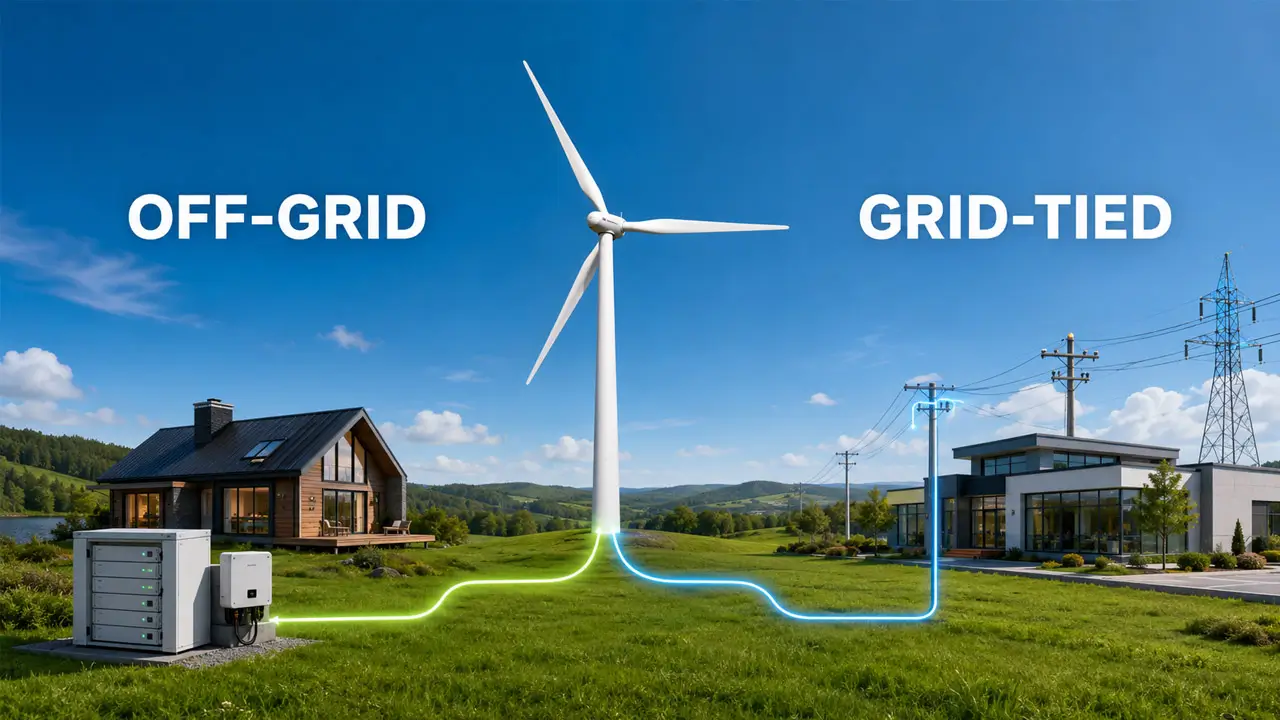
Off-Grid vs. Grid-Tied Wind Turbines: Key Differences
The main difference is not necessarily the wind turbine itself. It is how the electricity is stored, managed, and supplied to the loads.
| Comparison | Off-Grid Wind Power System | Grid-Tied Wind Power System |
|---|---|---|
| Public grid connection | No | Yes |
| Battery bank | Usually required | Usually not required |
| Operation during a grid outage | Continues if the batteries have sufficient energy | A standard system shuts down |
| Power supply during low wind | Batteries or a backup generator | Public utility grid |
| Excess electricity | Stored in batteries or sent to a dump load | Exported to the grid where permitted |
| Main purpose | Independent and reliable power | Reduce electricity purchased from the grid |
| Initial cost | Higher because of battery storage | Usually lower without batteries |
| Maintenance | Batteries require maintenance and replacement | Less storage-related maintenance |
| Approval requirements | Usually no grid approval | Utility approval may be required |
| Typical applications | Remote homes, farms, islands, and telecom sites | Homes, farms, factories, and commercial buildings |
Equipment Required for an Off-Grid Wind Power System
A complete off-grid system normally includes a wind turbine, wind charge controller, battery bank, off-grid inverter, dump load, tower, cables, and protection equipment.
Wind Turbine and Charge Controller
The wind turbine converts wind energy into electricity. Actual generation depends on local wind speed, tower height, nearby obstacles, turbulence, and the turbine’s power curve.
The wind charge controller regulates the turbine’s variable output and manages battery charging. Depending on the model, it may also include MPPT control, electromagnetic braking, monitoring, and overvoltage protection.
The controller’s voltage, input range, and maximum power must match the turbine and battery bank.
Battery Bank and Off-Grid Inverter
The battery bank stores electricity for use during low-wind periods.
The off-grid inverter converts the battery’s DC power into AC electricity. It must support both the normal operating load and the starting surge of equipment such as water pumps, refrigerators, compressors, and motors.
Dump Load and Electrical Protection
When the batteries are full, the dump load safely consumes excess energy and helps prevent the wind turbine from operating without a controlled electrical load.
The system should also include grounding, lightning protection, surge protection, circuit breakers, disconnect switches, and correctly sized cables.
Equipment Required for a Grid-Tied Wind Power System
A grid-tied system usually includes a wind turbine, grid-tied controller, wind inverter, tower, bidirectional meter, and electrical protection equipment.
The controller manages the turbine output and may provide braking, overspeed protection, and dump-load control. The grid-tied inverter converts the electricity into AC power that meets local utility requirements.
If electricity export is permitted, a bidirectional meter may be required. Circuit breakers, isolation switches, grounding, lightning protection, surge protection, and anti-islanding protection are also essential.
Advantages and Limitations of Off-Grid Wind Power
The main advantage of an off-grid wind turbine is energy independence. It is suitable for locations without a reliable grid connection and can reduce dependence on diesel generators.
Off-grid wind power can also be combined with solar panels and backup generators. This creates a more balanced energy supply when wind conditions change.
The main limitation is the battery bank. Batteries increase the initial investment and require proper charging, monitoring, and eventual replacement. The system must therefore be sized carefully to avoid insufficient power or unnecessary cost.
Advantages and Limitations of Grid-Tied Wind Power
A grid-tied wind turbine usually does not need a large battery bank. This can reduce the initial investment and simplify long-term maintenance.
The turbine’s electricity can be used directly by the building, while the public grid supplies additional power when wind generation is low. Excess electricity may also be exported where local policies allow it.
However, a grid-tied system does not provide full energy independence. It must comply with local grid standards, equipment certification, and connection procedures. Financial returns may also be affected by export limits, feed-in tariffs, and local electricity prices.
Can a Grid-Tied Wind Turbine Work During a Power Outage?
A standard grid-tied wind turbine normally stops operating when the public grid goes down.
This happens because of anti-islanding protection. When the inverter detects a grid outage, it stops sending electricity into the power lines to protect utility workers and electrical equipment.
If backup power is required, the system needs batteries, automatic grid isolation, and a compatible hybrid inverter with a backup output. This is known as a battery-backed or hybrid wind power system.
Which Wind Power System Costs More?
An off-grid system usually costs more at the beginning because it requires batteries and an off-grid inverter. Larger batteries provide longer backup time but also increase the project price.
A grid-tied system may cost less without batteries, but grid applications, certified inverters, electrical inspections, and connection work can add expenses.
| Cost Item | Off-Grid System | Grid-Tied System |
|---|---|---|
| Wind turbine | Required | Required |
| Wind controller | Required | Required |
| Dump load | Usually required | Usually required |
| Battery bank | Usually required | Not required in a standard system |
| Inverter | Off-grid inverter | Certified grid-tied inverter |
| Grid application | Not required | May be required |
| Battery replacement | Must be considered | Not applicable without batteries |
| Backup power | Batteries or generator | Normally supplied by the grid |
The lowest equipment price does not always produce the lowest total project cost.
For example, extending utility lines to a remote property may require new poles, transformers, cables, and construction work. In this situation, an off-grid wind-solar system may be more economical.
If a property already has a reliable grid connection, a grid-tied system without batteries may be the more practical option.
Should You Choose a Hybrid Wind Power System?
Some projects need more flexibility than a standard off-grid or grid-tied system can provide. A hybrid system can combine wind power with solar panels, batteries, the public grid, or a backup generator.
Off-Grid Wind-Solar Hybrid System
Solar panels mainly generate electricity during daylight hours. Wind turbines may continue producing energy at night, on cloudy days, or during seasons with limited sunlight.
Combining both sources can improve energy availability and reduce dependence on one type of weather.
This configuration is suitable for remote homes, farms, islands, telecom stations, agricultural facilities, and monitoring equipment.
The wind turbine and solar array should be sized according to local wind and solar data. Two systems with the same rated power may still produce very different amounts of electricity.
Grid-Tied System with Battery Backup
A battery-backed grid-tied system combines renewable energy, battery storage, and the public grid.
During normal operation, the building uses wind power and draws additional electricity from the grid when necessary. During an outage, the system disconnects from the public lines and uses the batteries to supply selected essential loads.
This solution offers greater flexibility, but it requires a compatible hybrid inverter and more advanced control and protection equipment.
How to Choose the Right Wind Power System
Start by checking whether the installation site has a stable public grid.
| Project Condition | Recommended System |
|---|---|
| No public grid is available | Off-grid wind power system |
| The grid is unstable or outages are frequent | Off-grid or battery-backed hybrid system |
| The grid is stable and the goal is to reduce electricity bills | Grid-tied wind power system |
| Essential equipment must operate during outages | Hybrid system with battery backup |
| The site has good wind and solar resources | Wind-solar hybrid system |
| Excess electricity will be exported | Grid-tied system, subject to local regulations |
| Large loads cannot be interrupted | Wind-solar-storage system with a backup generator |
1. What Are the Local Wind Conditions?
Average wind speed, seasonal changes, turbulence, terrain, trees, and nearby buildings all affect turbine output.
Ideally, wind speed should be measured near the planned turbine hub height. Data from a nearby weather station can provide an initial reference, but it may not represent the exact conditions at your site.
2. Is the Public Grid Stable?
If the grid is reliable and reasonably priced, a grid-tied system may be more practical. If connecting to the grid requires long cables, new utility poles, transformers, or major construction, an off-grid system may provide better value.
3. How Much Electricity Do You Use?
Calculate the power and daily operating time of each appliance to estimate daily energy consumption in kilowatt-hours.
You should also calculate the maximum simultaneous load and the starting surge of motors, pumps, refrigerators, and compressors. These values determine the required inverter capacity.
4. Do You Need Backup Power?
If your only goal is to reduce electricity bills, a standard grid-tied system may be sufficient.
If water pumps, refrigerators, medical devices, or communication equipment must continue operating during outages, you will need batteries and a system with backup output.
5. What Are the Local Grid Requirements?
Before purchasing a grid-tied wind turbine, confirm the required voltage, frequency, inverter certification, export limit, metering method, and application process.
Equipment approved in one country may not meet the connection standards of another country.
Common Wind Turbine Selection Mistakes
Choosing a Turbine Based Only on Rated Power
A wind turbine reaches its rated output only at a specified wind speed. If the actual wind speed remains below this level, average electricity production will be much lower than the rated power suggests.
Check the turbine’s power curve and compare it with the site’s wind data before purchasing.
Confusing Start-Up Wind Speed with Power Generation
Start-up wind speed is the point at which the blades begin to rotate. Cut-in wind speed is the point at which the turbine starts producing usable electricity.
A turbine turning in a light breeze does not necessarily generate a meaningful amount of power.
Assuming a Grid-Tied System Provides Backup Power
A standard grid-tied inverter stops working when the public grid fails. Backup power requires batteries, safe grid isolation, and a hybrid inverter with a dedicated backup output.
Selecting a Battery Bank That Is Too Small
An undersized battery bank provides limited backup time and may experience frequent deep discharging, which can shorten battery life.
Battery capacity should be based on energy consumption, backup time, battery type, depth of discharge, and expected system losses.
Ignoring Equipment Compatibility
Matching power ratings alone is not enough. The wind turbine, controller, battery bank, and inverter must have compatible voltages, input ranges, charging parameters, power limits, and protection functions.
Conclusion: Choose According to Your Power Needs
Choose an off-grid wind turbine if you need independent electricity or do not have access to a reliable utility grid.
Choose a grid-tied wind turbine if your property already has a stable grid connection and your main goal is to reduce electricity costs. If you also need power during outages, consider a hybrid system with battery backup.
The final decision should be based on local wind conditions, daily energy consumption, peak load, grid reliability, backup requirements, and total project budget.
Find the Right Wind Power System for Your Project
ELEGE supplies wind turbines from 100W to 500kW, together with controllers, inverters, batteries, towers, and complete wind-solar system solutions.
Send us your average wind speed, daily electricity consumption, maximum load, grid voltage, and required backup time. Our team can help match the wind turbine, controller, battery, and inverter for your project.
Frequently Asked Questions
1. Can an off-grid wind turbine power an entire house?
Yes. However, the turbine, battery bank, and inverter must be sized according to the home’s daily electricity consumption, peak load, local wind conditions, and required backup time.
2. Can a grid-tied wind turbine operate during a power outage?
A standard grid-tied system normally shuts down during an outage. Continued operation requires batteries and a compatible hybrid inverter with backup output.
3. Does an off-grid wind power system always need batteries?
Most off-grid systems need batteries to store excess electricity and supply power during low-wind periods. A backup generator or another energy source may also be added.
4. Can excess wind-generated electricity be sold to the grid?
This depends on local regulations and utility policies. Confirm the grid approval process, equipment certification, export limits, and electricity settlement method before installation.
5. Can wind turbines and solar panels work in the same system?
Yes. A properly matched controller, battery bank, inverter, and protection system can combine wind and solar energy into a reliable hybrid power solution.