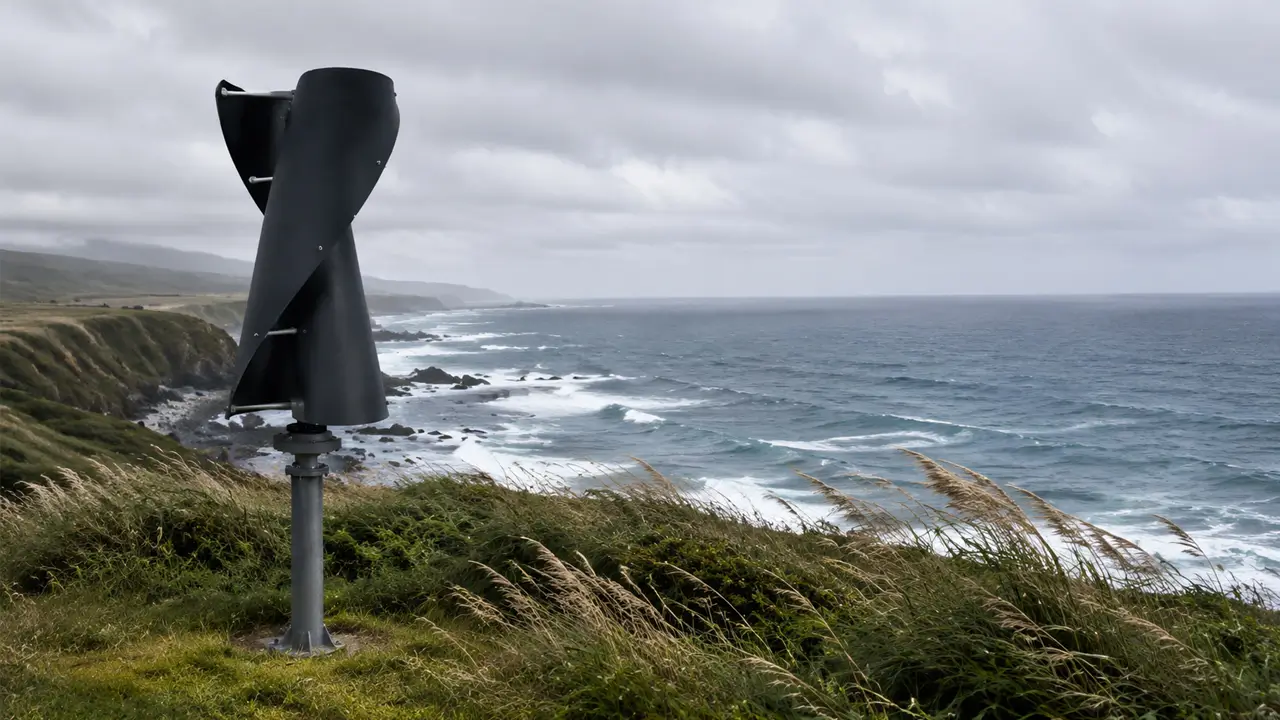
Coastal locations often have strong wind resources. However, choosing the right wind turbine for coastal areas requires more than comparing rated power. Salt air, humidity, changing wind directions, and extreme gusts can all affect turbine performance and service life.
Are Coastal Areas Suitable for Wind Turbines?
Open coastlines often have fewer trees and buildings blocking the wind. Temperature differences between land and sea can also create regular sea breezes. These conditions make many coastal homes, farms, resorts, and remote sites worth evaluating for small wind power.
However, living near the coast does not guarantee high energy output.
A turbine needs usable wind at its actual installation height. Weather apps, airport data, and short-term observations cannot show exactly how much energy a turbine will generate throughout the year. Buildings, cliffs, roof edges, and trees may also create turbulence even when the surrounding area is windy.
For a reliable assessment, consider the annual average wind speed, seasonal changes, prevailing direction, maximum gust, installation height, and nearby obstacles. Measuring wind near the proposed turbine height provides a clearer picture than relying only on regional weather data.
The U.S. Department of Energy Small Wind Guidebook also recommends evaluating the available wind resource and your electricity demand before choosing a small wind turbine.
Start-Up Wind Speed Is Not Rated Output
A low start-up wind speed means the rotor can begin turning in a light breeze. It does not mean the turbine reaches its rated power at that speed.
For example, the ELEGE EV vertical axis wind turbine starts at 1.3 m/s. Depending on the model, it reaches rated power at 10 or 11 m/s. Between these speeds, output changes according to the turbine’s power curve and the connected electrical load.
Simplified electrical power equation
Pelectric = ½ × ρ × A × v³ × Cp × η
- Pelectric is the electrical power delivered by the system
- ρ is air density
- A is the turbine’s swept area
- v is wind speed
- Cp is the turbine’s power coefficient
- η is the combined efficiency of the generator, controller, cables, and other electrical components
Because wind speed is cubed in this equation, a small change in wind speed can produce a much larger change in available energy.
This is a simplified calculation. Actual output is lower than the total energy available in the wind because aerodynamic, generator, controller, cable, battery, and inverter losses must also be considered.
This also explains why installing a larger turbine in a poor location may not solve a weak-wind problem. When comparing turbines, request a power curve and an annual energy estimate based on the wind-speed distribution at your site. Do not choose a model only because it has a low start-up speed or a high rated wattage.
What Makes a Wind Turbine Suitable for Coastal Areas?
A suitable coastal turbine should combine changing-wind performance, corrosion protection, high-wind safety, structural stability, and maintainable components.
Coastal wind may shift during the day because of sea breezes, changing weather, buildings, or terrain. A turbine that accepts wind from different directions can respond without repeatedly turning the rotor toward the wind.
Salt and moisture create a different challenge. They can affect coatings, fasteners, support structures, cable entries, electrical terminals, bearings, and generator enclosures. Protective materials reduce the risk, but they do not remove the need for maintenance.
The turbine should also have a defined survival wind speed and a suitable overspeed-control method. Its tower, mounting hardware, and foundation must be designed for the same site conditions.
Finally, consider the support available after installation. A long warranty has limited value if spare parts, technical guidance, and replacement procedures are unavailable.
Vertical or Horizontal Axis: Which Is Better Near the Coast?
Both vertical and horizontal axis wind turbines can work near the coast. The right choice depends on the wind direction, available space, installation height, and surrounding obstacles.
| Factor | Vertical Axis Wind Turbine | Horizontal Axis Wind Turbine |
|---|---|---|
| Wind direction | Accepts wind from different directions | Must face the incoming wind |
| Changing winds | Adapts without conventional yaw movement | Uses a tail vane or yaw system |
| Installation space | Usually more compact | Requires more open rotor space |
| Tower requirements | Flexible according to the project | Often benefits from a higher tower |
| Open coastal wind | Suitable | Often performs well |
| Turbulence | Handles directional changes but still loses output in disturbed airflow | More sensitive to disturbed airflow |
| Residential projects | Compact and generally lower-speed | Depends heavily on the model and tower position |
A vertical axis wind turbine is often easier to evaluate where the wind direction changes frequently or installation space is limited. Its rotor can accept wind from different directions without continuously turning toward the wind.
A horizontal axis wind turbine may be more suitable for an open shoreline, farm, or elevated tower with a stable prevailing wind direction.
Neither design can compensate for a poor installation position. Severe turbulence lowers output and increases mechanical fatigue, even when the rotor accepts wind from every direction.
How Does Salt Air Affect a Wind Turbine?
Salt air causes more than visible surface rust. Moisture and salt deposits can affect several parts of a wind turbine in different ways.
Surface Corrosion
Surface corrosion can start when paint or another protective coating is scratched during transport, installation, or maintenance. Once the underlying metal is exposed, salt and moisture accelerate deterioration.
Galvanic Corrosion
Galvanic corrosion may occur when dissimilar metals remain in electrical contact in the presence of salty moisture. Fasteners, brackets, washers, and support structures should therefore be evaluated as one material system.
Crevice Corrosion
Moisture and salt can remain trapped around bolts, flanges, seams, and overlapping components. Corrosion may develop inside these gaps while the surrounding surface still looks normal.
Electrical and Moisture Damage
Salt deposits can also affect terminals, cable entries, connectors, and electrical enclosures. Poor sealing or condensation may lead to oxidation, insulation problems, and electrical faults.
ISO 12944-2 classifies the corrosivity of environments to help guide the selection of protective paint systems. It does not mean that every product with protective paint automatically meets a specific ISO corrosion category. The appropriate protection still depends on the actual exposure conditions. See the official ISO 12944-2 overview.
Protective Coating Is Not the Same as Marine Grade
The ELEGE EV uses a protective coating to improve resistance to moisture and salt-laden air. It may be suitable for selected onshore coastal projects where direct seawater exposure is limited.
Important distinction
A protective coating does not automatically make a turbine corrosion-proof, marine-grade, offshore-rated, suitable for continuous saltwater exposure, or certified under a salt-spray testing standard.
A marine or offshore configuration may require a specified multilayer coating system, marine-grade fasteners, reinforced sealing, protected electrical connectors, drainage, condensation control, and documented corrosion testing.
An onshore turbine installed near the coast faces different conditions from a turbine installed on a boat, pier, floating platform, or offshore structure. Equipment exposed to direct spray and waves requires more extensive protection.
Before ordering, provide the approximate distance from the sea, whether the turbine will receive direct sea spray, local humidity, the installation structure, and expected maintenance access. This information helps determine whether the standard configuration is appropriate or requires changes.
What Does a 35 m/s Survival Wind Speed Mean?
ELEGE EV survival wind speed
35 m/s ≈ 78 mph ≈ 126 km/h
Survival wind speed does not mean the turbine can continuously generate rated power at 35 m/s. It describes the extreme wind condition the turbine is designed to withstand under its specified protection and installation conditions.
The EV limits rotor speed to below 300 RPM and uses electromagnetic control to reduce overspeed and controller-overload risk.
However, the turbine rating does not automatically apply to the complete installation. The tower, mounting bracket, anchor bolts, foundation, guy wires, and roof structure must also meet local wind-load requirements.
If storms, hurricanes, or typhoons at the project location may produce gusts above 35 m/s, do not select the standard configuration without additional engineering assessment.
When Is the ELEGE EV Suitable for a Coastal Project?
The ELEGE EV vertical axis wind turbine can be considered for selected onshore coastal projects with changing wind directions and limited direct seawater exposure.
Its compact vertical structure suits homes, farms, resorts, islands, remote sites, and small distributed energy systems. Final suitability should be confirmed according to salt exposure, maximum wind speed, tower design, maintenance conditions, and local electricity demand.
EV Model Comparison
| Model | Rated Power | Maximum Power | Rated Voltage | Rated Wind Speed |
|---|---|---|---|---|
| EL-EV-500W | 500W | 550W | 12V/24V | 10 m/s |
| EL-EV-1000W | 1000W | 1100W | 12V/24V | 10 m/s |
| EL-EV-1500W | 1500W | 1650W | 12V/24V/48V | 11 m/s |
| EL-EV-2000W | 2000W | 2200W | 24V–220V | 11 m/s |
All four EV models have a start-up wind speed of 1.3 m/s and a cut-in wind speed of 3.5 m/s.
The series uses a two-blade vertical axis design, glass/basalt composite construction, self-lubrication, electromagnetic control, and guyed- or independent-tower options.
The specified operating temperature range of the EV turbine body is −40°C to +80°C. Controllers, batteries, and inverters may have different operating-temperature limits and must be checked separately when designing the complete system.
Generator Design
The EV series uses a three-phase coreless permanent magnet maglev generator, designed to reduce starting resistance and support smooth, stable rotation at low speeds.
The disc-type construction provides space for additional copper windings and permanent magnets. Together with the winding design, magnetic field, air gap, and rotational speed, this helps the generator achieve the required power and voltage output.
Pure copper windings provide good electrical conductivity. The magnetic suspension structure, double-bearing support, and low-resistance rotation help the rotor respond in lighter winds.
These features do not remove the need for an adequate wind resource. They help the turbine use the available wind more effectively once it is installed at a suitable site.
Warranty and Technical Support
Blade Warranty
1 Year
Generator Warranty
10 Years
Service Response
Within 24 Hours
Spare-parts support and remote technical assistance are also available.
Final warranty coverage is subject to the written warranty terms, installation requirements, agreed operating conditions, and order confirmation. Damage caused by incorrect installation, unauthorized modification, inadequate maintenance, or wind conditions beyond the specified survival limit may not be covered.
How to Size a Coastal Wind Power System
Start with your energy demand rather than the turbine’s rated wattage.
Daily Energy Demand
Daily energy demand = Σ (load power × operating hours)
Example: 100W × 5 hours = 500Wh
Calculate the major loads and add them together. Then decide how much energy should come from wind, solar, batteries, or the utility grid.
System sizing should account for daily electricity consumption, maximum simultaneous load, local wind-speed distribution, solar resources, required battery backup time, system voltage, inverter output, controller capacity, electrical losses, and expected low-wind periods.
Do not automatically match a 2kW turbine to a 2kW inverter. The turbine produces variable power, while the inverter supplies instantaneous AC loads from the battery or another DC source.
Combining Wind and Solar
Wind and solar can complement each other in coastal off-grid projects. Solar panels generate most of their energy during daylight hours, while wind may continue at night, during cloudy weather, or in a different season.
Wind turbine + solar panels → hybrid controller → battery bank → off-grid inverter → electrical loads
The wind side also requires a correctly sized dump load. When the battery is full or charging needs to be limited, the controller directs surplus energy to the dump load to help protect the system.
ELEGE wind and solar hybrid systems can be configured according to local wind and solar resources, daily consumption, battery capacity, and required backup time.
Tower and Installation Requirements
Installation height can affect energy output more than a small difference in turbine rating. Wind close to the ground is slowed and disturbed by trees, walls, buildings, and terrain.
A rooftop may save land and place the turbine higher, but roof edges and nearby structures can create turbulence. The building must also support the turbine’s weight, wind load, vibration, and mounting forces.
Before rooftop installation, check the structural load capacity, mounting-point strength, waterproofing, vibration transfer, inspection access, and distance from airflow obstructions.
An independent ground tower usually provides more freedom to position the turbine in cleaner airflow. It may increase foundation, transport, and installation costs, but it also separates turbine vibration from the building.
For a detailed comparison, see Rooftop vs. Ground-Mounted Wind Turbines.
The Controller Is Part of the Protection System
A wind turbine should not be connected directly to a battery or ordinary solar inverter without suitable control equipment.
A matched wind controller regulates charging, limits overvoltage, directs surplus energy to the dump load, and helps protect the turbine, battery, and electrical system.
The controller, dump load, battery voltage, cable size, fuses, grounding, and inverter should be designed as one system. ELEGE supplies MPPT wind and hybrid controllers for different turbine capacities, battery voltages, and off-grid configurations.
Coastal Maintenance
Even with a protective coating, a coastal turbine needs regular inspection.
A six-month interval can be used as a general starting point, with additional checks after storms or unusually strong winds. Locations with heavy salt exposure may require shorter intervals.
Inspect the coating for scratches, bubbling, or peeling. Check bolts, seams, supports, and cable entries for corrosion or moisture. Look for loose fasteners, blade damage, unusual noise, increased vibration, and changes in tower or guy-wire tension.
Salt, sand, and wind-driven rain may also wear the blade surface. Inspection should cover blade edges and connection points, not only visible rust on metal parts.
If the coating is damaged, clean and repair the area with a compatible protective system before corrosion spreads beneath the surrounding finish.
What Should You Ask a Coastal Wind Turbine Supplier?
Before purchasing a wind turbine for coastal areas, ask the supplier for:
- Complete technical specifications and power curves
- Start-up, cut-in, rated, and survival wind speeds
- Blade, housing, fastener, and support-structure materials
- Coating and corrosion-protection information
- Controller, braking, and dump-load configuration
- Tower, mounting, and foundation requirements
- Installation and maintenance instructions
- Blade and generator warranty terms
- Spare-parts availability and technical support
- Written confirmation that the proposed configuration is suitable for your site
A reliable supplier should ask about your average wind speed, maximum gust, installation height, daily electricity use, system voltage, distance from the sea, and direct salt-spray exposure before recommending a model.
If a turbine is recommended based only on rated power, the recommendation is incomplete.
Conclusion
A successful coastal wind project depends on more than the turbine itself. The turbine, tower, controller, electrical system, and corrosion protection must all match the actual site conditions.
The ELEGE EV can be considered for selected onshore coastal applications with changing wind directions and limited direct seawater exposure. Its vertical axis design, protective coating, disc-type axial flux generator, electromagnetic control, and 35 m/s survival wind speed help address several common requirements of small coastal wind projects.
It is not automatically a marine-grade or offshore turbine. Final suitability should be confirmed according to local salt exposure, maximum wind speed, tower design, maintenance access, and energy demand.
Request a Coastal Wind System Recommendation
Send ELEGE your installation location, average wind speed, maximum gust, distance from the sea, tower height, daily electricity consumption, maximum load, battery voltage, and required backup time.
Our team can help you compare the EV models and match the turbine, controller, battery, inverter, dump load, and tower configuration.
Frequently Asked Questions
How far from the sea can salt air still affect a wind turbine?
There is no universal safe distance. Salt exposure depends on prevailing wind direction, wave action, elevation, humidity, rainfall, and local terrain. A turbine several kilometers inland may still receive salt-laden air when it faces the prevailing coastal wind.
Can rain wash salt deposits off a coastal wind turbine?
Rain removes some loose surface deposits but cannot replace inspection and maintenance. Salt and moisture may remain around bolts, seams, cable entries, and sheltered areas that rain does not reach effectively.
Can I connect an EV wind turbine to my existing solar inverter?
Usually not directly. A wind turbine normally requires a compatible wind or hybrid controller, dump load, correct battery voltage, and an inverter architecture that supports the complete system. Compatibility must be confirmed before connection.
Will salt air affect the controller, battery, and inverter?
Yes. Salt and humidity can damage terminals, connectors, circuit boards, and enclosures. Install these components in a dry, ventilated, protected location away from direct salt spray and water exposure.
Can the EV wind turbine be installed on a boat or offshore platform?
The standard EV configuration is intended for selected onshore applications. Boats, piers, floating platforms, and offshore structures involve more severe saltwater exposure, movement, vibration, and sealing requirements. These applications require a separate technical assessment and written confirmation from ELEGE.