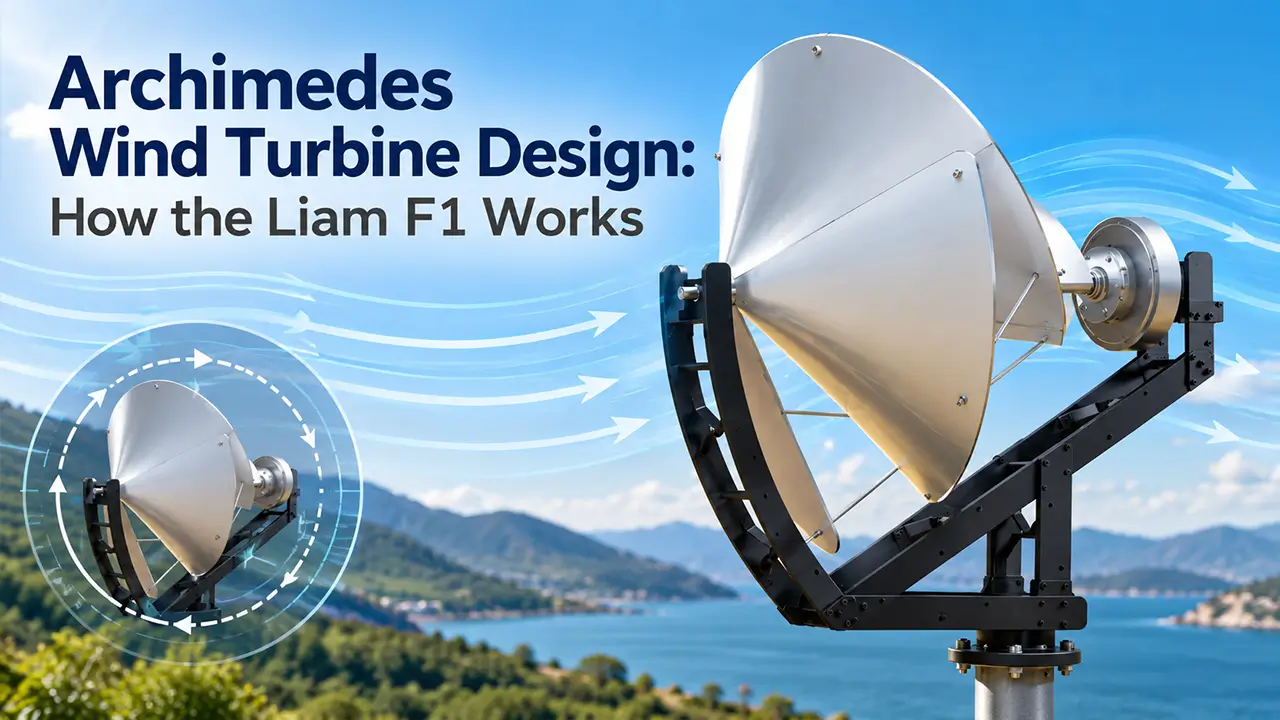
Archimedes wind turbine design takes a different approach to capturing wind energy. Instead of using long, narrow propeller blades, it features a compact spiral rotor inspired by the geometry of a screw or seashell.
The Liam F1 is one of the best-known examples of this design. Although its unusual appearance attracts attention, understanding its operation requires a closer look at airflow, torque generation, and aerodynamic performance.
What Is an Archimedes Wind Turbine?
An Archimedes-style wind turbine uses curved, spiral-shaped surfaces around a central rotational axis. These surfaces interact with incoming airflow and convert part of the wind’s kinetic energy into mechanical rotation.
The concept visually resembles an Archimedean screw. However, a wind turbine extracts energy from moving air, while a conventional Archimedes screw transfers energy to water or other materials.
Why Is the Rotor Shaped Like a Spiral?
The spiral arrangement creates curved surfaces that interact with incoming wind at different positions around the rotor.
As airflow moves across these surfaces, aerodynamic forces generate torque around the central shaft.
In contrast, conventional propeller blades primarily use carefully shaped airfoil sections to generate aerodynamic lift.
However, a spiral shape alone does not guarantee efficient energy conversion. Engineers must examine the rotor’s aerodynamic characteristics through analysis and experimental testing.
How Does the Liam F1 Spiral Rotor Work?
The Liam F1 converts wind energy into rotational motion through aerodynamic forces acting on its curved blade surfaces.
Although the geometry appears relatively simple, airflow around the rotor can become complex because aerodynamic forces vary across its surface.
Airflow and Torque Generation
As wind approaches the rotor, the spiral surfaces redirect airflow and create pressure differences.
These pressure differences contribute to aerodynamic forces that turn the rotor. In addition, the shape influences how air moves through and around the structure.
Depending on the geometry and operating conditions, both lift-related and drag-related effects may contribute to torque generation.
For example, engineers can use computational fluid dynamics and wind tunnel measurements to investigate airflow patterns, pressure distributions, and rotor performance.
Rotor Orientation and Wind Direction
The Liam F1 generally operates with its rotational axis facing the approaching wind. Therefore, rotor orientation plays an important role in its performance.
Historical Liam F1 testing documentation describes a yaw arrangement that helps the turbine respond to changes in wind direction.
This distinction matters because a spiral rotor does not automatically function like an omnidirectional vertical-axis turbine.
In practice, different turbine architectures require different approaches to wind alignment and mechanical control.
Why Use a Spiral Blade Design?
Spiral rotor geometry offers a different combination of aerodynamic, mechanical, and visual characteristics from conventional wind turbine blades.
Compact Rotor Geometry
One of the most recognizable characteristics of an Archimedes-style turbine is its compact spiral profile.
This configuration may appeal to projects where equipment appearance and physical dimensions influence design decisions.
However, a compact rotor does not necessarily generate more electricity than a conventional rotor occupying a similar space.
Instead, energy capture depends on the effective swept area, aerodynamic efficiency, local wind conditions, and operating characteristics.
Rotational Behavior and Acoustic Characteristics
Blade geometry influences rotational speed, aerodynamic loading, and noise generation.
For example, differences in blade shape can affect airflow separation and the aerodynamic sound produced during rotation.
Some spiral turbine designs emphasize quiet operation. Nevertheless, actual noise levels also depend on rotor speed, mechanical construction, wind conditions, and installation characteristics.
Therefore, engineers should use sound measurements under clearly defined conditions rather than assuming that an unconventional blade shape guarantees silent operation.
Visual Integration With Architecture
Unlike the familiar three-bladed silhouette of a conventional wind turbine, a spiral rotor has a distinctive sculptural appearance.
As a result, architects may consider this geometry for renewable energy demonstrations and projects where visual design matters.
However, appearance and aerodynamic performance represent separate engineering considerations.
Archimedes vs. Conventional Wind Turbine Rotor Design
Both Archimedes-style and conventional horizontal-axis turbines convert wind energy into mechanical rotation. However, their rotor geometry and aerodynamic behavior differ.
| Design Factor | Archimedes-Style Rotor | Conventional Propeller Rotor |
|---|---|---|
| Blade geometry | Curved spiral surfaces | Elongated aerodynamic blades |
| Aerodynamic behavior | Complex pressure forces and airflow interactions | Primarily lift-based aerodynamic operation |
| Visual profile | Compact spiral appearance | Open propeller-shaped rotor |
| Wind orientation | Generally requires wind-facing alignment | Generally requires wind-facing alignment |
| Performance assessment | Requires design-specific experimental data | Established aerodynamic design and testing methods |
Overall, neither architecture offers universal advantages under every operating condition.
Instead, engineers must compare specific rotor designs using consistent performance measurements and clearly defined objectives.
For additional background, explore our introduction to horizontal axis wind turbines.
What Are the Engineering Limitations of Spiral Wind Turbines?
Distinctive geometry introduces engineering trade-offs. Therefore, designers must consider aerodynamic efficiency, manufacturing requirements, and operating conditions.
Aerodynamic Efficiency and Swept Area
The amount of power available in the wind depends on air density, wind speed, and the effective area exposed to the flow.
Meanwhile, rotor geometry determines how much of that energy a turbine can convert into mechanical power.
Engineers commonly use the power coefficient, or Cp, to evaluate aerodynamic energy conversion relative to the power available in the wind.
Consequently, reliable efficiency comparisons require comparable Cp measurements under defined conditions.
Manufacturing Complexity and Rotor Balance
Curved spiral surfaces may require specialized molds, fabrication methods, and dimensional control.
For example, small differences in manufacturing tolerances can affect rotor balance and increase vibration during operation.
In addition, engineers must select materials that provide adequate structural strength, fatigue resistance, and long-term dimensional stability.
Performance in Turbulent Airflow
Buildings, vegetation, and surrounding structures often disturb airflow around small wind turbine installations.
As a result, turbulence can create rapidly changing aerodynamic loads and reduce the predictability of power generation.
Although spiral geometry may respond differently from conventional propeller blades, engineers still need controlled comparative testing to establish any performance advantage.
How Can Archimedes Wind Turbine Performance Be Evaluated?
Engineers can assess spiral rotor performance by combining aerodynamic modeling with experimental measurements.
Computational Fluid Dynamics
Computational fluid dynamics, or CFD, helps engineers investigate airflow patterns, pressure distributions, and aerodynamic forces around a rotor.
For spiral turbines, CFD can reveal regions of flow separation and predict how changes in blade geometry affect torque.
However, simulation accuracy depends on model assumptions, mesh quality, and boundary conditions.
Therefore, engineers should compare simulation results with experimental measurements whenever possible.
Wind Tunnel and Field Testing
Wind tunnel testing allows researchers to study rotor behavior under controlled wind conditions.
In contrast, field testing provides information about operation under changing wind direction, turbulence, temperature, and other environmental factors.
Both approaches offer useful evidence. For example, researchers can measure rotational speed, torque, electrical output, noise, and structural response.
Interpreting Power Curves Correctly
A turbine power curve shows how electrical output changes with wind speed under specified test conditions.
To compare different designs, engineers should document the measurement method, wind-speed range, air density, and system configuration.
Furthermore, historical Liam F1 performance claims do not automatically apply to newer Archimedes-style turbines because their dimensions, generators, and operating characteristics may differ.
What Can Small Wind Turbine Designers Learn From the Liam F1?
The Liam F1 demonstrates how alternative rotor geometries can expand the design possibilities of small wind energy systems.
However, its main contribution is not proof that spiral blades outperform conventional designs. Instead, it offers an opportunity to investigate relationships between rotor shape, airflow, torque, noise, and structural requirements.
For manufacturers, the most useful lessons involve balancing aerodynamic performance with manufacturability, material durability, and mechanical reliability.
These considerations apply across small wind turbine technologies, including conventional horizontal-axis designs and alternative rotor configurations.
Frequently Asked Questions
Is an Archimedes wind turbine the same as an Archimedes screw?
No. Although both designs use spiral geometry, they perform different functions. An Archimedes screw typically moves water or other materials, while an Archimedes-style wind turbine extracts energy from moving air.
Does a spiral rotor always rotate more slowly than a propeller rotor?
Not necessarily. Rotational speed depends on rotor geometry, diameter, aerodynamic loading, generator resistance, and wind conditions. Therefore, engineers need measurements under equivalent conditions to make a meaningful comparison.
Can spiral wind turbine blades be manufactured using 3D printing?
Yes. Engineers can use 3D printing to create small-scale aerodynamic prototypes and verify design concepts. However, components intended for sustained outdoor operation require suitable materials, structural assessment, and fatigue testing.
Are all Archimedes-style wind turbines based on the original Liam F1 design?
No. Manufacturers may use different blade profiles, dimensions, materials, and mechanical configurations. Therefore, a similar appearance does not guarantee identical engineering or performance.
Conclusion
Archimedes wind turbine design offers an alternative way to explore rotor aerodynamics through compact spiral geometry. The Liam F1 illustrates how blade shape can influence engineering decisions, but reliable performance comparisons still require appropriate testing.
For readers interested in commercially available configurations, explore the ELEGE Liam F1 wind turbine product page for model-specific information.