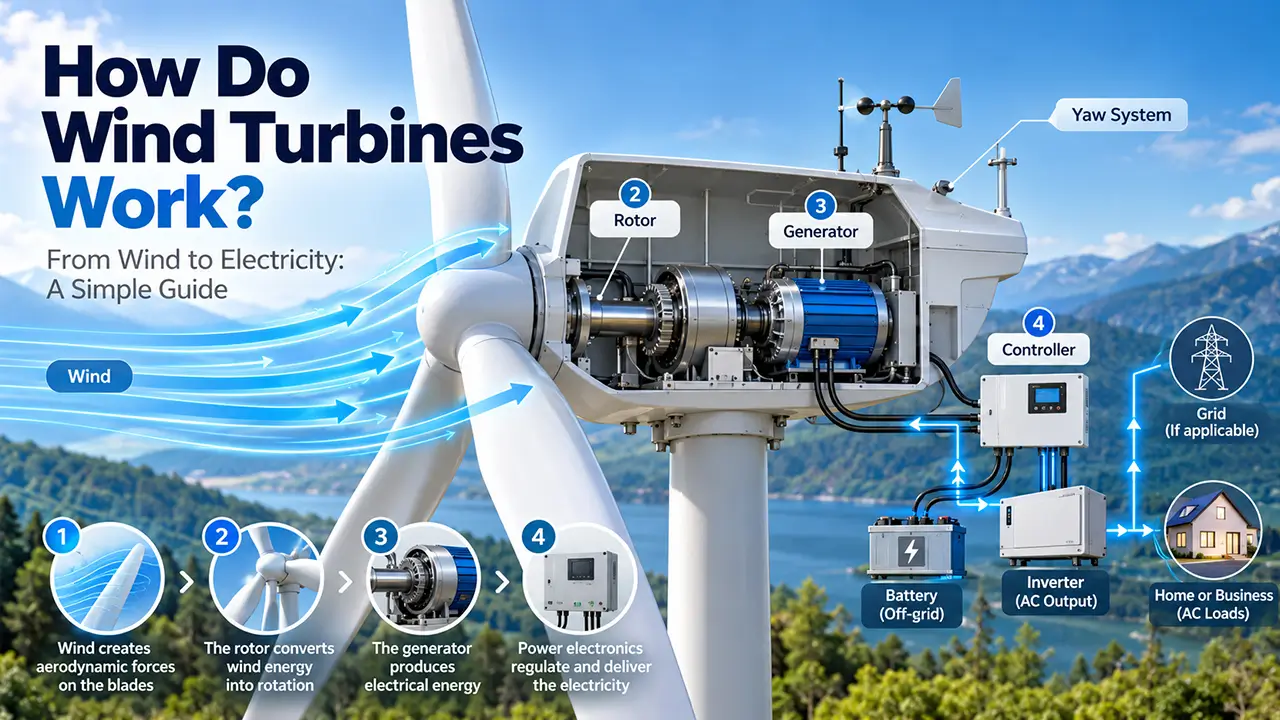
How do wind turbines work? Wind turbines convert the kinetic energy of moving air into electrical energy. As wind flows across the blades, aerodynamic forces turn a rotor, which drives a generator to produce electricity.
Although the basic principle is straightforward, reliable wind power generation depends on blade design, generator efficiency, wind conditions, and electrical control. Understanding each stage helps explain how modern turbines supply electricity to homes, farms, businesses, and remote equipment.
How Do Wind Turbines Generate Electricity?
Wind turbines generate electricity through a sequence of aerodynamic, mechanical, and electromagnetic processes. Rather than creating energy, they convert part of the energy already present in moving air into a form that electrical equipment can use.
Step 1: Wind Creates Aerodynamic Forces on the Blades
When wind moves across a turbine’s blades, the blade surfaces experience aerodynamic forces. On conventional horizontal-axis turbines, airfoil-shaped blades generate lift, which provides much of the torque that turns the rotor.
The blades have carefully designed shapes and angles. As a result, they can extract useful energy from airflow while limiting unnecessary aerodynamic losses.
Different rotor designs use different combinations of lift and drag. However, all wind turbines need sufficient aerodynamic torque to overcome mechanical resistance and begin rotating.
Step 2: The Rotor Converts Wind Energy Into Rotation
The blades connect to a central hub, forming the rotor assembly. As aerodynamic forces act on the blades, the rotor turns and transfers mechanical energy through a shaft or direct-drive connection.
Some large wind turbines use gearboxes to increase rotational speed before driving the generator. In contrast, many small wind turbines use direct-drive generators that operate without a conventional speed-increasing gearbox.
The rotor’s speed and torque depend on wind conditions, aerodynamic design, and the mechanical and electrical loads connected to the turbine.
Step 3: The Generator Produces Electrical Energy
The generator converts mechanical rotation into electricity through electromagnetic induction.
As magnetic fields move relative to electrical windings, the generator produces voltage. The electrical output depends on generator design, rotational speed, and the connected load.
Many small wind turbines use permanent magnet generators because they can provide a relatively compact, direct-drive solution. However, generator construction and electrical characteristics vary between manufacturers.
Step 4: Electrical Equipment Conditions the Output
A wind generator does not necessarily deliver electricity in the form required by household appliances or the utility grid.
Therefore, the system uses suitable power electronics to regulate or convert the output. Depending on the configuration, these components may include rectifiers, wind charge controllers, batteries, inverters, and electrical protection devices.
For example, a battery-based installation typically converts the generator’s variable electrical output into controlled battery charging power. An inverter can then supply compatible AC loads.
What Are the Main Components of a Wind Turbine?
Each component performs a specific function within the energy conversion process. Although large and small turbines share basic principles, their mechanical arrangements and control systems can differ considerably.
Blades, Rotor Hub, and Shaft
The blades capture energy from moving air, while the hub connects them to the rotating assembly. The shaft or direct-drive connection then transfers mechanical torque toward the generator.
Blade geometry, material stiffness, rotor balance, and manufacturing quality all influence operating performance and durability.
Generator, Bearings, and Support Structure
The generator produces electricity, while bearings support rotating components and help reduce mechanical friction.
Meanwhile, the frame, nacelle, or supporting structure keeps the turbine properly aligned and transfers operating loads to the tower or mounting foundation.
For small turbines, careful bearing selection and structural design are particularly important because vibration, misalignment, and mechanical losses can affect long-term reliability.
Yaw, Pitch, and Braking Systems
On many horizontal-axis turbines, a yaw system turns the rotor assembly toward the wind. Some turbines use active yaw motors, while smaller designs may rely on passive wind-following arrangements.
Pitch control performs a different function: it changes the angle of the blades around their longitudinal axes. Large turbines commonly use pitch control to manage aerodynamic loading and power output.
Braking and overspeed protection help manage potentially damaging operating conditions. Depending on the turbine design, these systems may use aerodynamic control, mechanical brakes, electrical braking, or a combination of methods.
How Do Horizontal-Axis and Vertical-Axis Wind Turbines Work?
Wind turbines generally fall into two broad categories according to the orientation of their main rotational axis. Both convert wind energy into electricity, but their aerodynamic behavior and mechanical layouts differ.
Horizontal-Axis Wind Turbines (HAWTs)
A horizontal-axis wind turbine has a rotor shaft that generally points toward the incoming wind. Most utility-scale turbines use this configuration, typically with three aerodynamic blades.
HAWTs can achieve high aerodynamic efficiency when engineers optimize blade geometry, wind alignment, and operating speed. However, their performance still depends on wind quality and the complete turbine design.
Learn more about the structure and operating characteristics of horizontal-axis wind turbines.
Vertical-Axis Wind Turbines (VAWTs)
A vertical-axis wind turbine rotates around an upright shaft. Common designs include Darrieus-type lift-based rotors and Savonius-type drag-based rotors.
Many VAWT configurations can accept wind from different horizontal directions without a conventional yaw mechanism. Nevertheless, their starting characteristics, torque, efficiency, and structural loading depend on the specific rotor geometry.
For example, a drag-based Savonius turbine typically operates differently from a lift-based Darrieus turbine. Therefore, it would be misleading to assign one efficiency or starting-wind-speed value to every vertical-axis design.
For additional information, explore ELEGE’s vertical-axis wind turbine series.
Key Differences Between HAWTs and VAWTs
| Feature | Horizontal-Axis Turbine | Vertical-Axis Turbine |
|---|---|---|
| Rotor axis | Generally horizontal | Vertical |
| Wind alignment | Usually requires yaw alignment | Often accepts changing horizontal wind directions |
| Aerodynamic principle | Primarily lift-based | Lift-based or drag-based, depending on design |
| Generator placement | Often behind the rotor | May be located near the base |
| Typical engineering focus | Yaw control, blade aerodynamics, rotor loads | Cyclic loading, starting behavior, rotor dynamics |
Neither configuration is universally better. Engineers should compare actual turbine performance, installation conditions, and operating requirements rather than relying on the axis orientation alone.
How Much Power Can a Wind Turbine Produce?
The amount of power available in moving air depends mainly on wind speed, air density, and the area swept by the rotor.
The Wind Power Formula
Engineers calculate the power available in the wind using the following equation:
P = ½ × ρ × A × v³
In this equation, P represents the power available in the airflow, ρ is air density, A is the rotor’s effective swept area, and v is wind speed.
The cubic relationship is especially important. For example, doubling wind speed increases the theoretical power available in the same airflow by a factor of eight, assuming other conditions remain unchanged.
However, a real turbine captures only part of that energy. Aerodynamic losses, generator efficiency, and electrical conversion losses reduce the final usable output.
What Is the Betz Limit?
The Betz limit describes the maximum fraction of wind power that an idealized turbine rotor can extract under the assumptions of one-dimensional actuator-disk momentum theory.
According to this model, the maximum power coefficient is 16/27, or approximately 59.3%.
A turbine cannot extract all the kinetic energy from the wind because air must continue moving downstream of the rotor. Otherwise, the airflow could not pass continuously through the turbine.
In practice, additional aerodynamic and mechanical losses reduce energy conversion below the ideal limit.
Why Rated Power Is Different From Actual Output
A wind turbine’s rated power refers to its specified electrical output under defined operating conditions, including a particular wind speed.
For example, a 1kW turbine does not continuously generate 1kW throughout the year. During periods of weak wind, its output may be much lower.
Therefore, realistic energy estimates require the turbine’s measured power curve and the wind-speed distribution at the installation site.
How Does Wind Speed Affect Turbine Operation?
Wind speed influences when a turbine starts, how much electricity it generates, and when its protection systems need to respond.
Start-Up, Cut-In, and Rated Wind Speeds
Start-up wind speed describes the approximate wind speed at which a rotor begins turning under specified conditions.
Cut-in wind speed refers to the point at which the turbine begins delivering useful electrical power according to the manufacturer’s definition.
Rated wind speed is the wind speed at which the turbine reaches its specified rated output. These values are not interchangeable.
In particular, a rotor that starts moving in a gentle breeze may still produce very little usable electricity at that speed.
Why Installation Height Matters
Wind speed often increases with height above ground because surface friction and nearby obstacles influence airflow.
Buildings, trees, and uneven terrain can also create turbulence, which reduces the predictability of electricity production and increases fluctuating mechanical loads.
As a result, a turbine installed at an exposed location may perform substantially differently from the same model mounted close to surrounding obstacles.
For sites with limited wind resources, our guide to small wind turbines for low wind speeds explains additional performance considerations.
How Does Wind Turbine Electricity Reach the Load?
After the generator produces electricity, the remaining equipment determines how the system stores, converts, and delivers that energy.
Off-Grid Wind Power Systems
In a typical small off-grid configuration, a wind generator supplies a compatible wind charge controller, which manages energy delivery to a battery bank.
The controller may also coordinate a diversion or dump load to help manage excess energy and protect the system under specified operating conditions.
Next, a suitable inverter converts stored DC electricity into AC electricity for compatible appliances or other loads.
The exact wiring, braking arrangements, protective devices, and charging requirements depend on the turbine and electrical equipment. Explore the broader system architecture in our off-grid wind power systems guide.
Grid-Connected Wind Power Systems
Grid-connected installations use suitable power electronics to convert variable generator output into electricity that meets applicable grid requirements.
These systems require appropriate synchronization, protection, and compliance with local utility and electrical regulations.
Unlike a battery-based system, a conventional grid-connected installation does not automatically provide backup power during an outage.
Wind and Solar Hybrid Systems
Wind and solar generation can complement each other when local weather patterns provide useful resources at different times.
For instance, wind generation may contribute during nighttime or cloudy periods when photovoltaic output is limited. However, actual benefits depend on local wind and solar data.
Learn how these technologies work together in a wind-solar hybrid power system.
What Determines Wind Turbine Efficiency and Reliability?
Wind energy performance depends on the complete system rather than a single component. Therefore, manufacturers must balance aerodynamic efficiency, mechanical durability, and electrical conversion.
Blade Design and Material Quality
Blade geometry influences aerodynamic forces, rotor speed, and structural loading. Meanwhile, suitable composite materials and manufacturing processes help the blades withstand repeated stress and environmental exposure.
Designers must also control rotor balance and blade consistency to limit unnecessary vibration.
Mechanical and Electrical Losses
Bearings, generators, controllers, and inverters each introduce some losses during operation.
For example, excessive mechanical friction can reduce available shaft power, while an unsuitable generator-controller combination can prevent the turbine from operating near its intended aerodynamic conditions.
Consequently, matching the turbine’s mechanical and electrical characteristics is essential for reliable performance.
System Protection and Maintenance
Wind turbines must operate under changing weather conditions. Their protection systems should address relevant risks such as overspeed, electrical faults, and excessive mechanical loading.
Regular inspection also helps operators identify loose connections, abnormal vibration, bearing problems, and visible blade damage before these issues become more serious.
For practical diagnostic information, refer to our wind turbine troubleshooting guide.
What Should Buyers Check Before Choosing a Small Wind Turbine?
Understanding how wind turbines work makes it easier to evaluate technical information supplied by manufacturers.
First, buyers should assess local wind conditions and the electricity demand of the intended application. These factors determine whether a wind turbine can provide meaningful energy production.
Next, they should compare measured power curves, rated wind speeds, generator characteristics, structural requirements, and compatible electrical equipment.
Finally, buyers should examine available technical documentation, maintenance requirements, warranty conditions, and supplier support. For commercial projects, consistent manufacturing quality and reliable after-sales assistance also matter.
ELEGE develops small wind turbine solutions for different system configurations. Readers exploring a specific project can review the relevant product and system pages after establishing their technical requirements.
Frequently Asked Questions
Do wind turbines use electricity to start spinning?
Most conventional wind turbines rely on aerodynamic torque to begin rotating. However, their control systems, sensors, actuators, or auxiliary equipment may consume electricity. Starting behavior depends on the turbine’s design.
Can wind turbines generate electricity while rotating backward?
Reverse rotation does not automatically mean a turbine can deliver useful power. The generator, controller, mechanical structure, and protection system must support the operating condition. Manufacturers generally specify the intended direction of rotation.
Why do some wind turbines stop when the wind is strong?
A turbine may stop or limit operation to protect itself from excessive mechanical loads, overspeed, or electrical faults. The relevant control strategy depends on the model and its protection design.
Can a wind turbine work without batteries?
Yes. Some grid-connected systems operate without battery storage, while other configurations supply suitable loads through dedicated power electronics. However, a battery-free installation still requires proper electrical regulation and protection.
Conclusion
Wind turbines work by converting moving air into rotor motion and then electrical energy. Their performance depends on aerodynamic design, wind conditions, generator characteristics, and electrical system integration.
Understanding these principles helps homeowners, project developers, and equipment buyers evaluate wind power solutions based on realistic performance rather than rated power alone.