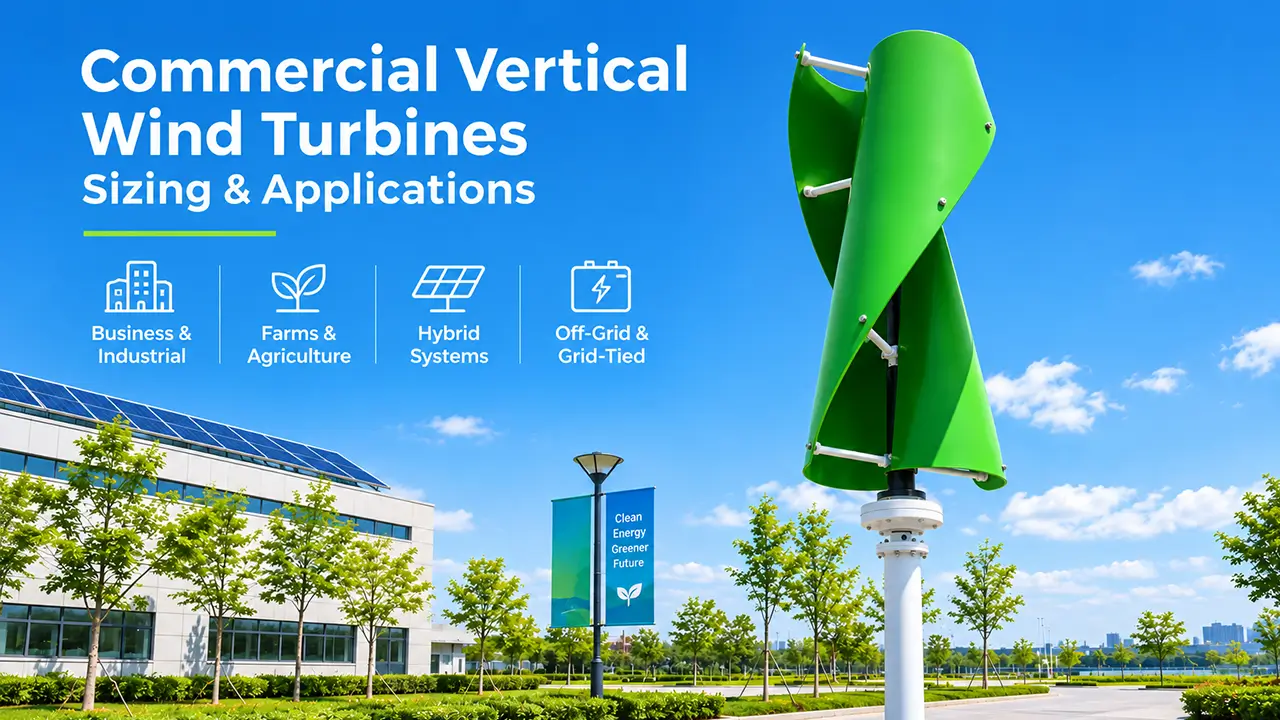
Commercial vertical wind turbines can support on-site renewable energy for businesses, farms, public facilities, remote sites, and distributed-energy projects. A successful project depends on more than turbine rated power. Wind conditions, energy demand, installation height, mounting method, electrical configuration, and expected annual generation all need to be evaluated together.
Commercial Vertical Wind Turbines for Business Projects
Commercial vertical wind turbines are vertical-axis wind turbines used in business, agricultural, industrial, public, and distributed-energy applications. Compared with a simple residential installation, a commercial project normally requires more attention to site conditions, load demand, system integration, mounting, maintenance access, and long-term operating economics.
The term “commercial” does not necessarily mean utility-scale generation. Many projects use small or medium VAWTs to offset part of a facility’s electricity demand, charge batteries, support remote equipment, power lighting, or operate alongside solar panels.
A commercial buyer should therefore look beyond 1 kW, 2 kW, 3 kW, or 5 kW labels. The more useful question is how much energy the complete system can deliver at the actual site.
Where Commercial VAWTs Make Sense
Commercial Buildings and Warehouses
Commercial buildings, factories, warehouses, retail facilities, and business parks may have rooftop or ground space available for distributed wind generation.
A vertical-axis turbine can be worth evaluating where wind direction changes frequently or where the project benefits from a compact rotor arrangement. However, a tall building does not automatically mean the roof has a strong wind resource.
Nearby buildings, parapets, HVAC equipment, trees, and roof geometry can create turbulence and sheltered areas. Two positions on the same roof may therefore have very different wind conditions.
Farms and Agricultural Sites
Farms often provide more open land and fewer nearby obstacles, making it easier to identify suitable mounting locations.
Commercial vertical wind turbines can support farm buildings, lighting, monitoring systems, workshops, pumps, remote equipment, or battery charging. Where both wind and solar resources are available, the turbine can also form part of a hybrid renewable-energy system.
Hotels, Resorts, Campuses, and Public Spaces
Hotels, resorts, schools, campuses, parks, commercial plazas, and public projects may value renewable-energy visibility as well as electricity generation.
Vertical turbines can suit these projects because of their compact layout and distinctive appearance. In some cases, the turbine becomes part of a broader sustainability installation that also includes solar panels, batteries, lighting, or public charging functions.
Remote Commercial Facilities
Remote monitoring stations, telecommunications sites, workshops, island facilities, and off-grid commercial locations may have limited or unreliable access to utility power.
In these projects, wind does not need to operate alone. A turbine can work with solar panels and batteries so that different energy sources contribute under different weather conditions.
Site Assessment for Commercial Wind Projects
Commercial wind projects should begin with the site, not the turbine catalog.
Wind Resource
Wind speed has a major influence on annual energy production. A turbine may reach its rated output under specified conditions, but that does not mean it will continuously produce rated power during normal operation.
Commercial buyers should compare the turbine power curve with actual wind conditions at the installation site.
Average wind speed is useful as an initial indicator, but it does not fully describe the wind resource. Wind-speed distribution, seasonal changes, prevailing direction, and periods of low or high wind can all affect annual output.
Turbulence and Obstacles
Buildings, walls, trees, industrial structures, and terrain can disturb airflow.
A VAWT can accept wind from changing horizontal directions, but that does not mean turbulence has no effect on performance. Wind-direction flexibility and good wind quality are two different issues.
Commercial rooftop installations need particular attention because airflow can accelerate around some roof edges while other areas remain inside recirculation zones.
Installation Height
Wind conditions generally change with height and surrounding roughness. Raising a turbine can improve exposure in some locations, but the correct mounting height depends on nearby obstacles, structure, tower design, maintenance access, and local restrictions. Therefore, select the installation height together with the turbine and mounting system instead of treating it as an independent decision.
Rooftop vs. Ground-Mounted Installation
Rooftop installation can save ground space and may use the height of an existing building. However, the roof structure, vibration transmission, maintenance access, nearby obstacles, and local airflow all need to be evaluated.
Ground mounting requires tower and foundation space but provides more freedom to position the turbine away from buildings and other obstructions. Where enough land is available, this can make it easier to reach cleaner airflow.
For a more detailed comparison, see rooftop vs ground-mounted wind turbines.
How to Size a Commercial Vertical Wind Turbine
Commercial turbine sizing should begin with your energy objective. A turbine used for monitoring equipment or lighting requires a very different system from one intended to offset part of a factory or warehouse load.
Define the Energy Demand
Start with the actual load. For an off-grid application, this may include daily energy consumption, peak load, operating hours, and required battery autonomy. For a grid-connected project, the goal may instead be to reduce purchased electricity over the year.
A 5 kW load that operates briefly may consume less daily energy than a 1 kW load that runs continuously. Commercial wind-system sizing should therefore consider both power and energy.
Match the Power Curve to the Site
After defining the load, compare the site wind conditions with the turbine power curve. The power curve shows how turbine output changes as wind speed increases. This is more useful than comparing rated power alone.
A turbine that appears larger on paper may not deliver more useful annual energy if most of the site’s wind occurs below its productive range.
Rated Power vs. Actual Energy Output
Rated power is a capacity value. Commercial project economics depend more heavily on energy production over time. Two turbines with the same rated power can deliver different annual energy at different sites because local wind conditions are different.
Rated power: the turbine’s specified output under defined conditions.
Expected energy: the electricity the turbine may generate over a day, month, or year under actual site conditions.
VAWT vs. HAWT for Commercial Projects
Vertical-axis and horizontal-axis turbines can both support commercial distributed wind projects. Neither configuration is automatically better for every site.
| Commercial Project Factor | VAWT | HAWT |
|---|---|---|
| Changing wind direction | Can accept wind from changing horizontal directions | Rotor normally aligns with incoming wind |
| Compact installation | Often useful where rotor layout matters | Requires adequate blade and yaw clearance |
| Complex commercial sites | Worth evaluating where direction varies | Strong option where clean prevailing wind is available |
| Open farmland | Suitable depending on wind and system goals | Often effective in clear, consistent wind |
| Rooftop projects | Requires airflow and structural assessment | Requires airflow, clearance, and structural assessment |
| Main buying criterion | Site wind, energy target, mounting, system design | Site wind, energy target, mounting, system design |
The decision should focus on project conditions rather than appearance. Compare wind resource, annual energy potential, rotor size, mounting requirements, tower height, maintenance access, power curve, electrical system, and total installed cost before choosing a turbine configuration.
Choosing the Right Commercial Wind Power System
Commercial vertical wind turbines can operate in several electrical configurations. The best system depends on whether grid power is available and what the project needs the turbine to achieve.
Off-Grid Commercial Systems
An off-grid wind system normally includes the wind turbine, controller, battery storage, inverter, protection, and electrical loads.
The system must balance turbine generation, battery capacity, inverter size, and load demand. Increasing turbine rated power alone does not solve an undersized battery or inverter.
Off-grid systems are particularly relevant for remote sites, farms, islands, monitoring equipment, and locations where utility power is unavailable or unreliable.
Grid-Tied Commercial Systems
An on-grid wind system operates together with the local utility network.
The project may use wind generation to offset part of its own electricity demand, depending on local grid rules and system design. Grid-compatible control, inverter, protection, and utility requirements need to be confirmed before equipment selection.
Wind-Solar Hybrid Systems
A wind-solar hybrid system combines wind generation with photovoltaic panels and, where required, battery storage.
Solar generation is concentrated during daylight, while wind may continue during cloudy conditions, evenings, or other periods when solar output is low.
The value of a hybrid system still depends on local wind, solar irradiation, battery capacity, load profile, and system control. The components need to be matched as one system.
Commercial Wind Turbine Cost and ROI
There is no universal payback period for commercial vertical wind turbines.
Project cost may include the turbine, tower or mounting structure, foundation work, controller, inverter, battery storage, protection equipment, monitoring, transport, installation, electrical work, and future maintenance.
Annual energy production is equally important. Two identical turbines can produce very different financial results at different sites. A turbine exposed to productive wind for many hours will generate more useful energy than the same turbine installed in weak or highly disturbed airflow.
Commercial ROI: Total installed cost → annual energy production → value of that electricity → maintenance and operating cost.
Electricity price, financing, incentives, battery replacement, project lifetime, and local regulations can further affect the result. A reliable proposal should explain the assumptions behind expected generation rather than promise a fixed payback period.
Maintenance and Commercial Project Reliability
Commercial wind turbines operate outdoors for long periods, so maintenance planning should begin during project design.
Routine checks can include blades, fasteners, electrical connections, tower hardware, bearings, wiring, controller status, corrosion, vibration, and abnormal noise. The appropriate inspection schedule depends on turbine design, local climate, exposure, operating hours, and manufacturer recommendations.
Coastal, dusty, humid, industrial, or high-salt locations may require additional inspection of metal surfaces, electrical connections, and mounting hardware.
Maintenance access should also be considered before installation. A turbine that is difficult to reach may increase long-term service cost even if the initial installation appears convenient. For common operating issues, see wind turbine troubleshooting.
Commercial VAWT Buying Checklist and RFQ Information
A commercial VAWT should match the project rather than forcing the project to match a specific turbine.
Before buying, confirm the site wind conditions, surrounding obstacles, required energy, installation type, system voltage, available space, electrical configuration, and environmental exposure.
Then compare the turbine power curve, rated wind speed, operating range, rotor dimensions, generator configuration, control system, inverter compatibility, mounting options, maintenance requirements, and warranty.
For projects evaluating a compact commercial vertical-axis model, the EV wind turbine can be considered as one option. Final selection should still depend on actual wind conditions, energy requirements, system voltage, tower height, and complete electrical configuration.
| Project Information | Why It Matters |
|---|---|
| Installation country and project type | Helps identify environmental and system requirements |
| Available wind data | Supports turbine sizing and energy evaluation |
| Installation height and nearby obstacles | Helps assess wind exposure and turbulence |
| Required power or daily energy | Defines the project’s real energy target |
| System voltage | Ensures electrical component compatibility |
| Off-grid, grid-tied, or hybrid | Determines controller, inverter, and battery requirements |
| Quantity | Supports system layout and quotation planning |
If the system will operate off-grid, include the expected loads and battery requirements. If it will connect to the grid, provide the local grid voltage and any known utility requirements. If solar is also planned, include the intended PV capacity where available.
For rooftop projects, building height, roof type, available installation area, and structural information are useful. For ground-mounted projects, available land, tower-height restrictions, and expected foundation conditions can help with system planning.
Frequently Asked Questions
Can Several Commercial Vertical Wind Turbines Operate at the Same Site?
Yes. Multiple turbines can form a distributed system, but spacing and wake interaction need to be considered. The best arrangement depends on rotor dimensions, site layout, prevailing wind, installation height, and available area.
Can Commercial VAWTs Support EV Charging?
They can contribute energy to a site that includes EV charging, but the turbine should not be expected to match charger demand in real time. The complete load, grid, battery, and renewable-energy system should be evaluated together.
Can Commercial Vertical Wind Turbines Operate During a Power Outage?
It depends on the system design. A standard grid-tied system normally cannot supply loads during an outage, while an off-grid or hybrid system with battery storage may continue powering selected loads.
Should a Commercial Wind Project Include Remote Monitoring?
Remote monitoring can help operators track turbine status, generation, alarms, and system performance without constant on-site inspection. Available functions depend on the controller and monitoring system.
Can a Commercial Wind Turbine System Be Expanded Later?
Potentially, but future expansion should be considered in the original system design. Adding turbines, batteries, solar panels, or loads may require changes to controllers, inverters, protection devices, wiring, and system capacity.
Final Thoughts
Commercial vertical wind turbines can support renewable-energy projects for businesses, farms, public facilities, and remote sites. The strongest projects begin with wind conditions, energy demand, installation design, and realistic annual generation rather than rated power alone.
ELEGE can help evaluate your site, turbine size, mounting method, voltage, and off-grid, grid-tied, or wind-solar configuration for a practical commercial wind project.