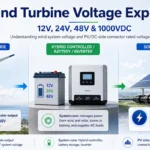
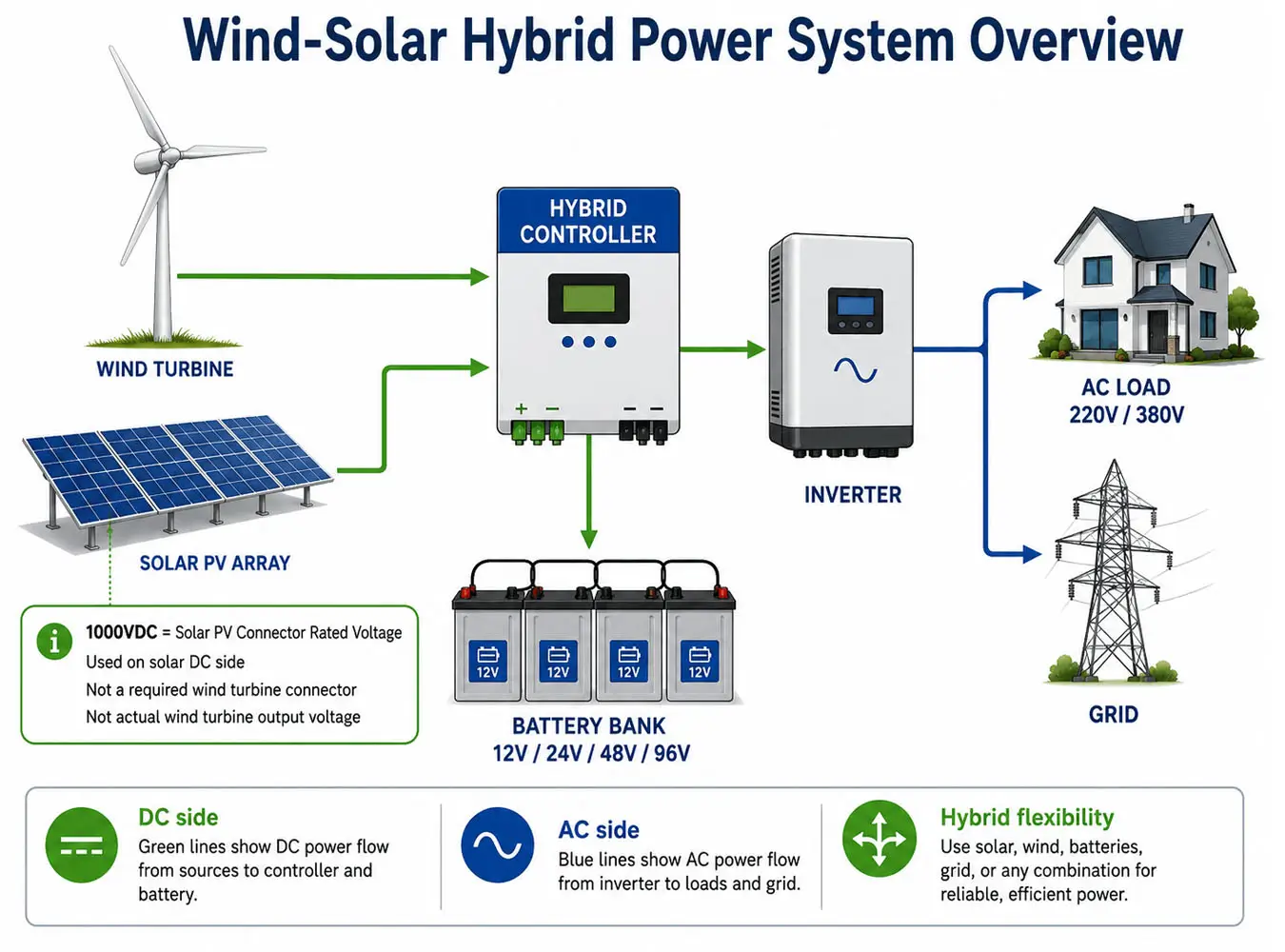
When customers read a wind turbine specification, they may see many voltage numbers, such as 12V, 24V, 48V, 220V, 380V, or even 1000VDC. These numbers often confuse buyers who are new to small wind turbine systems or wind-solar hybrid systems.
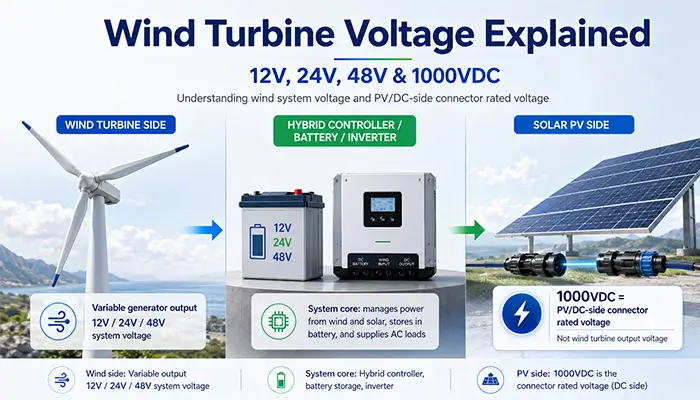
For example, some customers think a 48V wind turbine always outputs exactly 48V. Others see 1000VDC on a solar PV connector or DC-side component and think the wind turbine itself outputs 1000V. In fact, these numbers describe different parts of the system.
A complete renewable energy system may include a wind turbine, controller, battery bank, inverter, solar panels, cables and protection devices. Therefore, one voltage number cannot explain the whole system.
In this article, we will explain what 12V, 24V, 48V and 1000VDC mean. We will also show why 30V or 40V systems are not common, and why 48V appears so often in small wind turbine and wind-solar hybrid systems.
Why Wind Turbine Voltage Can Be Confusing
Wind turbine voltage can confuse customers because one system may include several electrical parts. Each part may use a different voltage level or voltage rating.
In most cases, a complete system includes:
- A wind turbine generator
- A wind charge controller or hybrid controller
- A battery bank
- An inverter
- Solar panels, if the system includes solar power
- DC cables and solar PV connectors
- Breakers, fuses, surge protection devices and other safety parts
- AC loads or grid connection equipment
These parts do not use the same voltage in the same way. For instance, a 48V battery system is different from a 220V AC inverter output. Also, a solar PV connector marked 1000VDC does not mean the wind turbine side works at 1000V.
For this reason, customers should first check what the voltage number describes. It may refer to system voltage, working voltage, output voltage, or rated voltage.
Does a Wind Turbine Always Output a Fixed Voltage?
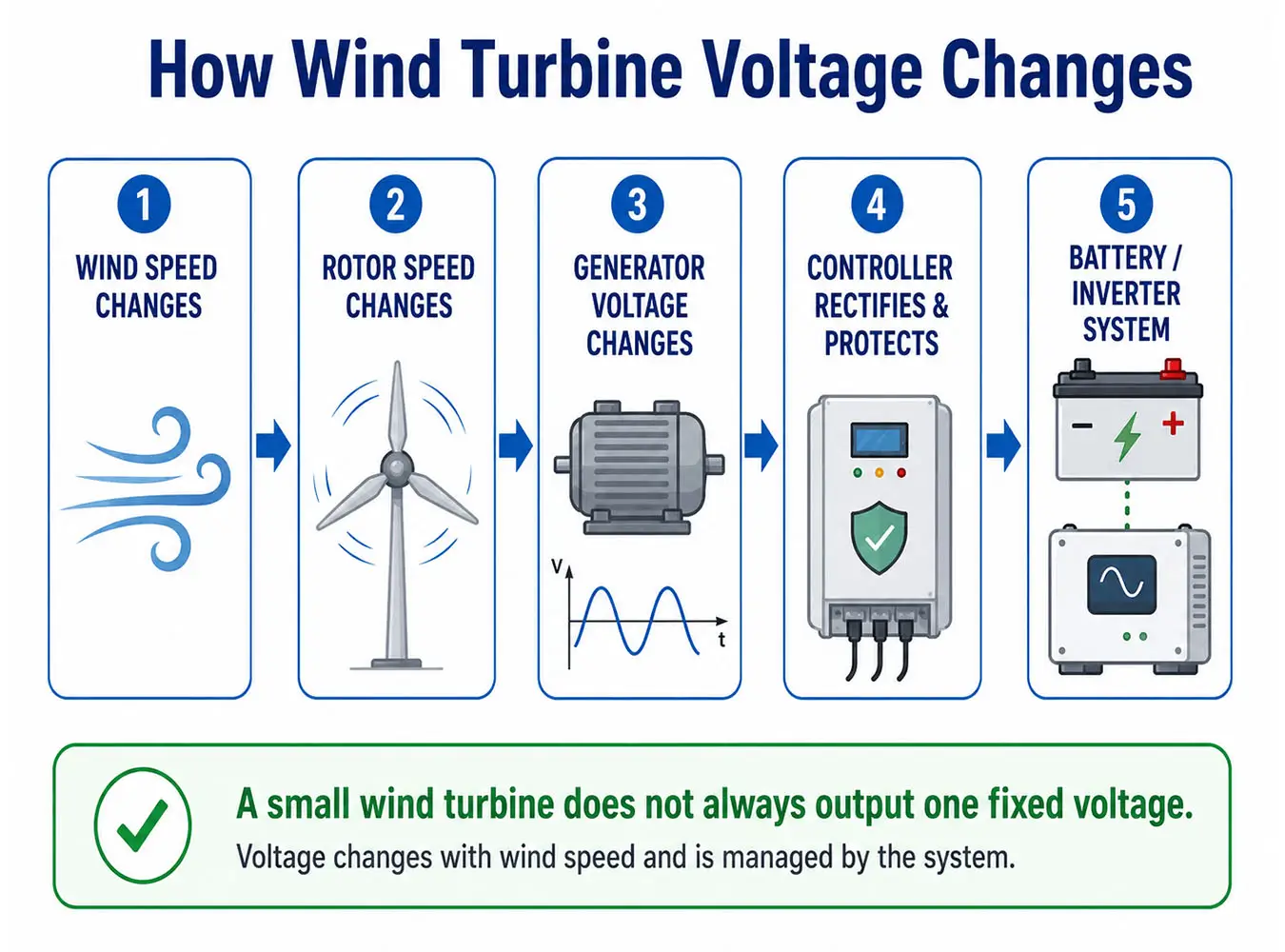
No. A small wind turbine does not always output one fixed voltage.
A battery has a relatively stable voltage range. However, a wind turbine generator changes with wind speed and rotor speed. When wind speed increases, the rotor usually spins faster. As a result, the generator output voltage may also rise.
When wind speed drops, the rotor slows down. Then the generator output voltage may fall. This is normal for small wind turbine systems.
In many systems, the wind turbine generator produces variable three-phase AC power. After that, the controller rectifies the power, regulates charging and protects the system. The controller helps the wind turbine work with the battery bank or inverter safely.
Therefore, when a product is described as a 12V, 24V or 48V wind turbine, this usually means the turbine matches that nominal system voltage. It does not mean the generator output stays at exactly 12.00V, 24.00V or 48.00V all the time.
What Do 12V, 24V and 48V Mean in a Wind Turbine System?
In small wind turbine systems, 12V, 24V and 48V usually refer to the nominal voltage of the battery, controller and inverter system.
A nominal voltage works like a standard voltage category. It helps the wind turbine, controller, battery bank and inverter match each other. During real operation, the voltage may move within a normal range during charging and discharging.
| System Voltage | Common Use | Typical Application |
|---|---|---|
| 12V | Very small systems | Lighting, small DC loads, small battery systems |
| 24V | Small off-grid systems | Small home systems or low-power wind-solar systems |
| 48V | Common small wind turbine systems | 1kW to 5kW wind turbine or wind-solar hybrid systems |
| 96V and above | Larger systems | Higher-power off-grid or hybrid power systems |
| 220V / 380V AC | Final AC output | After inverter or grid connection equipment |
For example, when a customer chooses a 48V battery system, the controller and inverter also need to match 48V. This makes the complete system easier to design, install and maintain.
Why Are 12V, 24V and 48V More Common Than 30V or 40V?
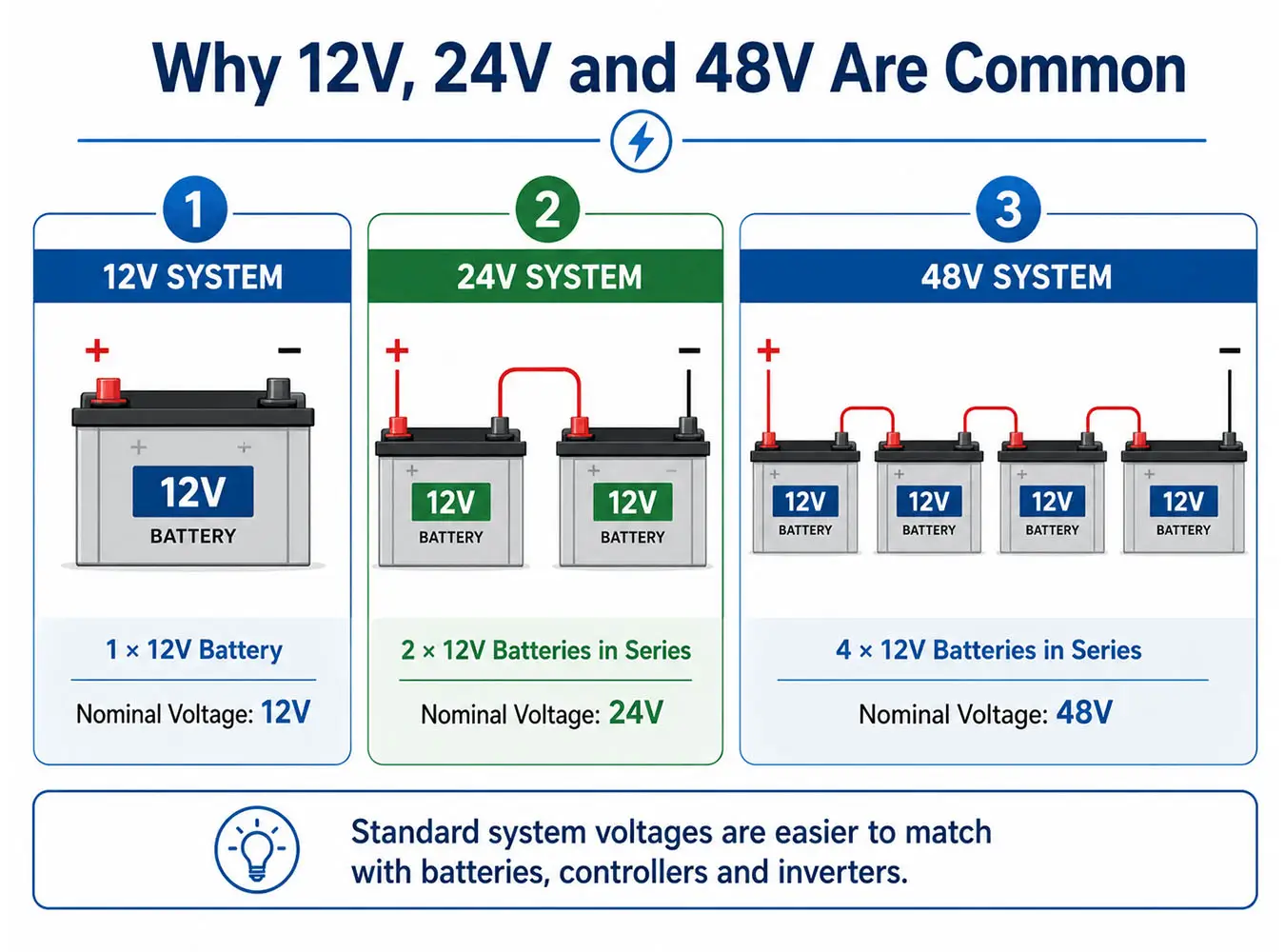
Technically, engineers can design a 30V or 40V wind turbine system. However, these voltages are not common standard system voltages.
A wind turbine system needs more than the turbine itself. It also needs a controller, battery bank, inverter, cable, breaker, fuse, connector and other protection devices. All these parts must match each other.
Many small power systems follow standard battery voltages. For example:
- One 12V battery creates a 12V system.
- Two 12V batteries in series create a 24V system.
- Four 12V batteries in series create a 48V system.
Because of this, 12V, 24V and 48V systems are easier to build. Customers can also find matching batteries, controllers, inverters and protection devices more easily.
By contrast, a 30V or 40V system may require more customization. It may also increase cost, extend production time and make future maintenance harder. For most small wind turbine projects, 24V or 48V makes more sense than 30V or 40V.
Why Is 48V Widely Used in Small Wind Turbine Systems?
48V appears often because it gives a practical balance between safety, efficiency and system cost.
The reason is simple. Under the same power level, higher voltage creates lower current. Lower current helps reduce cable loss, heat and the need for very thick cables.
For example, a 1000W system needs very different current levels at different voltages:
| Power | 12V System | 24V System | 48V System |
|---|---|---|---|
| 1000W | About 83A | About 42A | About 21A |
| 2000W | About 167A | About 83A | About 42A |
| 3000W | About 250A | About 125A | About 63A |
As the table shows, a 12V system can create very high current when power increases. High current creates more heat, increases cable loss and adds pressure to controllers, connectors and protection devices.
A 48V system reduces current significantly. Therefore, many small wind turbine systems in the 1kW to 5kW range use 48V battery and controller configurations.
At the same time, 48V remains easier to manage than higher-voltage systems. This makes it a practical choice for home wind turbine systems, off-grid power systems and wind-solar hybrid systems.
Is 48V Always Exactly 48.00V?
No. 48V is a nominal voltage level. It does not mean the system voltage stays at exactly 48.00V all the time.
In real operation, battery voltage changes during charging and discharging. For example, a 48V lead-acid battery system may move above or below 48V depending on the state of charge. Similarly, a 51.2V lithium iron phosphate battery often belongs to the 48V battery system category.
This is normal. The key point is not whether the voltage stays at exactly 48.00V. Instead, the battery, controller, inverter and protection devices must all work within the correct voltage range.
What Does 1000VDC Mean on a Solar PV Connector?
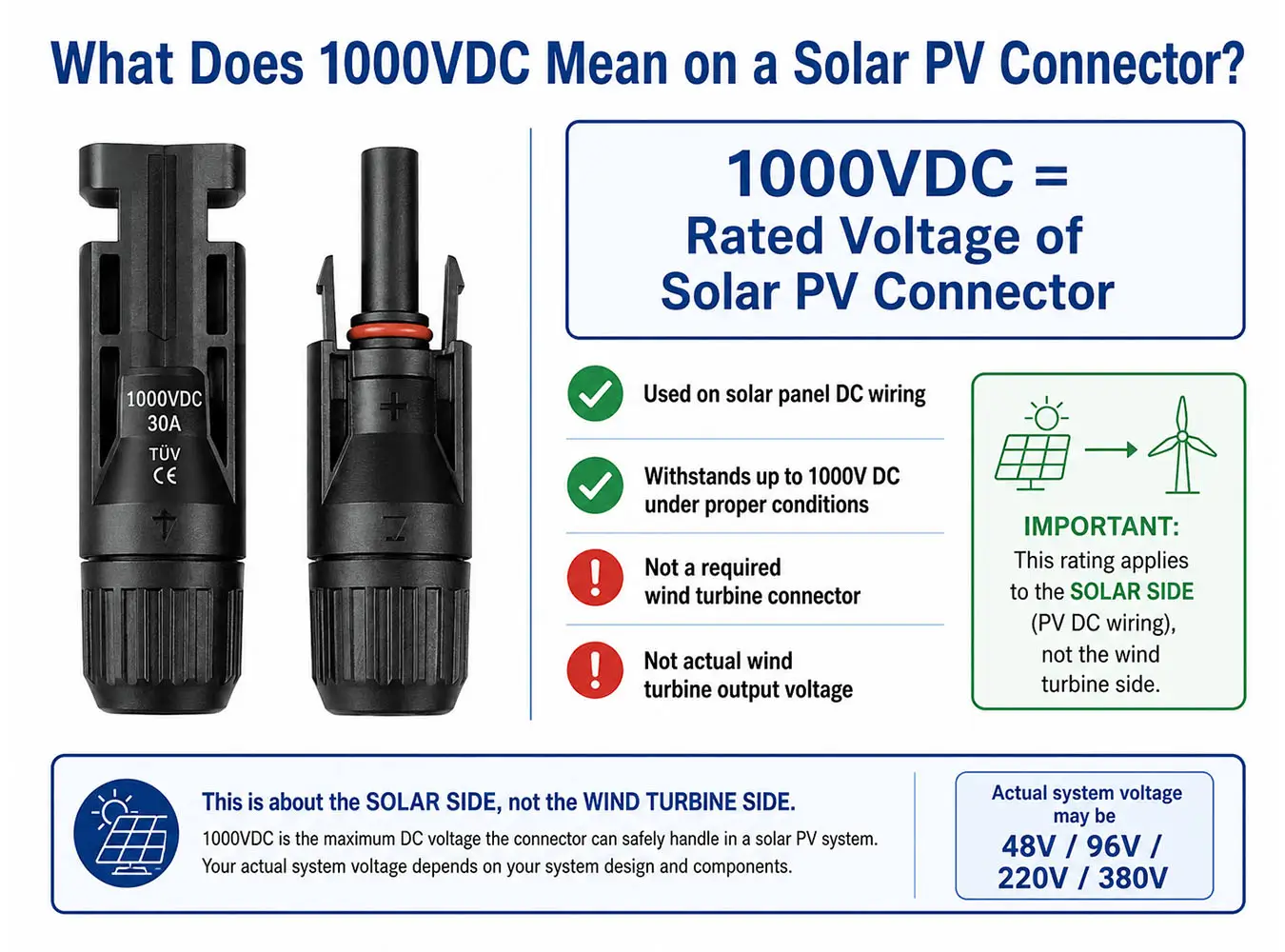
In a wind-solar hybrid system, customers may see 1000VDC on a solar PV connector, PV cable, DC breaker, fuse, surge protection device, or other DC-side component. However, this does not mean the wind turbine itself uses this connector. It also does not mean the wind turbine outputs 1000V.
MC-type or MC4-style connectors mainly serve solar panel DC wiring. Solar installers often connect panels in series, so the PV side may need connectors and protection devices with higher DC rated voltage, such as 1000VDC.
For the wind turbine side, the connection method depends on the turbine model, controller, cable design and system configuration. In most cases, a small wind turbine connects to a wind controller or hybrid controller through its own generator cables. It does not require a standard solar PV connector by default.
In simple terms, 1000VDC on a solar connector means the connector can withstand up to 1000V DC under proper conditions. This number describes the rated voltage of the solar-side component. It does not describe the actual output voltage of the wind turbine.
So the correct understanding is:
- 1000VDC solar PV connector rating means the connector can withstand a high DC voltage on the solar side.
- 48V battery system means the battery side uses a 48V nominal voltage category.
- 220V or 380V AC means the system provides final AC output after conversion.
- Wind turbine output voltage changes with wind speed and controller design.
Therefore, a 1000VDC solar PV connector may appear in a wind-solar hybrid system. But it does not mean the wind turbine side uses that connector, and it does not mean the system works at 1000V.
Rated Voltage vs Working Voltage: What Is the Difference?
Rated voltage and working voltage mean different things.
| Term | Meaning | Example |
|---|---|---|
| Rated Voltage | The maximum voltage a component can safely withstand | 1000VDC solar PV connector |
| Working Voltage | The actual voltage during system operation | 48V battery system |
| Output Voltage | The final usable voltage after conversion | 220V AC or 380V AC |
A simple example can make this easier to understand. If a bridge can support heavy trucks, it does not mean every vehicle on the bridge is a heavy truck. It only means the bridge has enough strength when needed.
In the same way, a 1000VDC solar PV connector does not mean the wind turbine outputs 1000V. It only means the connector has a high voltage rating for safe use on the solar DC side.
Off-Grid vs Grid-Connected Systems: Why Voltage Design Is Different
The right voltage also depends on whether the system works off-grid or connects to the grid.
Off-Grid Wind Turbine Systems
In an off-grid system, the wind turbine usually works with a controller, battery bank and off-grid inverter. The battery side commonly uses DC voltage levels such as 12V, 24V, 48V or 96V.
After storing energy in the battery bank, the inverter converts DC power into AC power for household loads. For example, the final output may be 220V or 230V single-phase AC.
Wind-Solar Hybrid Systems
In a wind-solar hybrid system, the wind turbine and solar panels may enter the same hybrid controller or separate control devices. The final design depends on the system size and project requirements.
On the solar side, PV cables and solar connectors may use ratings such as 1000VDC. On the wind turbine side, the turbine usually connects through generator cables that match the wind controller or hybrid controller. Therefore, customers should not treat a solar PV connector as a required wind turbine connector.
Grid-Connected Wind Turbine Systems
In a grid-connected system, the design follows local grid requirements. The wind turbine works with grid-tied control and inverter equipment. The final output must match local voltage standards, such as 220V, 230V, 380V or 400V AC.
Grid-connected systems also need protection devices, distribution equipment and grid-side safety components. For this reason, voltage selection should follow the complete system design, not only the wind turbine model.
How to Choose the Right Voltage for a Wind Turbine System
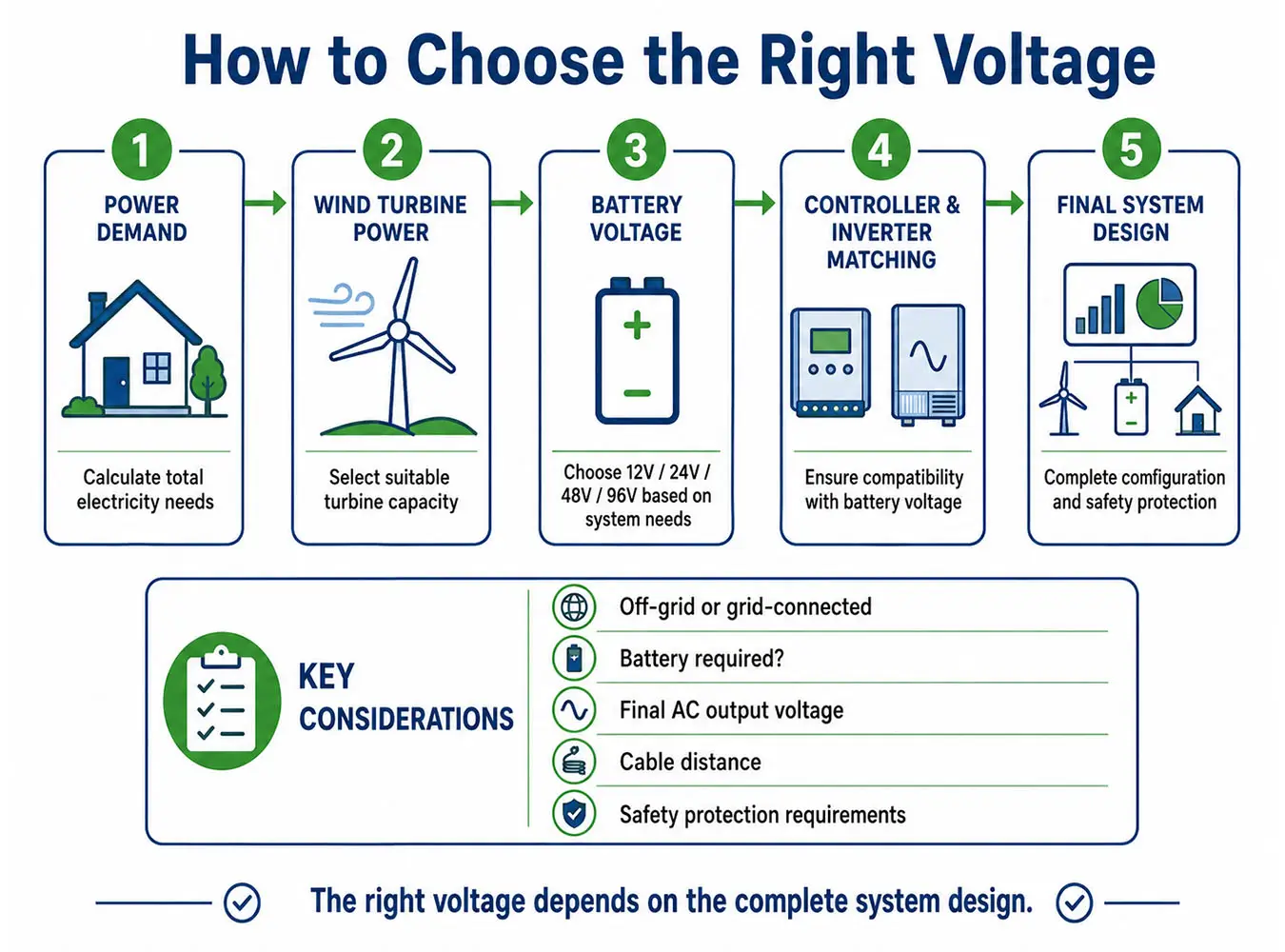
Choosing the right voltage depends on the full system design. Before selecting 12V, 24V, 48V or a higher voltage, customers should review the whole power system.
Important factors include:
- Wind turbine power
- Total power demand
- Battery voltage
- Whether the system needs battery storage
- Controller input and output voltage
- Inverter input voltage
- Final AC output voltage
- Off-grid or grid-connected application
- Whether solar panels are included
- Cable distance
- Local grid voltage
- Safety protection requirements
For very small systems, 12V or 24V may be enough. For many higher-power home wind turbine systems, 48V offers a better balance. Larger off-grid or commercial systems may need higher voltage designs.
However, the best solution is not always the highest voltage. A good system uses the voltage that matches the wind turbine, battery, controller, inverter and customer application safely and efficiently.
Common Questions About Wind Turbine Voltage
Does a 48V wind turbine always output 48V?
No. 48V usually refers to the nominal system voltage. The generator output changes with wind speed and rotor speed. Then the controller manages the power for battery charging or inverter use.
Why not use 30V or 40V?
30V or 40V systems can work in theory. However, batteries, controllers and inverters rarely follow these voltage standards. As a result, non-standard voltage may increase system cost and make matching more difficult.
Is 48V better than 12V?
For higher-power small wind turbine systems, 48V often works better than 12V because it reduces current, cable loss and heat. However, the right choice still depends on system power and application.
Does 1000VDC mean the wind turbine outputs 1000V?
No. 1000VDC usually refers to the rated voltage of a solar PV connector or DC-side component. It does not mean the wind turbine outputs 1000V during normal operation.
Does a wind turbine need an MC4 solar connector?
Not necessarily. MC4-style connectors mainly serve solar panel DC wiring. The wind turbine side usually connects to a wind controller or hybrid controller according to the turbine model, cable design and system configuration.
Can a 1000VDC solar connector appear in a 48V wind-solar hybrid system?
Yes. It may appear on the solar PV side if the connector type, current rating, cable size and system design match the project. However, this does not mean the wind turbine side uses the same connector. It also does not mean the whole system works at 1000V.
What voltage should I choose for a small wind turbine system?
For small systems, 12V or 24V may work. For many 1kW to 5kW wind turbine or wind-solar hybrid systems, 48V is a common choice. For larger systems, engineers should design the voltage according to the complete power system.
Get a Customized Wind Turbine or Wind-Solar Hybrid System
Wind turbine voltage should not be judged by one number alone. A complete system includes the turbine, controller, battery, inverter, cables, connectors and protection devices. If the project includes solar panels, the solar PV side may also need its own connectors and DC protection devices.
At ELEGE, we provide customized wind turbine and wind-solar hybrid system solutions based on real project needs. Whether you need an off-grid wind turbine system, a home wind power solution, or a grid-connected wind-solar hybrid system, our team can help you choose the right voltage and system configuration.
To get a suitable system design, you can share your power demand, local wind conditions, battery requirements, installation site, solar panel requirements and local grid voltage. Then ELEGE can help match the wind turbine, controller, inverter and other system components for safer and more reliable operation.