When choosing a small wind turbine for a home, farm, cabin, or off-grid system, people often have a problem:
Should you choose a 3-blade or 5-blade wind turbine?
At first glance, you might think that the more blades there are, the greater the power generation is bound to be.
But that’s not always the case.
The number of blades affects start-up performance, torque, speed, efficiency, noise, cost, and maintenance requirements.However, the actual amount of electricity generated does not depend only on the number of blades.
You’ll also need to consider local wind conditions, installation height, rotor diameter, generator efficiency, controller matching, and actual power demand.
This guide will provide a detailed comparison of 3-blade and 5-blade wind turbines from multiple dimensions such as structure, performance, cost, and application scenarios.
1. What Is a 3-Blade Wind Turbine?
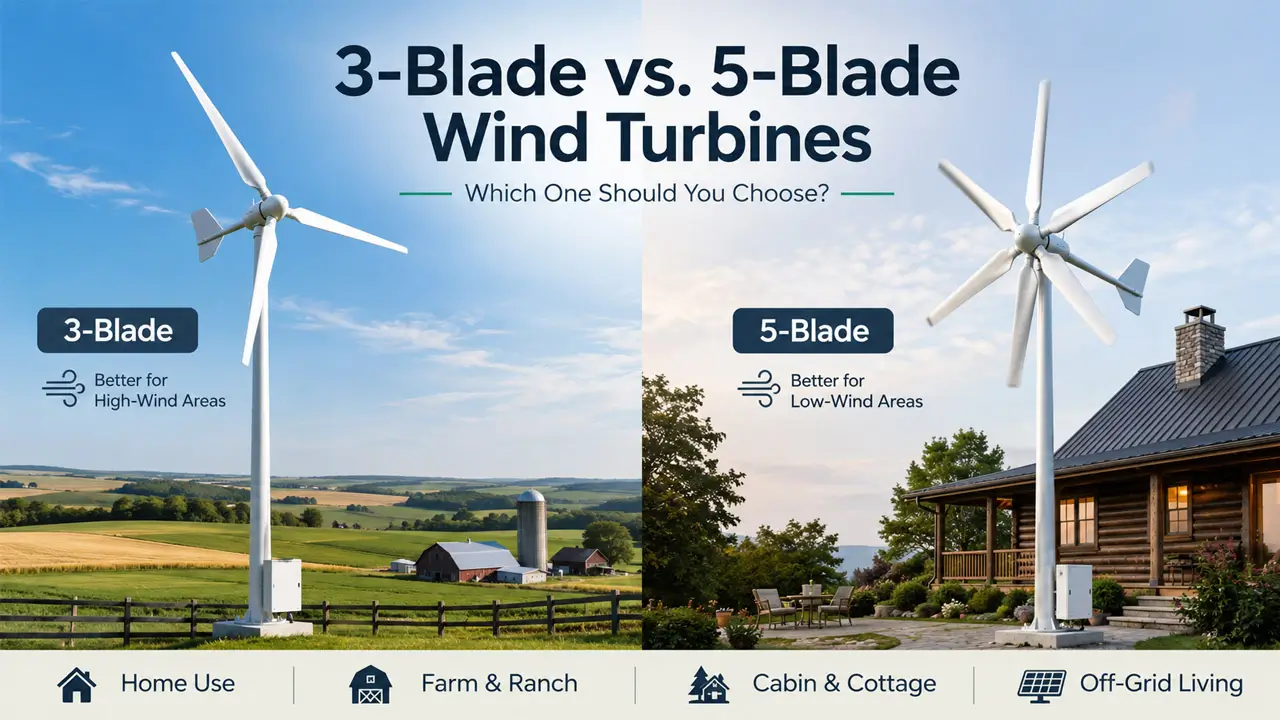
Three-blade wind turbines utilize three rotor blades to capture wind energy and drive the generator.
This is one of the most common wind turbine designs today and is widely used in large horizontal axis wind turbines, wind farms, and many small wind power systems.
The main advantages of the three-blade design are good balance, mature structure, stable operation and high overall efficiency.
Due to the small number of blades, three-blade wind turbines usually produce less air resistance when rotating, which helps the rotor to reach a higher rotational speed under suitable wind conditions.
For you, a three-blade wind turbine may be a more ideal choice if the installation site is wind stable and the site is open.
It is often suitable for:
| Application | Why It Works |
|---|---|
| Farms | Open land usually provides better wind conditions. |
| Rural homes | Suitable for off-grid or hybrid power systems. |
| Open areas | Less turbulence helps the turbine run more steadily. |
| Coastal areas | Stronger and more stable wind supports better efficiency. |
| Long-term projects | A simpler structure makes maintenance easier. |
If you want a mature, efficient, and easy-to-maintain wind turbine, a 3-blade design is usually a reliable option.
2. What Is a 5-Blade Wind Turbine?
A 5-blade wind turbine uses five rotor blades.
Compared with a 3-blade design, a 5-blade turbine has more blade surface area. This helps it generate higher starting torque, especially in low wind speed conditions.
For you, this can be useful if your project site does not have strong or stable wind.
A 5-blade wind turbine may start rotating earlier in weak wind. It may also look smoother when running at lower speeds.
That is why some small home wind power systems, cabins, courtyards, and low-wind-speed projects may use a 5-blade design.
However, more blades also bring some trade-offs.
A 5-blade wind turbine usually has more air resistance, more weight, more balance requirements, and higher manufacturing and maintenance costs.
So, you should not choose a 5-blade wind turbine only because it has more blades.
It is better suited for specific low-wind-speed applications.
3. Starting Torque and Low Wind Speed Performance
Starting torque is the force needed to make the wind turbine start rotating.
If your site has weak wind, starting torque becomes very important.
In this area, a 5-blade wind turbine usually has an advantage. Because it has more blades, it can capture more wind at low speed and help the rotor start earlier.
This can be helpful if you install the turbine in:
| Application Scenario | Why Starting Torque Matters |
|---|---|
| Low wind speed areas | The turbine needs to start in weak wind. |
| Cabins | Wind conditions may not be stable. |
| Small off-grid systems | Earlier start-up can support charging more often. |
| Courtyards | Wind may be blocked by buildings or trees. |
| Farms with uneven terrain | Wind direction and speed may change often. |
A 3-blade wind turbine usually depends more on stable wind conditions.
It may not start as early as a 5-blade turbine in weak wind. However, once the wind speed reaches the proper range, it can usually rotate faster and operate more efficiently.
In simple terms:
| Blade Type | Main Advantage |
|---|---|
| 5-blade wind turbine | Better low wind speed start-up |
| 3-blade wind turbine | Better efficiency under stable wind |
So, if your wind speed is often low, you may consider a 5-blade turbine. If your wind conditions are stable and open, a 3-blade turbine may give you better overall performance.
4. Rotational Speed and Power Generation Efficiency
A 3-blade wind turbine usually rotates faster.
This is because three blades create less drag than five blades. When the wind speed is medium to high, the rotor can reach a higher rotational speed more easily.
For many small wind generators, proper rotational speed helps improve power generation efficiency.
A 5-blade wind turbine usually rotates more slowly.
It may run smoothly at low speed, but when the wind becomes stronger, the extra blades create more resistance. This may limit further acceleration and reduce high-speed efficiency.
So, if your site has good wind resources, a 3-blade wind turbine is usually more likely to show stronger efficiency.
But this does not mean a 5-blade wind turbine is useless.
If your project site has low wind speed for a long time, a 5-blade design may help the turbine enter operation more often.
The real question is not simply:
Which turbine has more blades?
The better question is:
Does this wind turbine match your wind conditions, installation environment, and electricity demand?
5. Actual Power Generation
More blades do not automatically mean more electricity.
This is one of the most common misunderstandings when you choose a small wind turbine.
A 5-blade wind turbine may start earlier, but it also creates more air resistance.
A 3-blade wind turbine may need better wind conditions to start efficiently, but once the wind speed is suitable, it can often run faster and generate power more efficiently.
Your actual power generation mainly depends on these factors:
| Factor | Why It Matters |
|---|---|
| Average wind speed | More stable wind helps the turbine generate power continuously. |
| Rotor diameter | A larger swept area allows the turbine to capture more wind energy. |
| Blade design | Blade shape and material affect efficiency and noise. |
| Generator efficiency | Poor generator matching can waste wind energy. |
| Controller efficiency | The controller affects charging, braking, and system protection. |
| Tower height | A proper tower helps avoid ground-level turbulence. |
| Installation environment | Buildings, trees, and terrain can affect wind quality. |
| Battery and inverter | Off-grid systems need energy storage and stable power output. |
So, when you compare 3-blade and 5-blade wind turbines, you should not only ask which one has more blades.
You should ask:
Is this turbine suitable for my local wind?
Is this system suitable for my daily electricity needs?
Can this turbine work with my controller, battery, inverter, and tower?
These questions are more important than blade quantity alone.
6. Noise and Operating Stability
Noise is not decided only by the number of blades.
A 5-blade wind turbine may look smoother because it usually rotates at a lower speed. In some small wind power applications, lower rotational speed may also reduce sudden vibration and make the turbine look more stable.
However, a well-designed 3-blade wind turbine can also run quietly.
If you care about noise, you should look at the whole turbine design, not only the blade number.
Noise can be affected by:
| Factor | Impact |
|---|---|
| Blade shape | Poor blade design can create more wind noise. |
| Rotor speed | Higher speed may increase noise if not controlled well. |
| Blade material | Better materials can improve stability and reduce vibration. |
| Bearing quality | Poor bearings can cause mechanical noise. |
| Generator structure | A good generator helps the turbine run more smoothly. |
| Tower vibration | Weak tower design may increase noise and shaking. |
| Installation location | Rooftops, walls, and nearby buildings can reflect sound. |
| Distance from the house | More distance usually reduces noise impact. |
If you plan to install a wind turbine near your home, courtyard, roof, or small business space, you should focus on overall design, installation height, and surrounding obstacles.
Do not judge noise only by whether the turbine has 3 blades or 5 blades.
7. Cost and Maintenance
A 3-blade wind turbine is usually more cost-effective.
It uses fewer blades, fewer fasteners, and less material. The whole structure is simpler, which can reduce manufacturing cost, transportation cost, installation difficulty, and maintenance work.
For you, this means a 3-blade wind turbine may be easier to install and maintain in long-term use.
A 5-blade wind turbine usually costs more because it has more parts.
More blades also mean more components to inspect later, such as blade connection points, balance condition, bolts, and fasteners.
For small wind power systems, this maintenance work is not always difficult. However, from a long-term use perspective, a simpler structure is usually easier to manage.
If you want a wind turbine that is simple, stable, and easier to maintain, a 3-blade design is often the better choice.
If your site has low wind speed and you care more about start-up performance, a 5-blade design can also be worth considering.
8. 3-Blade and 5-Blade Wind Turbines: Quick Comparison
| Comparison Factor | 3-Blade Wind Turbine | 5-Blade Wind Turbine |
|---|---|---|
| Starting performance | Good | Usually better in low wind speeds |
| Starting torque | Relatively lower | Relatively higher |
| Rotational speed | Usually faster | Usually slower |
| Efficiency | Higher in stable wind conditions | Better for low-speed operation |
| Air resistance | Lower | Higher |
| Operating performance | Performs well at medium and high wind speeds | Runs smoothly at low speeds |
| Cost | Usually lower | Usually higher |
| Maintenance | Simpler | More parts to inspect |
| Suitable wind conditions | Stable wind, medium to high wind speed | Low wind speed, unstable wind |
| Suitable applications | Farms, open areas, off-grid systems | Cabins, courtyards, low-wind areas |
9. When Should You Choose a 3-Blade Wind Turbine?
You should consider a 3-blade wind turbine if you want a good balance between efficiency, cost, and long-term reliability.
When your installation site has relatively stable wind speed and open space, a 3-blade design can usually perform better.
It can often reach higher rotational speed and deliver better overall power generation efficiency.
A 3-blade wind turbine is especially suitable if you have:
| Application Scenario | Why It Is Suitable |
|---|---|
| Farm | Open space usually provides more stable wind. |
| Rural home | Suitable for off-grid or hybrid power systems. |
| Open land | Less turbulence allows the turbine to run steadily. |
| Coastal area | Good wind resources support efficient operation. |
| Wind-solar hybrid system | Works well with solar panels, batteries, and inverters. |
| Long-term project | Simple structure makes maintenance easier. |
If you want a mature, stable, and easy-to-maintain turbine with good overall efficiency, a 3-blade wind turbine is usually a reliable choice.
10. When Should You Choose a 5-Blade Wind Turbine?
You should consider a 5-blade wind turbine if your main problem is low wind speed.
Because it has more blades, a 5-blade wind turbine can usually generate higher starting torque in weak wind conditions.
This can help the turbine start rotating earlier when the wind is not strong.
A 5-blade wind turbine may be more suitable if your project is in:
| Application Scenario | Why It Is Suitable |
|---|---|
| Low wind speed area | Easier to start in weak wind. |
| Small home power system | Better for low-speed operation. |
| Cabin power supply | Helpful when wind conditions are unstable. |
| Courtyard installation | More focused on smooth low-speed running. |
| Micro off-grid system | Can work as a supplement to solar power. |
| Area with frequent wind changes | Easier to enter operation when wind is weak. |
However, you should remember that 5 blades do not automatically mean better performance.
Before you choose a 5-blade wind turbine, you still need to check the rated power, start-up wind speed, rated wind speed, rotor diameter, generator type, installation height, and controller matching.
Only when the turbine truly matches your local wind conditions and power demand is it the right choice.
Summary
The difference between 3-blade and 5-blade wind turbines is mainly a trade-off between efficiency, speed, starting torque, cost, and installation environment.
A 3-blade wind turbine is generally better for stable wind conditions, open installation areas, and long-term use. It has a simple structure, lower air resistance, faster rotational speed, and advantages in cost and maintenance.
A 5-blade wind turbine is generally more suitable for low wind speed areas. It can provide higher starting torque, start more easily in weak wind, and run more smoothly at low speed.
For your home, farm, cabin, or off-grid power system, the best wind turbine is not always the one with more blades.
The best choice is the turbine that fits your real wind conditions, installation environment, and electricity needs.
FAQ
1. What wind data should you collect before choosing a wind turbine?
You should check your average wind speed, main wind direction, seasonal wind changes, nearby obstacles, and wind conditions at the planned tower height.
2. Can you install a small wind turbine directly on your roof?
Not always. Rooftops often have turbulence, vibration, and noise risks. You should check roof structure, fixing method, and safety distance first.
3. Do you need a higher-power wind turbine in a low-wind-speed area?
Not necessarily. In low-wind areas, you should focus more on start-up wind speed, rotor diameter, generator matching, and tower height.
4. What should you confirm with the supplier?
You should confirm rated power, start-up wind speed, rated wind speed, blade material, rotor diameter, generator type, controller, voltage, tower, and warranty.
5. Is buying only the wind turbine enough for your off-grid system?
Usually not. Your off-grid system also needs a controller, battery, inverter, tower, cables, dump load, and protection devices.