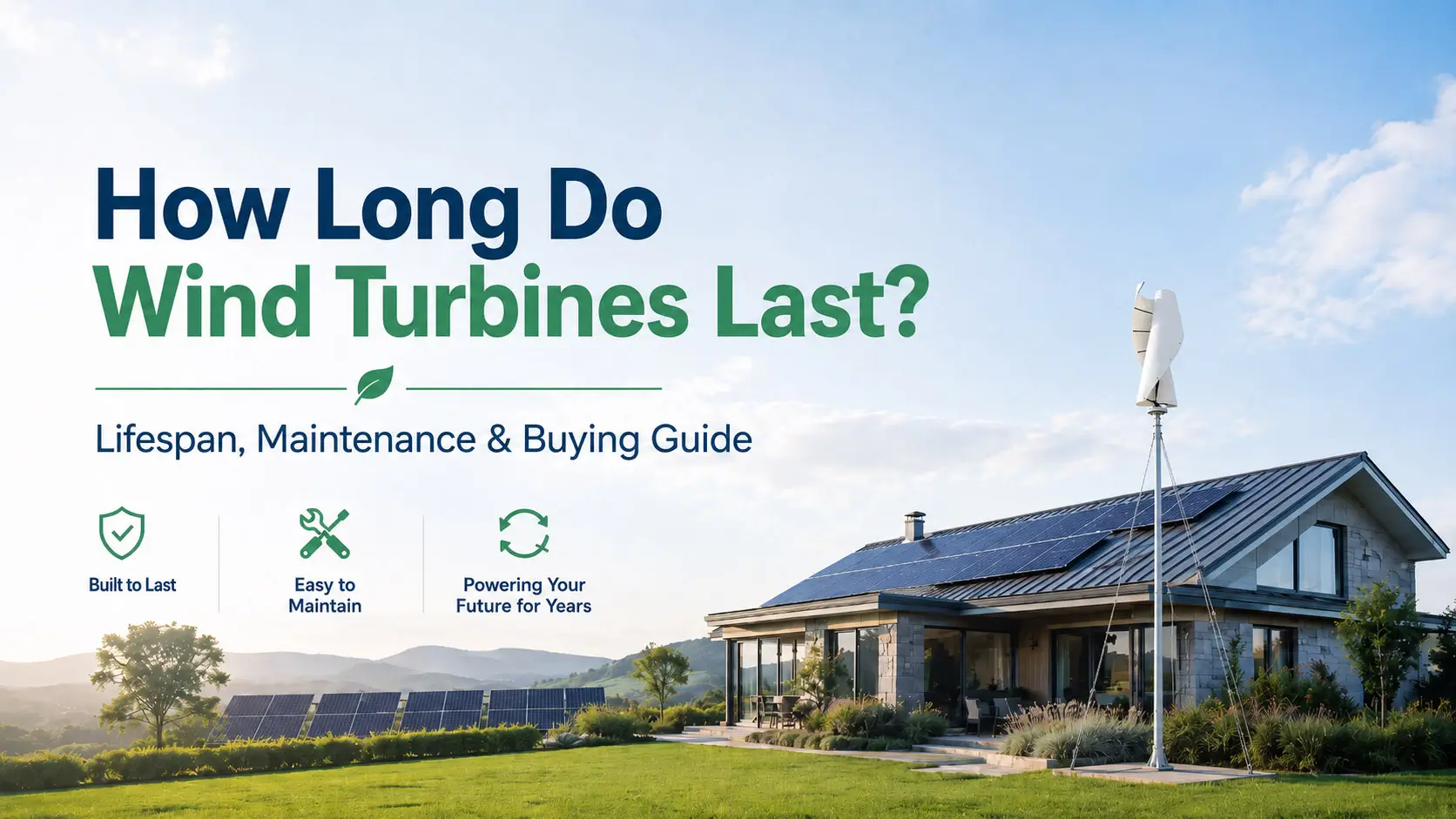
If you are asking how long do wind turbines last, the simple answer is that most well-built wind turbines can work for many years. In many utility-scale projects, wind turbines are expected to serve around 20 to 30 years. However, the real lifespan depends on turbine type, local wind conditions, blade material, generator quality, controller protection, installation, and regular maintenance.
Source: U.S. Department of Energy WINDExchangeFor small wind turbines used in homes, farms, gardens, and off-grid systems, lifespan should not be judged by the turbine alone. Instead, buyers should look at the complete wind power system, including the turbine, blades, generator, controller, inverter, battery, tower, cables, and protection devices.Therefore, a long-lasting wind turbine is not only about high rated power. It is also about proper system matching, safe installation, and long-term protection.
How Long Do Wind Turbines Usually Last?
A well-designed wind turbine can usually last 20 to 30 years under suitable conditions.
However, small wind turbines depend more heavily on local wind speed, material quality, installation environment, controller protection, and maintenance.
For example, the EV vertical axis wind turbine is designed for
20+ years of service life under proper installation and regular maintenance.
Wind Turbine Lifespan by Component
A wind turbine system does not age as one single product. Instead, every part has its own service life. As a result, some structural parts may last for decades, while some electrical or mechanical parts may need earlier inspection or replacement.
| Component | Typical Lifespan | What Affects It |
|---|---|---|
| Tower | 20–30+ years | Foundation, corrosion protection, installation quality |
| Blades | 10–20+ years | UV, salt, sand, ice, wind load, blade material |
| Generator | 10–20+ years | Coil quality, heat control, bearing structure |
| Bearings | 5–15 years | Lubrication, wind load, vibration, maintenance |
| Controller | 5–10+ years | Overload protection, braking, heat, wiring |
| Inverter | 5–15 years | Load, heat dissipation, battery matching |
| Battery System | 5–15 years | Battery type, cycle life, temperature |
| Cables and Connectors | 5–15+ years | Waterproofing, cable size, UV protection, corrosion |
Therefore, the better question is not only how long does a wind turbine last. Instead, buyers should also ask how long the whole wind power system can work reliably.
Do Small Wind Turbines Last as Long as Large Wind Turbines?
Large wind turbines used in wind farms are usually designed, monitored, and maintained by professional operation teams. In addition, their towers, foundations, blades, generators, and control systems are inspected regularly.
Meanwhile, small wind turbines are different. They are often installed on homes, farms, remote houses, gardens, islands, or wind-solar hybrid systems. Therefore, the small wind turbine lifespan depends more on site conditions and system matching.
For example, a small wind turbine installed in smooth open wind may last longer than the same turbine installed behind trees, walls, or buildings. In addition, a properly matched controller and inverter can reduce system stress and improve long-term reliability.
- Local average wind speed
- Tower height
- Wind turbulence
- Blade material
- Generator design
- Controller protection
- Battery and inverter matching
- Installation quality
- Maintenance habits
As a result, a small wind turbine can last a long time, but only when it is selected as part of a complete system.
The Real Divide: Wind Condition, Component Quality, and Protection System
The real lifespan difference comes from three things: wind condition, component quality, and protection system.
If one of these is ignored, even a good wind turbine may not perform well. However, if all three are handled correctly, the turbine can work more smoothly and last longer.
Wind Condition
Stable wind helps reduce vibration and mechanical stress. However, strong gusts and turbulent rooftop wind can shorten turbine service life.
Component Quality
In addition, blade material, generator design, bearings, tower structure, and corrosion protection all affect long-term durability.
Protection System
Therefore, a reliable wind turbine controller helps protect the turbine from over-speed, over-voltage, and battery overcharging.
1. Wind Conditions Affect Wind Turbine Lifespan
Wind conditions are one of the biggest factors affecting wind turbine lifespan. Stable wind is usually better for long-term operation because it reduces sudden vibration and mechanical stress.
However, strong gusts, frequent direction changes, and turbulent rooftop wind can increase stress on blades, bearings, towers, and generators. Therefore, for home and small off-grid projects, average wind speed matters more than one strong wind day.
Before installing a wind turbine, users should check local wind resources. For example, the Global Wind Atlas provides wind data such as mean wind speed and mean wind power density, which can help users understand whether a site is suitable for wind power.
Source: Global Wind Atlas
For low-wind or changing wind conditions, low start-up wind speed is important. The EV vertical axis wind turbine starts at 1.3 m/s. As a result, it can respond to light wind and unstable wind conditions more easily.
In addition, its vertical axis structure can capture wind from multiple directions. Therefore, it is suitable for homes, gardens, farms, remote sites, and wind-solar hybrid systems.
2. Blade and Body Material Matter
Blades are exposed to wind, rain, sunlight, dust, salt, and temperature changes every day. Therefore, poor blade material can crack, deform, or age faster outdoors.
For long service life, blade and body materials should resist UV exposure, rain, snow, salt spray, sand, dust, high wind pressure, temperature changes, and long-term vibration.
The EV wind turbine uses glass/basalt body material and a 2-piece blade design. In addition, this material choice supports long-term outdoor use and helps improve durability in home, farm, and off-grid environments.
Lower vibration also matters. Because less vibration can reduce long-term stress on the turbine structure, tower, bearings, and fasteners, better material design can help improve the total wind turbine service life.
3. Generator Quality Is the Heart of the Turbine
The generator is the heart of a wind turbine. If the generator is poorly designed, it may overheat, produce unstable output, or wear faster under changing wind conditions.
Therefore, a good generator should provide stable output, low resistance, and reliable long-term operation. In addition, it should match the controller, battery voltage, and system application.
The EV wind turbine uses a coreless 3-phase AC generator. As a result, this design supports smoother power generation and is suitable for small wind systems, home projects, and wind-solar hybrid applications.
When comparing small wind turbines, buyers should not only look at rated power. Instead, they should also check generator type, coil material, heat dissipation, bearing structure, output voltage, controller matching, and protection method.
Therefore, a turbine with high rated power but poor generator quality may not be a better long-term investment.
4. Controller Protection Helps Prevent Early Damage
A wind turbine needs a reliable control system to protect it from over-speed, over-voltage, overload, and battery overcharging. This is especially important for small wind turbines because wind cannot be turned off like solar input.
When the battery is full or wind speed suddenly increases, the turbine still needs a safe way to control energy. Otherwise, the generator, controller, blades, or battery system may be damaged.
Therefore, a reliable wind turbine controller helps manage charging, braking, and dump load protection. For long-term system safety, users should match the correct controller according to turbine power, battery voltage, and system type.
In addition, the EV wind turbine uses an electromagnetic control system, which helps support safer turbine operation under changing wind conditions.
5. Inverter and Battery Matching Affect System Life
For home and off-grid systems, the turbine is only one part of the power system. Therefore, the inverter and battery also affect long-term performance.
The inverter converts stored battery power into usable electricity for household or project loads. However, if the inverter is undersized, overloaded, or poorly matched with the battery system, it can create system instability and shorten equipment life.
For a complete wind power system, users should check turbine rated voltage, battery voltage, inverter power, load type, controller capacity, off-grid or hybrid system design, and solar input requirements.
As a result, a properly matched wind turbine inverter helps the whole system work more smoothly, especially for homes, farms, cabins, and remote power projects.
6. Installation Quality Can Extend or Shorten Service Life
Installation quality can directly affect how long a wind turbine lasts. For example, a turbine installed at the wrong height, behind obstacles, or on an unstable structure may face more turbulence and vibration.
As a result, poor installation can reduce power output and increase mechanical wear. Therefore, buyers should pay attention to tower height, tower foundation, guyed tower or independent tower design, bolt tightening, cable protection, grounding, lightning protection, distance from buildings, rooftop vibration control, and maintenance access.
The EV wind turbine supports guyed tower and independent tower installation options. Therefore, users can choose a suitable tower form based on project location and site conditions.
7. Temperature and Outdoor Environment
Outdoor temperature also affects wind turbine service life. For example, electrical parts, bearings, cables, and batteries can all be affected by extreme heat or cold.
The EV wind turbine is designed for a working temperature range of -40°C to +80°C. As a result, it is suitable for a wide range of outdoor environments.
In addition, corrosion resistance is important for coastal, island, or high-humidity areas. Because salt spray can damage metal parts, bolts, connectors, and exposed hardware, buyers should ask suppliers about surface treatment, hardware quality, and corrosion protection before ordering.
Designed for Long-Term Outdoor Use
EV Vertical Axis Wind Turbine
The EV vertical axis wind turbine is designed for home, farm, garden, and off-grid wind-solar hybrid systems.
In addition, with a 1.3 m/s start-up wind speed and 20+ years designed service life, it is suitable for low-wind and changing wind conditions.
EV Wind Turbine Specifications for Long-Term Use
The EV vertical axis wind turbine is designed for low-wind power generation, quiet operation, stable output, and wind-solar hybrid energy systems. Therefore, it can be used in homes, gardens, farms, villas, remote sites, off-grid systems, wind-solar hybrid systems, and small commercial projects.
| Model | Rated Power | Maximum Power | Rated Voltage | Start-Up Wind Speed | Rated Wind Speed |
|---|---|---|---|---|---|
| EL-EV-500W | 500W | 550W | 12/24V | 1.3 m/s | 10 m/s |
| EL-EV-1000W | 1000W | 1100W | 12/24V | 1.3 m/s | 10 m/s |
| EL-EV-1500W | 1500W | 1650W | 12/24/48V | 1.3 m/s | 11 m/s |
| EL-EV-2000W | 2000W | 2200W | 24–220V | 1.3 m/s | 11 m/s |
- 2-piece blade design
- Glass/basalt body material
- Coreless 3-phase AC generator
- Electromagnetic control system
- Automatic windward angle
- Self-lubrication
- Guyed tower or independent tower
- Working temperature from -40°C to +80°C
- Designed service life of 20+ years under proper installation and maintenance
As a result, these features make the EV series suitable for buyers who want a small wind turbine for long-term home, farm, or off-grid use.
Real Home Installation: Why System Matching Matters
One customer installed an EV vertical axis wind turbine at his own home to support daily household power needs.
However, for this type of home project, the key is not only turbine power. The whole system must match the local wind condition, installation height, controller, inverter, battery, and expected load.
In many cases, a smaller but properly matched wind turbine can perform better than an oversized turbine installed in the wrong place. Therefore, a stable tower, proper controller protection, and suitable inverter matching can help reduce vibration, improve safety, and extend the service life of the system.
This case also shows why home users should not buy a wind turbine based only on rated power. Instead, they should choose a complete system according to wind speed, location, battery voltage, and daily electricity demand.
How to Make a Wind Turbine Last Longer
A wind turbine can last longer when it is selected, installed, and maintained correctly. Therefore, buyers should focus on the whole system instead of only the turbine body.
Choose the Right Turbine for Your Wind Conditions
First, do not choose a wind turbine only by rated power. For example, a 2000W turbine will not perform well if the local wind resource is too weak or the tower is too low.
Before buying, check average wind speed, common wind direction, obstacles around the site, tower height, local weather conditions, coastal corrosion risk, and off-grid or hybrid system needs.
Use the Right Controller and Dump Load
Next, choose the correct controller. A controller protects the turbine and battery system, so it should match the turbine power, voltage, and battery type.
In addition, controller protection is very important because wind cannot be turned off like solar input. When the wind continues to blow, the system needs proper braking or dump load protection.
Otherwise, a weak or undersized controller can shorten the life of the turbine and battery system.
Match the Inverter Correctly
After that, match the inverter correctly. A wind turbine system often powers household appliances, farm equipment, lighting, monitoring equipment, or off-grid loads through an inverter.
Therefore, the inverter should match battery voltage, load power, surge power, system type, controller output, and off-grid or hybrid design.
Install the Turbine at the Right Height
In addition, install the turbine at the right height. Wind is usually stronger and cleaner at a higher position. However, if the turbine is installed too low or too close to buildings, trees, or walls, it may face turbulent wind.
As a result, turbulence can cause lower power output, more vibration, more noise, faster bearing wear, and higher blade stress. Therefore, a proper tower helps the turbine capture smoother wind and work more reliably.
Inspect Blades, Bolts, Bearings, and Cables Regularly
Finally, regular inspection can prevent small problems from becoming expensive failures.
| Maintenance Item | Suggested Check |
|---|---|
| Blades | Every 3–6 months |
| Bolts and Tower | Every 3–6 months |
| Bearings | Every 6–12 months |
| Controller and Wiring | Every 6 months |
| Battery System | Monthly or quarterly |
| Full System Inspection | Once a year |
For coastal or high-humidity areas, corrosion checks should be more frequent.
NREL notes that better reliability prediction and proactive maintenance can help reduce operation and maintenance costs and extend gearbox life in wind systems. Although small wind turbines are different from utility-scale geared turbines, the same basic idea applies: early inspection helps prevent larger failures.
Source: NREL
When Should a Wind Turbine Be Repaired or Replaced?
A wind turbine does not always fail suddenly. Instead, most systems show warning signs before serious damage happens.
- Power output drops obviously
- Turbine vibration increases
- Blades show cracks or deformation
- Noise becomes louder
- Controller alarms frequently
- Bearing noise appears
- Battery cannot charge properly
- Tower bolts become loose
- Cables or connectors show corrosion
- Braking system does not respond normally
If the turbine is old and repair costs are high, replacing major components or upgrading the system may be more practical than repeated repairs.
Is a Cheaper Wind Turbine Worth It?
A cheap wind turbine may look attractive at first. However, low initial cost does not always mean lower long-term cost.
For example, low-quality turbines may use weak blade material, poor generator design, unstable output, small bearings, poor corrosion resistance, undersized controllers, limited protection functions, and shorter actual service life.
As a result, a better wind turbine may cost more at the beginning, but it can reduce maintenance, replacement, and system failure costs over time.
Therefore, for long-term projects, buyers should compare total cost of ownership instead of only unit price.
How to Choose a Wind Turbine for Long-Term Use
If you want a wind turbine that lasts longer, use this checklist before buying.
- Check your average wind speed.
- Confirm your installation location.
- Choose the right turbine power.
- Compare blade and body materials.
- Check the generator type.
- Match the right controller.
- Match the correct inverter and battery.
- Choose a suitable tower height.
- Consider corrosion, temperature, and weather.
- Ask for technical support and system matching.
In other words, a reliable supplier should not only sell a turbine. They should help you match the turbine, controller, inverter, battery, tower, and solar input if needed.
FAQs About Wind Turbine Lifespan
How long do wind turbines last?
Most wind turbines can last many years, and utility-scale wind turbines are often expected to serve around 20 to 30 years. However, actual lifespan depends on turbine type, wind conditions, material quality, installation, protection system, and maintenance.
Can a small wind turbine last 20 years?
Yes, a small wind turbine can last 20 years or more if it uses durable materials, a reliable generator, proper controller protection, and correct installation. In addition, regular inspection and correct system matching are also important.
How long do wind turbine blades last?
Wind turbine blades can last many years. However, their lifespan depends on material quality, UV exposure, salt spray, sand, ice, strong wind, and vibration. Therefore, blade condition should be checked regularly.
What part of a wind turbine fails first?
Common early-wear parts include bearings, blades, controllers, cables, and electrical components. These parts face mechanical stress, weather exposure, heat, vibration, and changing wind conditions.
How often should a wind turbine be maintained?
A small wind turbine should be visually checked every few months. In addition, a full system inspection should be done at least once a year. Blades, bolts, tower, controller, cables, batteries, and grounding should all be inspected.
Does wind speed affect wind turbine lifespan?
Yes. Stable wind is usually better for turbine lifespan. However, strong gusts, turbulent wind, and frequent wind direction changes can increase stress on blades, bearings, towers, and generators.
Is a vertical axis wind turbine good for long-term home use?
A vertical axis wind turbine can be a good option for home use when the site has changing wind directions or limited installation space. However, it still needs proper tower height, controller protection, inverter matching, and regular maintenance.
Choose a Wind Turbine Built for Long-Term Use
So, how long do wind turbines last? In short, a well-designed turbine can last for decades.
However, the real service life depends on wind conditions, materials, generator quality, protection system, installation, and maintenance.
Therefore, before choosing a wind turbine, send us your installation location, average wind speed, required power, battery voltage, and system type.
Our team can help you match the right EV wind turbine, controller, inverter, battery, and tower for your project.