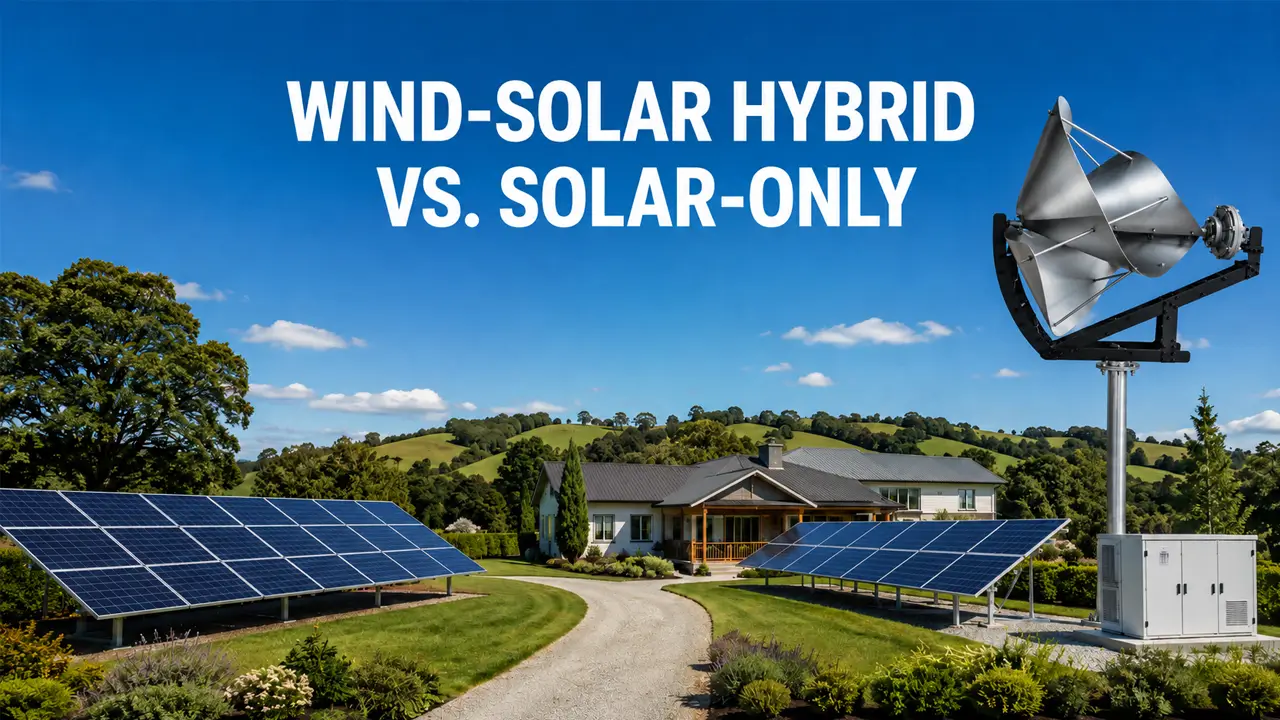
A solar-only system generates electricity from sunlight. A wind-solar hybrid system adds a wind turbine, allowing the project to use two renewable energy sources.
Wind power can continue contributing at night, during cloudy weather, or in seasons with lower solar production. This gives a hybrid system a wider potential generation window.
However, adding a wind turbine only makes sense when the site has useful wind. In a sunny location with weak or highly turbulent wind, expanding the solar array may be more practical.
Quick answer: Choose a wind-solar hybrid system when your site has both usable wind and solar resources. Choose solar-only when sunlight is strong, wind is weak, or you want a simpler system with lower initial costs.
What Are Wind-Solar Hybrid and Solar-Only Systems?
Both configurations can be grid-connected, off-grid, or combined with battery storage. The main difference is the number of energy sources.
Wind-Solar Hybrid System
A wind-solar hybrid system combines a wind turbine with solar panels. It may also include controllers, an inverter, battery storage, a dump load, protection devices, and a turbine tower or mounting structure.
Solar panels generate electricity when sunlight is available. The wind turbine generates power whenever the wind reaches an effective operating speed. The two sources may operate together or at different times.
A properly designed wind and solar hybrid system matches all components to the local wind, sunlight, installation site, and electricity demand.
Solar-Only System
A solar-only system uses photovoltaic panels as its only renewable generation source.
Grid-connected systems can supply local loads and may export surplus electricity where local regulations allow. Off-grid and battery-backed systems store excess solar power for use at night or during periods of low sunlight.
Solar-only systems use fewer components and no rotating generation equipment. This generally makes them easier to install and maintain.
Wind-Solar Hybrid vs. Solar-Only: Quick Comparison
| Factor | Wind-Solar Hybrid System | Solar-Only System |
|---|---|---|
| Energy source | Wind and solar | Solar only |
| Generation time | Sunny and windy periods | Daylight hours |
| Night generation | Possible with sufficient wind | No direct generation |
| Initial cost | Usually higher | Usually lower |
| System complexity | More equipment and controls | Simpler configuration |
| Installation | Requires suitable wind and solar locations | Requires unshaded panel space |
| Maintenance | Turbine and solar equipment | Mainly panels and electrical equipment |
| Best suited to | Sites with useful wind and sunlight | Sunny sites with limited wind |
Key Differences Between Wind-Solar Hybrid and Solar-Only Systems
1. Generation Time and Seasonal Performance
Solar production follows the sun. It starts after sunrise, rises during the day, and stops after sunset. Clouds, shading, temperature, and seasonal daylight hours affect the amount of electricity produced.
Wind follows a different pattern. A turbine may generate during the day or night whenever sufficient wind is available.
At some locations, wind is stronger at night or during months with lower solar production. In these conditions, wind and solar can complement each other. Local resource data should confirm whether this pattern applies to your site.
2. Actual Energy Output
A wind-solar hybrid system has the potential to produce more electricity because it uses two sources. Actual output still depends on the available resources.
Important factors include solar irradiance, shading, average wind speed, wind distribution, tower height, rotor size, and equipment power curves.
Important: A 5kW wind turbine and a 5kW solar array do not continuously produce 10kW. Each device reaches rated output only under specified conditions.
For wind power, annual energy production provides more useful information than rated power alone. The turbine power curve and wind speed at the proposed installation height should form part of the calculation. The U.S. Department of Energy provides further guidance in its Small Wind Guidebook.
3. Power Stability and Reliability
A solar-only system depends on one renewable resource. Its daily production is relatively predictable, but generation decreases in poor weather and stops at night.
A hybrid system uses two resources. Available wind power may contribute when solar output falls, while solar panels can produce electricity when the wind is weak but sunlight is available.
This improves energy diversity but does not guarantee uninterrupted power. The grid, batteries, or another backup source must cover periods when renewable production is insufficient.
4. Equipment and System Complexity
A solar-only system normally includes panels, mounting structures, an inverter or solar controller, cables, and protection devices. Battery storage is optional.
A hybrid system adds a wind turbine, tower or rooftop mount, wind controller, dump load, and wind-specific protection.
A wind-solar hybrid controller can manage wind and solar input in one device when its voltage and power ratings match the system. Other projects may use separate controllers.
A dump load helps manage surplus wind energy when the battery is full or the system cannot accept more power. Read more about the function of a wind turbine dump load.
A standard solar inverter cannot normally accept the variable three-phase output of a wind turbine directly. ELEGE provides different wind turbine inverter options for hybrid, grid-connected, and independent applications.
5. Installation Space and Site Requirements
Solar panels need sufficient unshaded space. They can be installed on roofs, open ground, carports, and other suitable structures.
A hybrid system needs suitable locations for both the panels and turbine. Trees, buildings, walls, and roofs can create turbulent airflow and reduce wind turbine performance.
A low start-up wind speed only indicates when the rotor begins moving. It does not prove that a site can deliver useful annual wind energy.
ELEGE can supply independent towers in different heights. Taller towers may reach cleaner airflow, but they also increase manufacturing, freight, foundation, and lifting costs.
6. Initial and Long-Term Costs
A solar-only system usually costs less initially because it has fewer components and simpler installation requirements.
A hybrid system adds the turbine, wind controller, dump load, tower or rooftop mount, foundation, freight, and installation work.
Tower transportation can represent a significant part of an international project. Longer tower sections require more shipping space and may need a segmented design.
At a windy site, the turbine may add valuable production outside the solar generation period. At a low-wind site, additional solar panels may offer better value.
7. Maintenance and Service Life
Solar maintenance normally includes cleaning the panels, checking cables and mounts, and monitoring inverter performance.
A wind-solar hybrid system requires the same solar maintenance plus turbine inspection. ELEGE recommends checking the blades, bolts, tower, mounting structure, cables, corrosion, noise, and vibration approximately every six months.
Under suitable installation and normal maintenance conditions, a wind turbine may provide a service life of approximately 20 years. ELEGE provides a one-year product warranty. Specific coverage depends on the product and contract terms.
Grid-Connected and Off-Grid Applications
Both systems can operate with or without a utility-grid connection.
A grid-connected system uses locally generated electricity first and draws additional power from the grid when required. An off-grid system relies on its own generation and usually requires battery storage.
The choice between wind-solar and solar-only concerns the energy sources. The choice between grid-connected and off-grid concerns how the system supplies and manages electricity. For more information, see Off-Grid vs. Grid-Tied Wind Turbines.
Which System Is Better for Your Project?
| Project Condition | System to Consider |
|---|---|
| Strong sunlight and weak wind | Solar-only |
| Good sunlight and usable wind | Wind-solar hybrid |
| Useful wind is available at night | Wind-solar hybrid |
| Initial budget is limited | Solar-only |
| Panel space is limited but wind is good | Wind-solar hybrid |
| No suitable turbine location | Solar-only |
| Two renewable sources are preferred | Wind-solar hybrid |
| Minimum mechanical maintenance is required | Solar-only |
| Cloudy periods often occur with usable wind | Wind-solar hybrid |
| No reliable wind information is available | Assess the wind before deciding |
A hybrid system is usually more suitable for farms, rural properties, telecom stations, commercial facilities, and projects that need energy beyond daylight hours.
Solar-only is often more practical for sunny locations with poor wind, limited turbine space, or strict cost and maintenance requirements.
An EV vertical-axis wind turbine can be considered for residential, rooftop, farm, commercial, and hybrid applications when its output and dimensions match the site.
Information Needed Before System Design
Before asking a supplier to size the system, prepare:
- Project location
- Daily electricity consumption
- Maximum load and motor starting power
- Daytime and nighttime consumption
- Solar-resource information
- Average wind speed or measured wind data
- Available roof or ground space
- Photographs of nearby buildings and trees
- Grid-connected, off-grid, or backup requirements
- Required voltage and preferred battery type
This information helps determine the wind turbine size, solar capacity, controller, inverter, batteries, and mounting structure.
Custom Wind-Solar System Design from ELEGE
ELEGE configures wind-solar systems according to the project rather than using one standard package for every site.
We can help match the wind turbine, solar array, controller, inverter, battery, dump load, tower, mounting structure, system voltage, and AC output.
Send us your location, energy consumption, wind information, solar conditions, available space, and site photographs to receive a custom wind-solar hybrid solution.
Frequently Asked Questions
Can I Add Wind Power to an Existing Solar Installation?
Yes. A turbine can often be added without replacing the solar panels. The system voltage, controller, inverter, battery, and protection devices must be checked first.
Can Wind and Solar Charge the Same Battery Bank?
Yes, if both controllers match the battery voltage and chemistry. Their combined charging current must remain within the battery’s permitted limit.
What Happens When Wind and Solar Generate at the Same Time?
Both sources can supply loads or charge the battery. Surplus power may enter the grid where permitted, while excess wind energy must be managed by the controller and dump load.
Will the System Work During a Grid Outage?
A standard grid-connected system normally shuts down. Backup power requires battery storage, a compatible hybrid inverter, and a separate backup-load circuit.
Can I Monitor Wind and Solar Generation Separately?
Yes, if the equipment supports separate monitoring. A suitable platform can display wind, solar, battery, load, and grid data.
Conclusion
A wind-solar hybrid system can extend the generation period and reduce dependence on sunlight alone. It offers the greatest value at sites with usable wind and solar resources.
A solar-only system costs less initially, uses fewer components, and requires less mechanical maintenance. It remains a strong choice for sunny locations with weak wind.
Compare the two systems using real wind and solar data, installation conditions, energy demand, and total project cost. The right system is the one that converts the resources available at your site into useful electricity throughout the year.