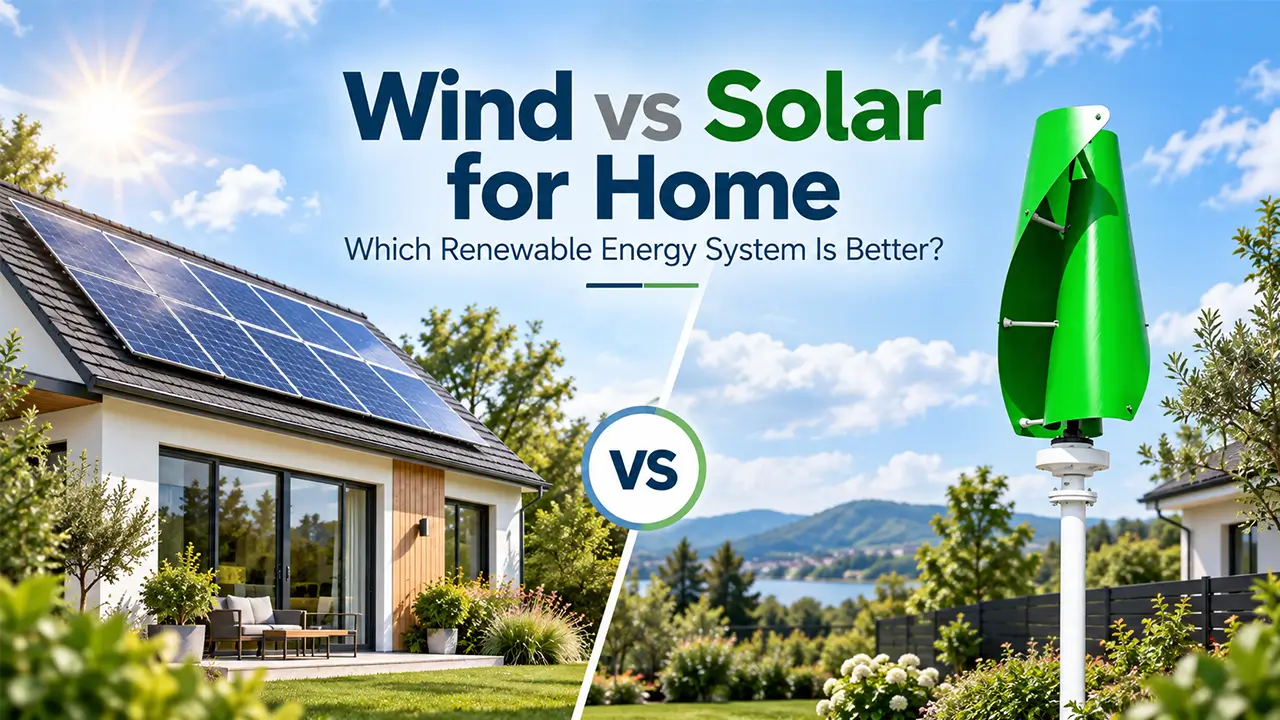
When comparing wind vs solar for home, the right choice depends mainly on the site.
Solar is usually simpler for sunny urban and suburban properties. By contrast, a small wind turbine can make sense for farms, rural homes, coastal areas, and off-grid sites with consistent wind.
Where both resources are available, a wind-solar hybrid system can combine wind, solar, battery storage, and an inverter for broader renewable energy coverage.
Wind vs Solar for Home: Quick Comparison
| Factor | Solar Panels | Small Wind Turbine |
|---|---|---|
| Main resource | Sunlight | Wind |
| Generation period | Mainly daylight | Day or night when wind is available |
| Best location | Sunny, low-shade property | Open, consistently windy property |
| Installation | Roof or ground | Tower or suitable mounting structure |
| Moving parts | Very few | Rotor and generator components |
| Maintenance | Generally lower | Periodic mechanical inspection |
| Night generation | No direct generation | Possible with sufficient wind |
| Battery compatible | Yes | Yes |
| Hybrid use | Yes | Yes |
Quick Answer: Start with the site resource. A solar system on a heavily shaded property or a wind turbine in turbulent, low-wind conditions may both perform poorly.
How Solar Panels Work for a Home
Solar photovoltaic panels convert sunlight into direct-current electricity. Then, an inverter converts that electricity into alternating current for household appliances, lighting, pumps, and other electrical loads.
Depending on the system design, the system can store surplus electricity in batteries or export it to the utility grid where local rules allow.
However, solar production still depends on solar radiation, panel orientation, installation angle, shading, seasonal daylight, temperature, and overall system efficiency. Panels can also produce electricity during cloudy conditions, although output is normally lower.
For many homes, the main advantage of solar is simplicity. In addition, panels have few moving parts, operate quietly, and generally require less mechanical maintenance than a wind turbine.
How a Home Wind Turbine Works
A wind turbine converts the kinetic energy of moving air into electrical power. The blades rotate the generator, while the controller and other electrical equipment manage the power before batteries, an inverter, local loads, or a compatible grid-connected system use it.
Wind Turbine → Controller → Battery / Inverter → Home Loads
By contrast, wind power is not directly tied to daylight. If sufficient wind is available, a turbine can generate during the day or at night.
However, occasional windy weather does not automatically make a property suitable for wind power. Instead, long-term wind conditions at the intended turbine location matter much more.
For projects that operate independently from the utility grid, see ELEGE’s off-grid wind power systems.
Wind and Solar Should Be Compared by Energy Production, Not Rated Power
Therefore, a 5kW solar system and a 5kW wind turbine do not necessarily produce the same amount of electricity over a year.
Rated power describes output under specific operating conditions. Instead, expected energy production over time provides a more useful comparison.
| Wind Energy Production Depends On | Solar Energy Production Depends On |
|---|---|
| Average wind speed and wind-speed distribution | Solar radiation and seasonal daylight |
| Turbine height and surrounding turbulence | Panel orientation, angle, and shading |
| Rotor characteristics and power curve | Temperature and panel characteristics |
| Electrical and system losses | Inverter and system losses |
For this reason, compare renewable systems using real site conditions and estimated annual production rather than nameplate wattage alone.
For a deeper explanation, read ELEGE’s guide to small wind turbine actual power output.
Site Requirements for Solar and Wind
In addition, solar and wind systems have very different site requirements. A location that works well for one technology may not suit the other.
| Site Check | Solar | Wind |
|---|---|---|
| Resource | Sunlight exposure | Average wind at turbine height |
| Obstacles | Trees and buildings can create shading | Trees and buildings can create turbulence |
| Structure | Suitable roof or ground structure | Tower, foundation, or suitable mounting structure |
| Electrical layout | Inverter and cable location | Controller, inverter, battery, and cable distance |
| Local requirements | Building and grid rules | Tower, setback, noise, safety, and electrical rules |
Rooftop Wind Turbines: A Special Case
However, rooftop installations need additional evaluation because buildings can disturb airflow and transmit vibration into the structure.
Therefore, check roof strength, mounting design, wind quality, vibration, maintenance access, and local requirements before installation. In locations with severe rooftop turbulence, an elevated or ground-mounted turbine may receive cleaner airflow.
More information is available in ELEGE’s guide to roof-mounted vertical axis wind turbines.
Installation and Maintenance: Wind vs Solar
Solar panels generally require less mechanical maintenance because they have few moving components.
Meanwhile, small wind turbines contain rotating and structural components that require periodic inspection. Typical inspection points include blades, fasteners, bearings, electrical cables, the tower or mounting structure, generator, controller, braking components, corrosion, and vibration.
In addition, wind projects may require a tower, foundation, installation equipment, and longer electrical cable runs. Therefore, include these items when comparing the complete installed cost of wind and solar.
Grid-Tied, Off-Grid, or Wind-Solar Hybrid?
Grid-Tied Systems
A grid-connected renewable system supplies local loads and may export excess electricity to the utility network where local rules permit it. For wind projects, use compatible control equipment, an inverter, electrical protection, and the correct grid configuration.
Off-Grid Systems
By contrast, an off-grid system operates independently from the utility network and normally relies on battery storage to balance generation and electricity demand.
Wind / Solar → Controller → Battery → Off-Grid Inverter → Loads
For this reason, size the battery according to electricity consumption, peak load, required backup duration, system voltage, and expected renewable generation.
Wind-Solar Hybrid Systems
A hybrid system combines wind and solar as two renewable generation sources. Solar can contribute strongly during daylight hours, while wind may add energy at night, during cloudy periods, or during windier seasons.
As a result, wind and solar can complement each other in some locations. Design the turbine, solar array, controller, battery, inverter, cables, and protection equipment as one complete system.
See ELEGE’s wind-solar hybrid system and wind-solar hybrid vs. solar-only comparison for more detail.
Which System Fits Which Type of Property?
In practice, the property type and available renewable resource often provide the clearest starting point.
| Property or Requirement | More Suitable Starting Point |
|---|---|
| Urban home with strong sunlight | Solar |
| Suburban home with limited land | Solar |
| Open rural property with consistent wind | Wind |
| Farm with local electrical loads | Wind or hybrid |
| Off-grid cabin | Depends on local wind and solar resources |
| Property with useful wind and sunlight | Wind-solar hybrid |
| Site with turbulent or weak wind | Solar is usually more practical |
| Renewable generation needed outside daylight hours | Wind or hybrid |
ELEGE EV Wind Turbine for Home and Farm Applications
For projects where wind is a suitable resource, the ELEGE EV Wind Turbine supports residential, agricultural, off-grid, and wind-solar hybrid applications.
Available configurations range from 500W to 5kW, depending on project requirements.
| Parameter | EV Wind Turbine |
|---|---|
| Power range | 500W–5kW customizable |
| Rated voltage | 12V / 24V / 48V / 220V |
| Start-up wind speed | From 1.3 m/s |
| Rated wind speed | 10 m/s |
| Generator | Maglev generator |
| Body material | Glass fiber / basalt |
| Battery support | Yes |
| Grid connection | Supported with compatible configuration |
| Wind-solar hybrid | Supported |
| Certification | CE |
Important: However, low start-up wind speed does not mean high power output at low wind speed. Actual production still depends on the site’s complete wind resource and installation conditions.
For detailed product information, see the ELEGE EV Wind Turbine.
In addition, battery-charging projects need a compatible wind turbine controller that matches the turbine, system voltage, battery, and overall electrical design.
Common Mistakes When Choosing Between Wind and Solar
Comparing Only Rated Power
First, nameplate wattage does not show how much electricity a renewable system will generate over a month or year.
Selecting Wind Power Without Evaluating the Site
Second, do not choose a turbine only because a property occasionally experiences strong wind.
Confusing Start-Up Wind Speed With High Output
Similarly, a rotor beginning to move at low wind speed does not mean the turbine is producing its rated output.
Ignoring Turbulence
In addition, buildings, walls, trees, and roof structures can disturb airflow and reduce wind turbine performance.
Comparing Equipment Price Instead of Complete System Cost
Finally, wind and solar projects both require balance-of-system equipment. Therefore, compare the complete installed system rather than the price of one component.
Final Recommendation
For most urban and suburban homes, solar is the simpler starting point.
However, wind becomes more attractive where a property has verified wind, open space, and suitable installation conditions. For rural and off-grid projects with both resources, a hybrid system may provide broader renewable energy coverage.
Ultimately, base the final choice on real site conditions and electricity demand rather than rated power alone.
Get a System Recommendation from ELEGE
ELEGE provides small wind turbines and wind-solar systems for residential, agricultural, off-grid, distributor, and system-integration projects.
For project-specific recommendations, contact ELEGE with your site conditions and energy requirements.
FAQ
Can the EV Wind Turbine Be Customized for Distributor Projects?
Yes. ELEGE supports selected voltage, color, logo, and system configuration options for distributor and project requirements.
What Information Should I Send ELEGE for a System Recommendation?
Send the project location, electricity demand, wind conditions, system voltage, battery requirements, installation information, and grid or off-grid requirements.
Does ELEGE Support OEM and ODM Wind Turbine Projects?
Yes. ELEGE supports OEM and ODM options for suitable distributor and renewable energy projects.