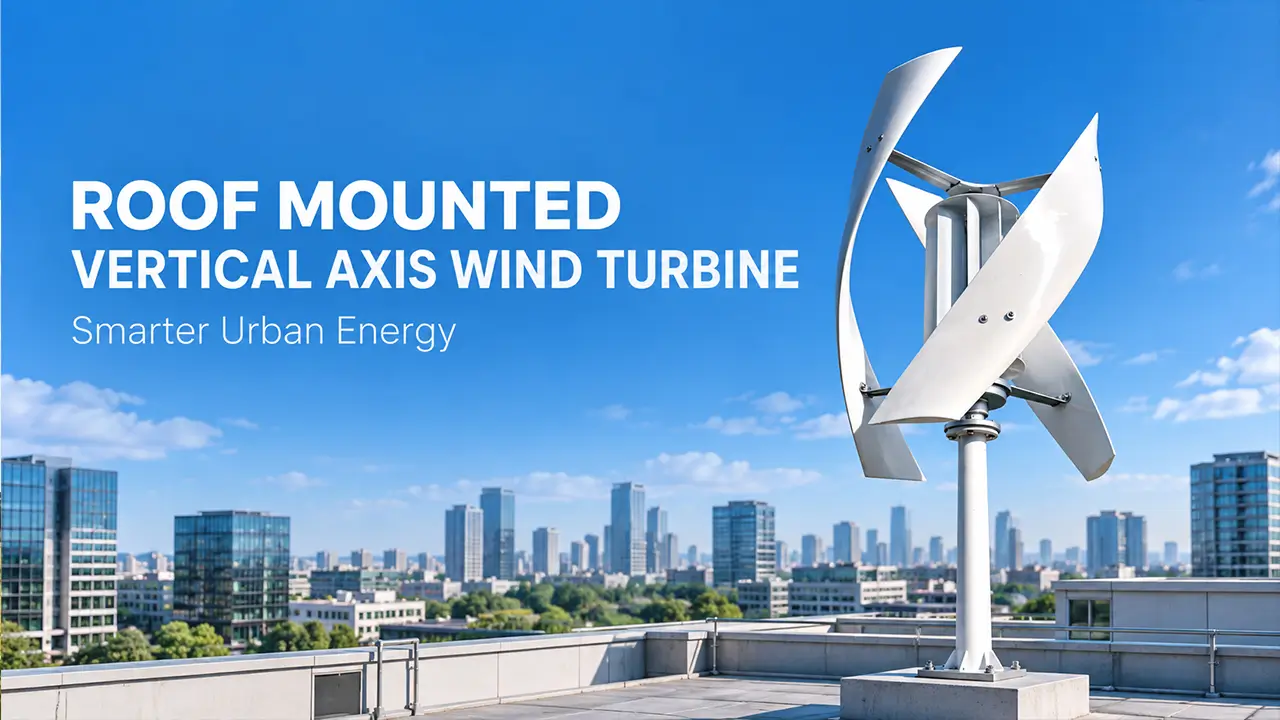
Smarter Urban Energy: The Benefits of a Roof Mounted Vertical Axis Wind Turbine
A roof mounted vertical axis wind turbine can use building space that would otherwise remain unused. For homes, offices, warehouses, and other urban properties, rooftop wind may offer a renewable-energy option where a conventional tower is difficult to install.
The key question is not simply whether the roof is high enough. Airflow quality, structural strength, turbine position, vibration, and actual energy production determine whether rooftop wind makes sense.
Key takeaway: A rooftop VAWT works best when the roof has usable wind, clean enough airflow, sufficient structural support, and realistic annual energy potential. Roof height alone is not enough.
Is a Roof-Mounted Vertical Axis Wind Turbine Really a Good Idea?
It can be, but the building and wind conditions need to support the idea.
Rooftops already provide elevation, which can expose a turbine to stronger wind than ground level. At the same time, the building itself changes how air moves.
Wind is forced around walls, roof edges, parapets, nearby buildings, trees, and rooftop equipment. As a result, some roofs experience useful exposed airflow while others experience highly disturbed wind.
A vertical axis wind turbine, or VAWT, has one practical advantage in these environments: it can accept wind from different horizontal directions without turning a nacelle toward the wind.
That makes changing wind direction less of a problem. Severe turbulence, however, is still a problem. A suitable rooftop project therefore starts with the wind conditions at the proposed turbine position rather than the available roof area alone.
Why VAWTs Are Considered for Rooftop Use
Vertical axis wind turbines have several characteristics that can suit limited-space installations.
Because the rotor axis is vertical, the turbine can respond to wind arriving from different horizontal directions without a conventional yaw mechanism.
The configuration can also provide a relatively compact footprint, which matters when roof space must be shared with solar panels, HVAC equipment, access routes, antennas, and other building systems.
Depending on the rotor design, VAWTs may also operate with different rotational and aerodynamic characteristics from conventional horizontal-axis turbines. These advantages make VAWTs interesting for urban and building-mounted applications, but turbine type alone does not determine performance.
Rooftop Turbulence Is the Main Challenge
A roof can feel windy without providing good turbine conditions.
As wind passes over a building, it changes direction and speed. Roof edges can create accelerated flow, while parapets, taller neighboring structures, ventilation systems, and other obstacles can create vortices and unstable airflow.
A turbine operating inside this disturbed zone may repeatedly accelerate and slow instead of receiving steady wind.
That can reduce energy production and increase mechanical loading.
Higher does not automatically mean better. A lower building with open exposure can provide better turbine conditions than a taller building surrounded by obstacles.
For rooftop wind, clean airflow is often more important than simply finding the highest point.
Measure the Wind Before Choosing the Turbine
City-level wind data can help with early screening, but it does not describe the airflow above one specific building.
Wind should ideally be evaluated close to the proposed turbine height and installation position.
A weather station several kilometers away may experience very different conditions because of terrain and surrounding buildings.
Measurement also helps identify seasonal differences. Some sites experience stronger wind during winter when solar production is lower, while others may have reasonable annual averages but long periods of weak wind.
The more important the turbine is to the energy system, the more valuable site-specific wind data becomes.
Where Should a Rooftop VAWT Be Positioned?
The best turbine position is not always the location with the highest instantaneous wind speed.
A rotor mounted too close to the roof may remain inside disturbed airflow. Raising it above parapets and major rooftop obstacles can improve exposure, but additional height also increases support and structural requirements.
Building geometry matters as well. Certain roof edges may experience locally accelerated wind, but higher speed can come with increased turbulence.
Better positioning rule: Look for a location that combines usable wind, acceptable turbulence, and practical structural support rather than simply choosing the highest point.
Can the Roof Support the Turbine?
A turbine creates more than static weight.
Wind loads change continuously as rotor speed and wind conditions vary. Gusts, braking events, and long-term cyclic loading introduce forces that must be transferred safely into the building.
Mounting therefore needs to consider the roof structure, anchors, load paths, support frames, and local structural requirements.
Waterproofing matters too. Any penetration through the roof membrane should be designed and sealed correctly to avoid creating future leakage problems.
Noise and Vibration Need Separate Attention
Airborne noise and structural vibration are different issues.
Airborne sound can come from aerodynamic interaction, bearings, the generator, and other moving components.
Structural vibration travels through the mounting system into the building.
A turbine may sound relatively quiet outdoors while still transmitting noticeable vibration into an occupied space.
Rotor balance, mounting stiffness, bearing condition, structural resonance, and turbine speed all affect the result.
Roof-Mounted VAWT vs Ground- or Tower-Mounted Turbine
| Factor | Roof-Mounted VAWT | Ground / Tower-Mounted Turbine |
|---|---|---|
| Space | Uses existing roof area | Requires ground space |
| Airflow | Can be affected by building turbulence | Easier to position in clean wind |
| Structure | Loads transfer into the building | Loads carried by tower and foundation |
| Maintenance | Access may be more difficult | Often easier to plan |
| Urban suitability | Useful where land is limited | Better suited to open sites |
| Height flexibility | Limited by building structure | Tower height can be selected more freely |
A rooftop installation mainly solves a space and siting problem. A dedicated tower gives more freedom to place the turbine in better airflow.
How Much Energy Can a Rooftop VAWT Really Produce?
Rated Power vs Real Output
Rated power does not represent continuous generation.
A 1kW turbine reaches approximately 1kW only near the wind conditions used for its rated output. At lower wind speeds, production falls.
Two turbines with identical nameplate power can deliver very different results if one operates in smooth exposed wind and the other operates in turbulent airflow.
The turbine power curve, rotor area, rated wind speed, and local wind distribution therefore tell you more than maximum wattage alone.
Annual Energy Matters More Than Nameplate Watts
For a real project, annual energy production is more useful than rated power.
Expected yearly output depends on the turbine power curve, local wind-speed distribution, system losses, and operating availability.
When comparing systems, ask how much useful energy the turbine is likely to produce over a year at the actual site rather than only comparing 1kW, 2kW, or 5kW labels.
Does Low Start-Up Wind Speed Matter?
It matters, but it should not be confused with useful electrical production.
Start-up wind speed describes when the rotor begins turning. A turbine can rotate in very light wind while producing little charging power.
For rooftop projects, this distinction is particularly important because gusty airflow may cause the rotor to start and slow repeatedly.
Better question: Instead of asking only when the turbine starts, ask how much usable power it produces across the wind speeds expected at the site.
How to Choose a Roof-Mounted Vertical Axis Wind Turbine
Once the roof and wind resource have been evaluated, product selection becomes easier.
Rated power should match realistic energy requirements rather than simply being maximized.
Rotor size matters because swept area affects how much wind energy the turbine can interact with.
Rated wind speed shows the conditions required to approach the turbine’s rated output, while survival wind speed and braking protection matter for severe weather.
Electrical compatibility also needs attention. The turbine voltage should fit the controller, battery architecture, inverter, cabling, and protection equipment.
Outdoor durability is another consideration because rooftop equipment remains exposed to rain, UV radiation, temperature changes, dust, and potentially salt-laden air in coastal locations.
Can a Rooftop VAWT Work With Solar Panels?
Yes, provided both resources are suitable at the site.
Solar panels primarily generate during daylight, while wind can contribute whenever sufficient airflow is available.
When those generation patterns complement each other, both sources can support the same battery-based energy system through compatible controllers.
Roof layout needs to be considered carefully. Solar panels should not obstruct turbine access, and the turbine structure should avoid unnecessary photovoltaic shading.
Panels and other rooftop equipment should also be positioned so they do not create avoidable airflow disturbance around the rotor.
When Does Rooftop Wind Make Sense?
Rooftop VAWTs are most attractive where the building has good exposure, sufficient structural capacity, limited surrounding obstruction, and safe maintenance access.
Warehouses, industrial buildings, exposed low-rise structures, remote facilities, and some coastal sites may provide useful conditions.
Dense urban areas need more caution. A roof surrounded by taller buildings may have poor wind quality even if wind speed occasionally feels strong.
Rooftop wind is also less attractive where the structure is vibration-sensitive, maintenance access is difficult, or the turbine would require excessive structural modification.
Check Local Rules Before Installation
Technical suitability does not automatically mean the project can be installed without approval.
Local requirements may cover building modifications, turbine height, noise, setbacks, structural review, visual impact, and electrical safety.
Grid-connected systems can also require utility interconnection approval.
Because requirements vary widely, regulatory checks should happen before equipment is purchased.
X-Type Vertical Axis Wind Turbine
The ELEGE X-Type Vertical Axis Wind Turbine is available in several power and voltage configurations for different renewable-energy projects.
| Specification | X-Type Vertical Axis Wind Turbine |
|---|---|
| Available Models | 1000W / 2000W / 3000W / 5000W |
| Rated Voltage | 12V / 24V / 48V / 96V / 120V / 220V |
| Start-Up Wind Speed | 1.3 m/s |
| Rated Wind Speed | 14 m/s |
| Number of Blades | 3 |
| Generator | Maglev Generator |
| Structure | Vertical Axis, X-Type Rotor |
The vertical-axis configuration allows the rotor to respond to changing wind directions without a conventional yaw mechanism.
Multiple power and voltage options allow the turbine to be matched to different system architectures. Blade colors, patterns, and logos can also be customized for different project or branding requirements.
The listed 1.3 m/s value refers to start-up wind speed. It indicates when the rotor begins moving and should not be interpreted as guaranteed useful electrical output at that wind speed.
Final Decision: Should You Install a VAWT on the Roof?
A roof mounted vertical axis wind turbine can be a practical way to add renewable generation where land is limited.
The best results come from evaluating the site first and choosing the turbine second. Good airflow, correct positioning, sufficient structural support, realistic annual energy expectations, and compatible electrical equipment matter more than simply selecting the largest turbine available.
FAQs
Can a Rooftop Wind Turbine Affect Property Insurance?
It can in some markets. Building owners should check whether rooftop renewable-energy equipment needs to be declared to the insurer and whether structural or installation documentation is required.
Does a Rooftop Wind Turbine Need Lightning Protection?
Possibly. Requirements depend on turbine height, building design, local electrical standards, and lightning exposure. Grounding and lightning protection should be reviewed during the system design stage.
Can a Rooftop Wind Turbine Feed Power Into the Grid?
Yes, when the turbine, inverter, protection equipment, and local utility requirements support grid connection. Interconnection rules vary by location and should be confirmed before installation.
Can a Rooftop Wind Turbine Operate During a Power Outage?
Not automatically. A grid-connected system may shut down during an outage unless it includes appropriate battery storage, islanding capability, and a backup-capable inverter.