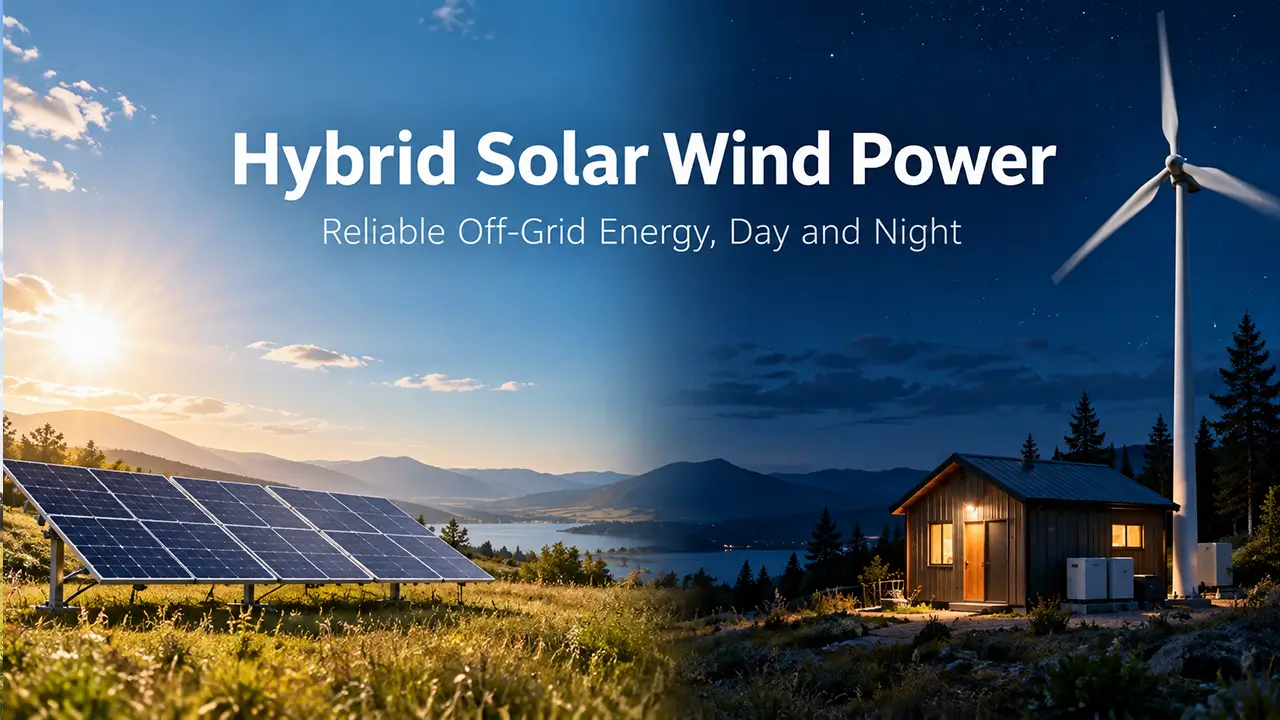
Off-grid energy systems often rely heavily on solar power, but solar production changes with daylight, weather, and season.
A hybrid solar wind power system adds another renewable source. When local wind conditions are suitable, a wind turbine can contribute energy at times when solar production is weak or unavailable.
Key takeaway: A wind-solar hybrid system does not guarantee constant renewable generation. Its real advantage is combining two different energy resources so the battery system depends less on a single weather condition.
Why Combine Wind and Solar for Off-Grid Power?
Solar and wind follow different generation patterns.
Solar panels normally produce most of their electricity during daylight hours. Wind turbines generate whenever wind speed is high enough, which may include evenings, nights, cloudy periods, or seasons with lower solar production.
That difference can improve the overall energy profile of an off-grid system.
In a solar-only system, batteries carry the load whenever sunlight is insufficient. Adding useful wind generation gives the battery bank another charging source and can reduce dependence on one renewable resource.
This does not mean every off-grid project needs both technologies. Hybrid systems make the most sense where solar and wind resources are both strong enough to contribute meaningful energy.
How a Hybrid Solar Wind Power System Works
A typical off-grid hybrid system combines renewable generation, battery storage, power control, and an inverter.
Solar panels and wind turbines behave differently, so each source must be controlled correctly before energy reaches the battery bank.
→
Wind Controller
→
Battery Bank
→
MPPT Controller
→
Battery Bank
→
Inverter
→
AC Loads
Some projects use an integrated wind-solar hybrid controller, while others use separate controllers for wind and photovoltaic generation.
Either arrangement can work when the controller ratings, battery voltage, turbine output, solar input, inverter, and protection equipment are properly matched.
What Problems Does a Hybrid System Actually Solve?
A hybrid system is useful when it solves a real energy problem. Simply adding more generation equipment does not automatically create a better off-grid system.
Reduce Dependence on a Single Energy Source
A solar-only system depends heavily on sunlight. Several cloudy days can reduce battery charging, while a wind-only system may experience long periods of calm weather. When local wind and solar resources complement each other, combining both can reduce dependence on one source.
Improve Charging Coverage Across the Day
Solar follows a relatively predictable daytime production curve. Wind can occur at different times. At suitable sites, evening, nighttime, or seasonal winds may add battery charging outside the main solar-production window.
Reduce Backup Generator Runtime
Many remote installations still use diesel or gasoline generators as backup. Better renewable coverage can reduce generator runtime in some projects, lowering fuel consumption, noise, and maintenance. The actual reduction depends on load demand, weather, battery capacity, and system sizing.
Support Remote Loads
Cabins, farms, telecom sites, monitoring stations, island installations, and off-grid homes often need electricity where grid extension is difficult or expensive. Hybrid generation can become part of a broader system that includes batteries and backup power.
Wind and Solar Do Not Always Complement Each Other
Adding a wind turbine does not automatically improve every solar system.
If the site has poor wind, the turbine may add equipment cost without generating enough useful energy to justify it.
A site may also feel windy while still producing poor turbine performance. Trees, buildings, terrain, walls, and roof structures can create turbulence that reduces usable energy and increases mechanical loading.
More renewable equipment does not automatically mean a more reliable system. Wind should be added because the site has a usable wind resource and because that generation improves the overall energy balance.
In locations with excellent solar conditions and weak wind, investing in additional solar capacity or storage may be more practical than adding a turbine.
Hybrid design should therefore begin with resource assessment rather than equipment selection.
How Much Wind and Solar Capacity Should You Combine?
There is no universal 50/50 wind-solar ratio.
A project should begin with daily electricity consumption and peak load rather than a fixed percentage of wind and solar capacity.
Solar capacity depends on local solar resource, available installation area, panel orientation, seasonal production, and expected daily generation.
Wind capacity depends on wind-speed distribution, tower height, turbulence, rotor characteristics, turbine power curve, and seasonal wind conditions.
Battery autonomy and inverter capacity then determine how the generated energy can be stored and used.
1. Daily and peak electricity demand
2. Local solar and wind resources
3. Wind and solar generation capacity
4. Battery autonomy requirement
5. Inverter, controller, and protection design
Following this order gives a more realistic system than starting with a turbine or solar-array size and trying to adapt the rest of the equipment afterward.
Battery Sizing Still Matters
Adding wind power does not automatically mean the battery bank can be reduced significantly.
Battery sizing depends on how long the system must operate without enough renewable generation.
Battery chemistry, depth of discharge, inverter losses, load profile, weather variability, seasonal generation, and the required autonomy period all affect storage capacity.
A location with strong winter wind may achieve better seasonal balance when solar production drops. Another site may experience weak solar and weak wind at the same time.
Important: Battery size should be based on the expected generation profile and required autonomy, not simply reduced because a wind turbine has been added.
Controller, Dump Load, and System Voltage
Control equipment plays a central role in a hybrid solar wind power generation system.
Solar and wind behave differently, so their controllers also perform different functions.
An MPPT solar controller manages photovoltaic input and battery charging. A wind controller manages turbine charging and may also participate in braking, current limiting, or diversion control depending on the system design.
Wind systems can also require a dump load. When the battery cannot accept additional energy, excess turbine power may need to be diverted to a resistive load rather than simply leaving the turbine electrically unloaded.
System voltage matters as well. Small off-grid installations often use 12V or 24V battery architectures, while larger systems commonly move to 48V to reduce current for the same power level.
The turbine, battery bank, controller, inverter, cable sizing, and protection equipment should all be designed around a compatible electrical architecture.
Hybrid Controller or Separate Controllers?
Some systems use one integrated wind-solar hybrid controller. Others use a dedicated wind controller and a separate solar MPPT controller.
An integrated controller can simplify wiring and system management when its wind input, solar input, battery voltage, protection functions, and total capacity match the project.
Separate controllers can offer more flexibility. The solar array can use an MPPT controller optimized for photovoltaic input, while the wind turbine uses a controller designed around turbine charging, braking, and dump-load requirements.
Neither arrangement is automatically better. Compatibility, system size, maintenance requirements, protection strategy, and future expansion should determine the choice.
Where Hybrid Solar Wind Systems Make the Most Sense
Different applications use hybrid generation for different reasons. The system should be adapted to the load and environment rather than copied from another project.
| Application | Why Hybrid Can Help | Main Design Focus |
|---|---|---|
| Remote home or cabin | Broader renewable charging coverage | Battery autonomy and seasonal balance |
| Farm | Supports distributed remote loads | Pumps, lighting, sensors, equipment |
| Telecom or monitoring site | Adds another renewable source at isolated locations | Reliability and low-maintenance operation |
| Coastal or island site | Wind may complement solar production | Corrosion protection and site exposure |
| Permanent off-grid property | Diversifies renewable generation | Load profile, storage, inverter, backup |
Remote Homes and Cabins
Remote properties often need lighting, refrigeration, water pumps, communication equipment, and household appliances. Solar can handle much of the daytime generation, while wind may contribute additional energy when local conditions are favorable.
Farms and Remote Equipment
Farms may have distributed loads such as pumps, lighting, monitoring equipment, sensors, ventilation, or communications systems. Where grid access is limited, hybrid generation can reduce reliance on fuel-based power.
Telecom and Monitoring Sites
Telecom towers, surveillance equipment, weather stations, and remote monitoring systems can require continuous low-to-medium electrical loads. Combining renewable generation with batteries and suitable backup can improve resilience at isolated sites.
Coastal and Island Locations
Coastal sites may offer useful wind exposure, but salt spray and humidity create additional requirements. Coatings, fasteners, electrical connections, corrosion resistance, and maintenance frequency all need more attention.
How to Evaluate a Hybrid Solar Wind Power System Before Buying
A useful comparison starts with the load rather than the equipment list.
Average daily consumption and peak demand should be calculated first. The next step is evaluating the local solar resource and the wind resource at the actual turbine location.
Only after those conditions are understood should wind capacity, solar capacity, battery storage, inverter size, and controller requirements be selected.
Controller compatibility deserves particular attention. Turbine voltage, battery voltage, solar-input limits, dump-load requirements, inverter voltage, and protection equipment must work together.
Installation conditions should also be checked before purchasing equipment. Wind turbines need clean airflow and suitable tower placement, while solar panels need good exposure, orientation, and mounting conditions.
Maintenance access, cable routing, protection devices, and system documentation should be planned from the beginning rather than added after installation.
Wind-Solar Systems for Different Off-Grid Projects
ELEGE provides small wind turbines and related components for off-grid and distributed renewable energy projects.
Depending on the project, a system can combine wind generation with solar panels, controllers, battery storage, dump loads, and off-grid inverters.
Different turbine models can be selected according to local wind conditions, required power, battery voltage, tower height, installation environment, and the role wind is expected to play in the system.
Rather than using one fixed wind-to-solar ratio for every project, system selection should begin with actual energy demand, local resources, storage requirements, and backup expectations.
Is a Hybrid Solar Wind Power System Right for Your Project?
A hybrid solar wind system makes the most sense when wind and solar resources complement each other and both can contribute useful energy.
It can be especially valuable for remote locations where grid connection is difficult, generator fuel is expensive, or a single renewable source does not provide enough generation coverage.
More equipment, however, does not automatically create a better system. A well-designed solar-only installation can outperform a poorly designed hybrid system at a weak-wind site.
Start with the load, evaluate the resources, size the storage correctly, and then choose wind and solar capacity around those conditions.
FAQs
Can a Hybrid Solar Wind System Work Without Batteries?
Yes, in some grid-connected or specialized designs. Most off-grid hybrid systems still use batteries because both wind and solar generation vary over time.
Does a Hybrid System Need a Backup Generator?
Not always. Backup requirements depend on battery autonomy, renewable resource reliability, critical loads, and how much power interruption the project can tolerate.
Can an Existing Solar System Be Upgraded With a Wind Turbine?
Often yes, but the existing battery voltage, inverter, controller arrangement, protection equipment, available installation space, and local wind conditions should be checked before adding wind generation.
What Happens if Both Solar and Wind Production Are Low?
The system normally supplies loads from stored battery energy. If renewable generation remains low and the battery reaches its operating limit, a backup generator or another power source may be needed depending on the system design.