Small wind turbines: Providing electricity for camping and off-grid living
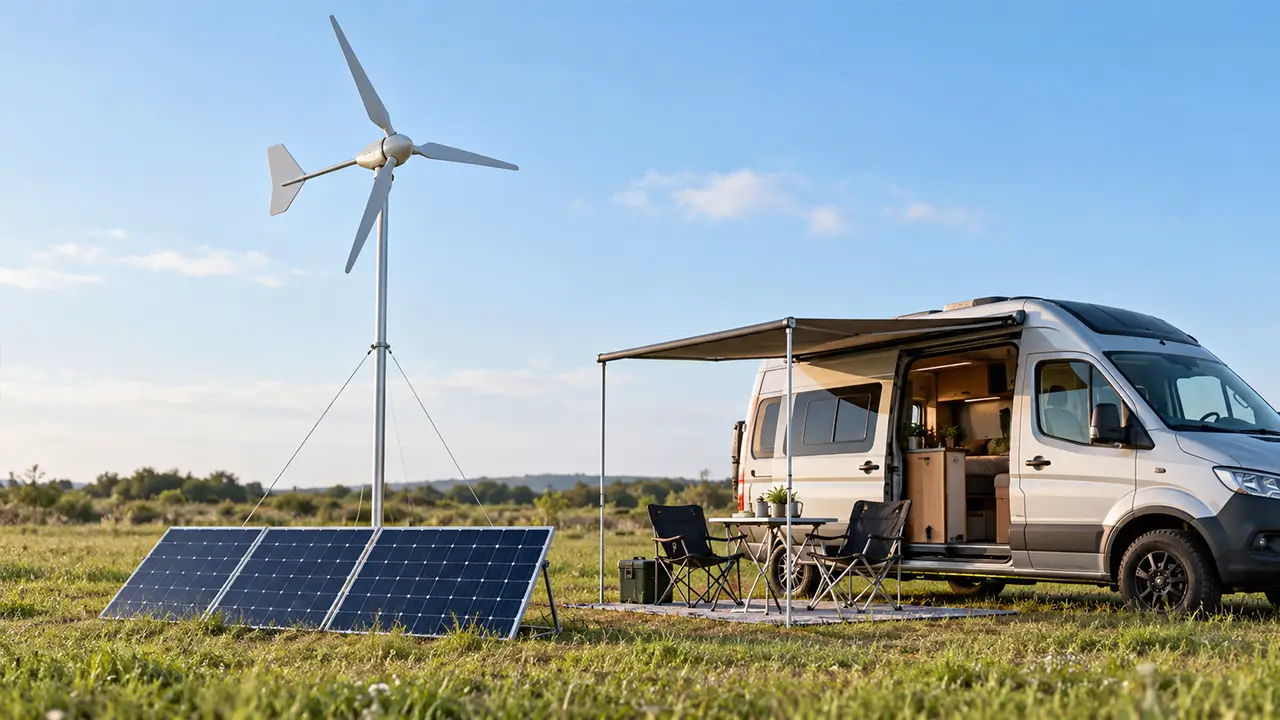
A small wind turbine can provide useful power for camping, cabins, RVs, and other off-grid applications when the site has enough wind.
Unlike solar panels, wind turbines are not limited to daylight. They can continue charging batteries whenever sufficient wind is available, including at night or during cloudy weather.
Key takeaway: For camping, wind is usually a supplemental source. For cabins and permanent off-grid systems, it becomes more valuable when combined with solar, batteries, and a properly matched controller.
Can a Small Wind Turbine Really Power an Off-Grid Setup?
Yes, but the role of the turbine depends on the application.
For short camping trips, wind power is usually a supplemental energy source. It can help recharge batteries, portable power stations, lighting equipment, communication devices, cameras, and other small electronics.
A remote cabin has different requirements. Refrigeration, pumps, routers, laptops, security equipment, and household appliances create a much larger daily energy demand. In this case, wind generation is normally combined with battery storage and solar panels.
Permanent off-grid properties require a more complete system. Wind generation may contribute a meaningful share of the electricity, but it still needs to be matched with storage, an inverter, controllers, and realistic local wind conditions.
Start With Daily Energy Consumption
Turbine selection should begin with energy use rather than rated wattage.
A device rated at 500W does not necessarily consume more energy than a 100W device. Operating time matters just as much as power.
For example, a 100W load running for five hours uses 500Wh. A 500W appliance running for 30 minutes uses only 250Wh.
Once daily demand is known, it becomes easier to decide how much energy should come from wind, how much from solar, and how much battery storage is needed to cover periods of weak generation.
What Size Wind Turbine Makes Sense?
Different power levels suit different types of off-grid use. The ranges below are general starting points rather than fixed rules.
Suitable for camping equipment, small lighting systems, monitoring devices, communication equipment, and supplemental battery charging.
A more practical range for RVs, remote shelters, small cabins, and battery-based wind-solar systems.
Better suited to permanent cabins, larger battery banks, and long-term off-grid energy systems.
100W to 400W for Light Loads
Smaller turbines work best where electricity demand remains relatively low. Camping equipment, basic lighting, monitoring devices, communication equipment, and battery maintenance are typical examples.
In these situations, wind usually acts as a secondary charging source. A compact turbine may be useful during longer trips, but a 300W turbine does not continuously produce 300W simply because its blades are turning.
400W to 800W for RVs and Small Cabins
Several hundred watts of wind capacity can be more practical for RVs, remote shelters, small cabins, and longer off-grid stays.
At this level, the turbine is usually connected to a battery system rather than used only for portable charging. Solar often covers much of the daytime demand, while wind can contribute during evening hours or weaker solar conditions.
1kW to 2kW for Long-Term Off-Grid Use
Kilowatt-class turbines are more suitable for permanent cabins and larger off-grid installations. They can support larger battery banks and higher daily energy demand, especially when combined with solar.
Tower height, cable size, braking protection, battery capacity, controller design, and local wind conditions all become more important as system size increases.
Larger Systems Need Full System Design
Once wind power reaches several kilowatts, turbine selection should become part of a complete energy design.
Daily consumption, peak load, battery autonomy, solar contribution, inverter capacity, seasonal wind changes, and installation conditions all need to be evaluated together.
Rated Power Is Not Actual Daily Output
Rated wattage is one of the most misunderstood small wind turbine specifications.
A 500W turbine can approach 500W only under the wind conditions used for its rated output. At lower wind speeds, production is lower.
Starting wind speed: the point where the rotor begins to move.
Cut-in wind speed: the point where the turbine begins producing useful electrical power.
Rated wind speed: the wind condition required for the turbine to approach its rated output.
A rotor beginning to turn at 1.3 m/s does not mean the turbine is already delivering meaningful charging power at that wind speed.
For buyers comparing small wind turbines, the power curve is therefore more useful than start-up speed alone.
Low Start-Up Speed Does Not Guarantee High Low-Wind Output
Low start-up speed is useful, but it is only one part of turbine performance.
A turbine may begin rotating in very light wind while still producing very little electrical power.
Actual low-wind output depends on rotor area, generator design, controller behavior, charging voltage, aerodynamic efficiency, and available wind energy.
Low start-up speed does not automatically mean strong low-wind generation. The rotor can begin moving before the turbine produces meaningful charging power.
Buyers should look beyond the point where the blades start moving and ask how much usable power is produced across normal site wind speeds.
Wind Conditions Matter More Than Product Labels
Even a well-designed wind turbine cannot produce strong output at a poor wind site.
Buildings, trees, walls, hills, and other obstacles can create turbulence and reduce energy production.
Two locations within the same region can perform very differently simply because one has open airflow while the other is surrounded by obstructions.
A turbine mounted in clean, exposed airflow may generate more useful energy than a larger turbine installed close to roofs, trees, or walls.
Installation Height Can Change Performance Significantly
Wind close to the ground is usually more affected by obstacles and turbulence.
Raising the turbine into cleaner airflow can improve performance considerably. The correct height depends on local terrain, nearby obstacles, turbine size, and installation limitations.
A smaller turbine installed correctly can sometimes provide more useful energy than a larger turbine placed in disturbed airflow.
Is Rooftop Installation a Good Idea?
Rooftops appear attractive because they already provide elevation.
In practice, airflow above a building may be turbulent, especially near roof edges or surrounding structures. Turbine vibration can also transfer into the building.
For long-term off-grid use, a dedicated tower or ground-mounted structure often provides more predictable airflow and makes maintenance easier.
Why Wind and Solar Work Well Together
Wind and solar rarely produce their maximum output at exactly the same time.
Solar panels generate primarily during daylight hours. Wind turbines can operate whenever sufficient wind is available, including evenings, nights, and cloudy periods.
When the two sources complement each other, battery charging becomes more consistent.
→
Wind Controller
→
Battery Bank
→
Inverter
→
AC Loads
→
MPPT Controller
→
Battery Bank
The goal is not simply to install two renewable sources. A well-designed hybrid system uses different generation patterns to reduce dependence on one weather condition.
Battery Capacity Still Matters
Adding wind power does not automatically mean a smaller battery is enough.
Battery sizing depends on how long the system needs to operate without strong wind or sunshine.
Weather variability, battery chemistry, depth of discharge, inverter losses, peak demand, and seasonal generation all affect storage requirements.
Storage should therefore be based on expected generation and energy use rather than turbine wattage alone.
Controller and Battery Voltage Must Match the System
A small wind turbine does not operate independently from the rest of the system.
The controller manages charging and helps protect the electrical system as wind conditions change. Wind systems may also require a dump load when batteries cannot accept additional charging.
A turbine designed for 12V, 24V, or 48V operation should be selected to match the controller, battery bank, and inverter.
Trying to adapt mismatched components later can reduce efficiency and create unnecessary complexity.
How to Evaluate a Small Wind Turbine Before Buying
A useful comparison goes beyond maximum wattage.
Start with the power curve. Output at several wind speeds tells you much more than a single rated-power figure.
Next, check whether the turbine voltage matches the controller and battery system. Charging behavior matters just as much as generator output.
Protection should also be considered carefully. Permanent installations need a clear braking or overspeed strategy for stronger wind conditions.
The installation environment matters as well. Coastal locations require stronger corrosion resistance, while cold climates place different demands on materials and electrical components.
Maintenance access deserves attention too. Bearings, blades, bolts, wiring, tower components, and braking systems all need periodic inspection.
Choosing a System for Different Off-Grid Scenarios
| Application | Role of Wind | Typical Range | Common Setup |
|---|---|---|---|
| Weekend camping | Supplemental charging | 100W–400W | Wind + portable battery |
| RV or mobile use | Secondary renewable source | 300W–800W | Wind + solar + battery |
| Remote cabin | Regular battery charging | 500W–2kW | Wind + PV + battery + inverter |
| Permanent off-grid home | Hybrid generation | 1kW+ | Complete wind-solar hybrid system |
Weekend camping usually benefits most from a compact turbine used as a supplemental source. Portability and simple battery charging matter more than maximum output.
An RV or mobile off-grid setup can justify several hundred watts of wind power when the vehicle remains in exposed locations for long periods.
Remote cabins can use larger turbines because the installation is more permanent. A 500W to 2kW system may make sense depending on daily consumption, wind conditions, battery capacity, and solar contribution.
Permanent off-grid homes require the most detailed planning. Kilowatt-scale wind generation can provide valuable energy, but only when the wind resource, storage system, inverter, and solar array are designed together.
Small Wind Turbines for Different Off-Grid Projects
ELEGE offers horizontal-axis and vertical-axis wind turbines for camping support, remote equipment, cabins, farms, communications applications, and larger battery-based systems.
System voltage, local wind conditions, installation height, turbine type, controller design, battery capacity, and solar contribution can all be matched according to the project.
For lower-wind locations, starting characteristics and generator behavior deserve more attention. Permanent systems also need reliable braking protection, suitable controllers, and correctly sized electrical components.
When Does a Small Wind Turbine Make Sense?
Small wind turbines make the most sense where electricity is needed away from the grid and the site has a usable wind resource.
Camping usually requires only supplemental charging, while cabins can benefit from larger battery-based systems.
Permanent off-grid properties often gain the most from combining wind, solar, and battery storage. The key question is not how many watts are printed on the turbine, but whether it can produce useful energy at the site and work properly with the rest of the system.
FAQs
Can a Small Wind Turbine Be Transported Regularly?
Some compact models are suitable for repeated transport, but larger turbines are designed for permanent installation. Frequent assembly and disassembly can also increase wear on mounting hardware and electrical connections.
How Far Should a Wind Turbine Be Installed From a Tent or Living Area?
Distance depends on turbine size, tower design, local regulations, noise, and safety requirements. Portable turbines should be installed where moving blades, guy wires, and mounting hardware cannot create a hazard for people nearby.
Can a Small Wind Turbine Stay Outdoors All Year?
Many models are designed for permanent outdoor installation, but suitability depends on temperature range, corrosion protection, wind survival rating, and maintenance. Coastal and extreme-weather locations require particular attention.
Can a Small Wind Turbine Be Stored for Months Between Camping Trips?
Yes. The turbine should be stored in a dry place and protected from moisture, impact, and corrosion. Before reinstalling it, check the blades, fasteners, cables, connectors, and mounting parts for damage or looseness.