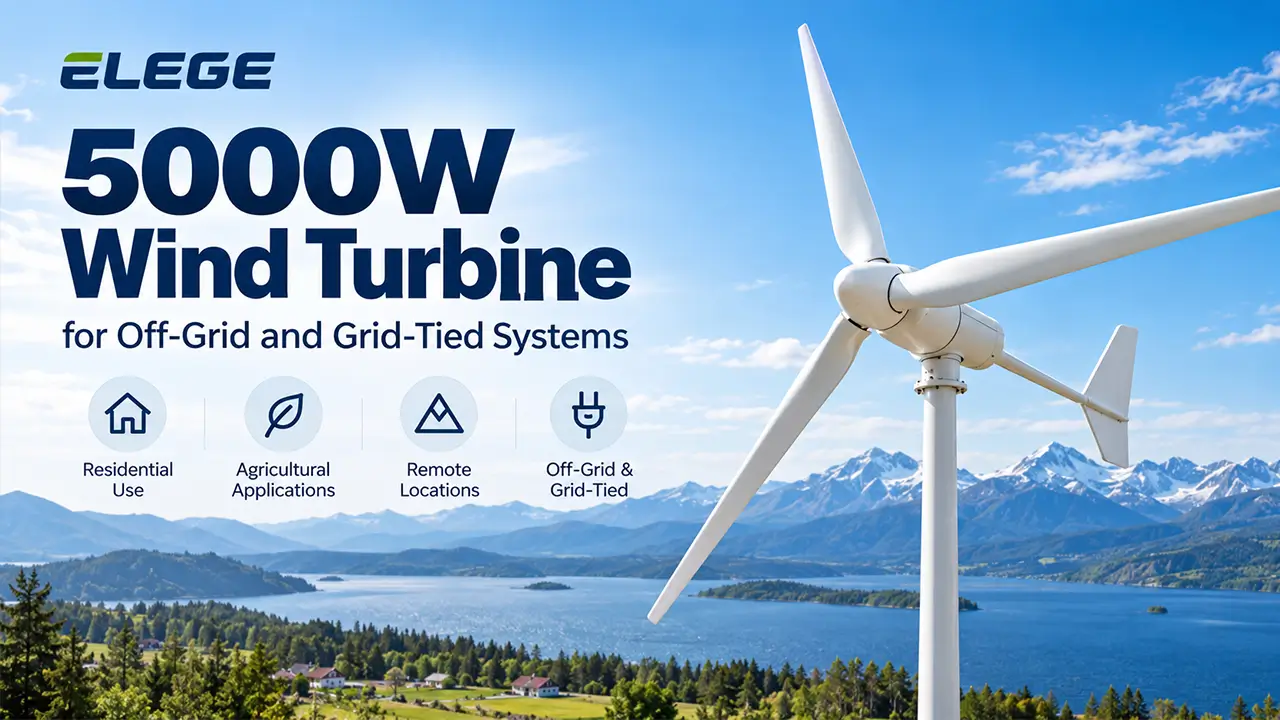
A 5000W wind turbine can provide renewable electricity for homes, farms, and remote facilities with suitable wind resources. ELEGE’s EL-L-5KW horizontal-axis wind turbine supports off-grid, grid-tied, and wind-solar hybrid applications when paired with compatible equipment.
This guide covers its specifications, estimated energy output, system configurations, and key selection considerations to help buyers plan a suitable 5kW wind power system.
What Is a 5000W Wind Turbine?
A 5000W wind turbine converts the kinetic energy of moving air into electrical energy through a rotor and generator. Its 5kW rating represents the electrical output achieved under specified operating conditions rather than continuous power generation.
Unlike solar panels, wind turbines can produce electricity during both daytime and nighttime when sufficient wind is available. This makes wind generation particularly useful in locations with favorable evening winds or seasonal wind patterns.
A 5kW wind turbine may be suitable for rural homes, agricultural facilities, remote cabins, telecommunications equipment, and other applications where wind resources justify installation.
Before selecting a turbine, the expected energy production should be compared with the property’s electricity consumption and available wind conditions.
ELEGE EL-L-5KW Wind Turbine Specifications
The ELEGE EL-L-5KW is a three-blade horizontal-axis wind turbine featuring a three-phase permanent magnet generator, nylon-fiber blades, and an aluminium-alloy body.
Its electromagnetic braking system and automatic windward alignment are designed to support turbine control and orientation during operation. The model also incorporates a self-lubricating design, although periodic inspection and maintenance remain necessary.
The following specifications are based on ELEGE’s L Series product documentation.
| Parameter | Specification |
|---|---|
| Model | EL-L-5KW |
| Turbine Type | Horizontal-Axis Wind Turbine |
| Rated Power | 5000W (5kW) |
| Maximum Power | 5500W (5.5kW) |
| Rated Voltage | 48V / 96V / 120V |
| Start-Up Wind Speed | 3 m/s |
| Rated Wind Speed | 14 m/s |
| Survival Wind Speed | 45 m/s |
| Number of Blades | 3 |
| Blade Material | Nylon Fiber |
| Body Material | Aluminium Alloy |
| Generator | Three-Phase AC Permanent Magnet Generator |
| Control System | Electromagnetic Brake |
| Yaw Mode | Automatic Windward Alignment |
| Lubrication | Self-Lubrication |
| Tower Configuration | Guyed Tower / Independent Tower |
| Working Temperature | -40°C to 80°C |
Specifications refer to the EL-L-5KW model. Available electrical configurations, controller compatibility, and installation requirements should be confirmed before ordering. Maximum power and survival wind speed should not be interpreted as continuous operating ratings.
Start-Up Wind Speed vs. Rated Wind Speed
The EL-L-5KW has a specified start-up wind speed of 3 m/s and a rated wind speed of 14 m/s. These values describe different stages of turbine operation.
Start-up wind speed refers to the wind speed at which the rotor can begin turning under specified conditions. It does not indicate that the turbine has reached a useful charging output or its rated electrical capacity.
Rated wind speed refers to the wind condition associated with the turbine’s specified 5000W output.
Between these points, electricity generation varies with wind speed and the turbine’s power curve. For accurate performance estimates, buyers should request model-specific power-curve data rather than relying on start-up and rated wind speeds alone.
How Much Electricity Can a 5000W Wind Turbine Generate?
A 5000W wind turbine operating at its rated output can theoretically generate 5kWh of electricity in one hour. If it maintained that output for 24 hours, production would reach 120kWh.
In practice, wind speed changes throughout the day, and a turbine rarely operates continuously at rated output. Energy production also depends on electrical losses, system availability, and local wind conditions.
A simplified annual energy calculation is:
Annual Energy Production (kWh) = Rated Power (kW) × 8,760 Hours × Capacity Factor
Capacity factor compares actual annual energy generation with the theoretical output of a turbine operating at rated power throughout the year.
The following examples illustrate how different assumed capacity factors affect estimated production.
| Assumed Capacity Factor | Annual Energy Production | Average Daily Energy |
|---|---|---|
| 10% | 4,380 kWh | 12 kWh |
| 15% | 6,570 kWh | 18 kWh |
| 20% | 8,760 kWh | 24 kWh |
| 25% | 10,950 kWh | 30 kWh |
These values are calculation examples, not measured performance figures or guaranteed energy production for the ELEGE EL-L-5KW.
Capacity factor is a simplified planning metric rather than a fixed turbine performance rating. A more reliable estimate requires the turbine’s power curve, the site’s wind-speed distribution at the proposed hub height, and allowances for electrical losses, equipment availability, and operating restrictions.
Why Installation Location Matters
Two identical 5000W wind turbines can produce significantly different amounts of electricity because of their installation environments.
Wind speed generally increases with height above ground, while buildings, trees, and uneven terrain can create turbulence that reduces energy production and increases mechanical loading.
A properly positioned tower in an open area may provide better wind exposure than an installation surrounded by nearby obstacles. However, the optimal tower height depends on site conditions, local regulations, and structural requirements.
For reliable project planning, wind resources should be evaluated at or near the proposed turbine hub height rather than relying only on regional average wind-speed data.
Off-Grid 5000W Wind Turbine System
An off-grid 5000W wind turbine system operates independently of the public electricity network. It is suitable for remote properties, agricultural facilities, islands, and other locations where utility-grid access is unavailable or impractical.
A typical system includes the wind turbine, compatible wind charge controller, battery storage, off-grid inverter, electrical protection equipment, and an appropriately designed tower.
Wind Turbine → Wind Charge Controller → Battery Bank → Off-Grid Inverter → Electrical Loads
The controller manages turbine output and battery charging according to the system’s electrical requirements. Battery storage supplies electricity when wind generation is insufficient, while the inverter converts DC electricity into AC power for connected equipment.
Wind turbine controllers may also incorporate braking or diversion-load functions to manage excess generation and support safe operation. The required protection arrangement depends on the turbine and controller design.
Battery Storage and Inverter Matching
Battery capacity should be selected according to daily electricity consumption, required backup duration, allowable depth of discharge, and expected system losses.
For example, a nominal 48V 200Ah battery bank has an energy capacity of:
48V × 200Ah = 9.6kWh
This represents nominal stored energy rather than guaranteed usable AC electricity. Actual available energy depends on battery chemistry, discharge limits, inverter efficiency, temperature, and battery-management settings.
The EL-L-5KW is listed with 48V, 96V, and 120V rated-voltage options. These configurations should not be treated as interchangeable without checking the turbine’s electrical characteristics, controller input requirements, and battery-system design.
Inverter selection also depends on maximum simultaneous electrical loads, AC output requirements, and the starting surge of equipment such as pumps or motors.
Grid-Tied 5000W Wind Turbine System
A grid-tied 5000W wind turbine system operates alongside the public electricity network. It allows a property to use wind-generated electricity while drawing additional power from the grid when necessary.
A typical configuration includes the wind turbine, compatible wind power control equipment, a suitable grid-tied inverter, electrical protection devices, and the required utility connection.
When wind generation is lower than electricity demand, the grid supplies the difference. If generation exceeds on-site consumption, surplus electricity may be exported where local regulations and utility agreements allow.
Conventional grid-tied systems generally do not require battery storage. However, they must meet applicable interconnection requirements, including anti-islanding protection and approved equipment specifications.
A standard grid-tied inverter normally shuts down during a utility outage. Providing backup electricity requires a system specifically designed for islanded operation, with suitable isolation and energy-management equipment.
For a detailed comparison of the two system types, read ELEGE’s Off-Grid vs. Grid-Tied Wind Turbines.
Available 5000W Wind Turbine Configurations
The EL-L-5KW can be considered for different wind energy configurations depending on project requirements and the compatibility of the selected electrical equipment.
| Configuration | Main Equipment | Suitable Application |
|---|---|---|
| Wind Turbine Only | Turbine and specified mechanical components | Existing systems or customized integration |
| Wind Turbine with Controller | Turbine and compatible wind controller | Battery charging or hybrid system integration |
| Off-Grid System | Turbine, controller, battery storage, and off-grid inverter | Remote or independent electricity supply |
| Grid-Tied System | Turbine, compatible controller, and grid-tied inverter | Properties with an approved utility connection |
The exact package contents depend on the selected configuration. Towers, batteries, inverters, cables, protection devices, and installation accessories should be confirmed individually when requesting a quotation.
Can a 5000W Wind Turbine Work with Solar Panels?
Yes. A 5000W wind turbine can be integrated with solar panels in a properly designed wind-solar hybrid system.
Solar panels generate electricity when sufficient sunlight is available, while wind turbines can operate whenever wind conditions permit, including at night. Combining both sources may improve the diversity of electricity generation, particularly where wind and solar resources complement each other seasonally.
However, a hybrid system does not guarantee uninterrupted generation. Battery storage or another backup source may still be required during extended periods of low wind and limited sunlight.
Wind and solar inputs must be managed by compatible control equipment or a coordinated system architecture. Controller ratings should be checked against the EL-L-5KW’s electrical specifications and the solar array’s voltage and power characteristics.
Explore ELEGE’s Wind Turbine Controllers for additional information about controller selection.
How to Choose the Right 5000W Wind Turbine System
Choosing a 5000W wind turbine requires evaluating whether the turbine, site conditions, and electrical equipment are suitable for the intended project.
Evaluate Wind Resources and Installation Conditions
Begin with the site’s wind-speed data, seasonal wind patterns, proposed hub height, and surrounding obstacles. A turbine’s rated power is meaningful only when considered alongside the wind conditions required to achieve it.
The tower and foundation must also be designed for the turbine’s structural loads and local environmental conditions. For the EL-L-5KW, ELEGE lists guyed and independent tower configurations, but final tower selection should follow project-specific engineering requirements.
Match the System to Electricity Demand
Estimate daily energy consumption in kWh and identify the maximum simultaneous electrical load in kW.
For off-grid applications, these figures help determine the required generation capacity, battery autonomy, and inverter output. For grid-tied applications, they help assess how wind generation may offset existing electricity consumption.
The turbine’s expected energy production should be calculated from site wind data rather than assuming that a 5kW turbine will continuously supply 5kW.
Verify Electrical Compatibility and Protection
Before ordering, confirm the selected turbine voltage, controller input limits, inverter specifications, and required protection equipment.
The EL-L-5KW uses electromagnetic braking, but the complete system may also require compatible electrical braking control, diversion-load protection, grounding, and surge protection.
A standard solar charge controller or solar-only grid-tied inverter should not be connected directly to the turbine unless the manufacturer explicitly supports that configuration.
For further guidance, see ELEGE’s Wind Turbine Inverter Guide.
Consider Maintenance and Project Costs
The total project cost extends beyond the turbine itself. Tower construction, foundations, electrical equipment, installation labor, shipping, and ongoing maintenance can significantly affect overall investment.
Routine inspections should address blade condition, fasteners, corrosion, vibration, electrical connections, and the control system. The turbine’s self-lubricating design does not eliminate the need for scheduled maintenance.
How Much Does a 5000W Wind Turbine Cost?
The price of a 5000W wind turbine depends on the turbine model, electrical configuration, included components, and whether the project requires an off-grid or grid-connected system.
A turbine-only package typically has a lower equipment cost than a complete system incorporating a controller, inverter, battery bank, and installation accessories.
Additional expenses may include towers, foundations, electrical protection, transportation, permits, and installation labor. For grid-connected projects, utility approval and interconnection requirements may also influence total cost.
When comparing quotations, buyers should confirm exactly which components are included rather than comparing turbine ratings alone.
For a more detailed breakdown, read 5kW Wind Turbine Price: Basic Kit vs. Complete Off-Grid System.
Is a 5000W Wind Turbine Right for Your Project?
A 5000W wind turbine may be suitable for rural homes, farms, remote facilities, and renewable energy projects with sufficient wind resources and compatible electrical infrastructure.
Its value depends on expected annual electricity production, installation costs, maintenance requirements, and the availability of alternative energy sources.
Locations with low average wind speeds, significant turbulence, or restrictive installation conditions may not achieve the expected economic benefits.
For distributors, installers, and project developers, selecting the correct turbine configuration and electrical equipment is essential to achieving a reliable and practical installation.
Frequently Asked Questions
Can a 5000W wind turbine operate in freezing temperatures?
The ELEGE EL-L-5KW is specified for an operating temperature range of -40°C to 80°C. However, ice accumulation on turbine blades can affect performance and safety. Cold-climate installations should include appropriate operating precautions and follow the manufacturer’s guidance.
How noisy is a 5000W wind turbine?
Noise levels depend on rotor design, wind speed, installation conditions, and surrounding terrain. For project-specific noise assessments, buyers should request acoustic performance data for the selected turbine model under defined operating conditions.
Can multiple 5000W wind turbines operate in one system?
Yes, multiple turbines can be integrated into a properly engineered installation. The combined system requires compatible electrical controls, appropriately rated power conversion equipment, suitable protection, and adequate turbine spacing to limit wake interference.
What information is needed to request a 5000W wind turbine quotation?
Provide the installation location, available wind data, required voltage and frequency, intended application, and preferred system configuration. For off-grid projects, daily electricity consumption and battery-storage requirements are also helpful.
Conclusion
A 5000W wind turbine can be a practical energy solution when matched with suitable wind conditions and electrical equipment.
ELEGE supports distributors, installers, and project developers with 5kW wind turbine configurations and system selection. Contact us with your project requirements to request a suitable solution and quotation.