QUICK ANSWER
A wind turbine charge controller manages the variable electrical output from a wind generator, prepares it for battery charging, and handles excess energy through functions such as MPPT, dump-load control, current limiting, and system protection.
Unlike a solar panel, a wind turbine uses a rotating generator. As wind speed changes, turbine speed, voltage, current, frequency, and available electrical power change with it.
As a result, the controller must continuously adapt to both the turbine and the battery. It manages the electrical conditions before the energy reaches the storage system.
In this guide, you will follow the power from the wind turbine to the battery. Along the way, you will see how rectification, MPPT, dump-load control, braking, wiring, battery matching, and monitoring work together in a small wind power system.
What Does a Wind Turbine Charge Controller Do?
A wind turbine charge controller sits between the wind generator and the battery system. However, its job goes far beyond switching charging on and off.
For example, a wind controller may provide MPPT charging, PWM dump-load control, current limiting, electrical braking, battery protection, and operating-data monitoring.
In addition, a wind-solar hybrid controller can manage a separate solar input while both energy sources charge the same battery bank.
How Does a Wind Turbine Charge Controller Work?
The easiest way to understand how a wind turbine charge controller works is to follow the electrical energy from the generator to the battery.
ENERGY FLOW
Wind
↓
Wind Turbine Generator
↓
Three-Phase AC
↓
Rectification
↓
MPPT & Charging Control
↓
Battery
1. The Turbine Generates Variable Three-Phase AC
Many small permanent-magnet wind turbines generate three-phase AC power. Typically, three wind-input terminals marked U, V, and W connect the generator to the controller.
Because rotor speed follows the changing wind, several electrical values change at the same time:
- Generator voltage
- Current
- Electrical frequency
- Available power
Therefore, the controller never receives a perfectly fixed electrical supply. Instead, it must respond to changing turbine output and battery conditions.
Low-wind note: A turbine can already rotate while producing very little charging power. For this reason, weaker-wind sites need more than a low start-up speed. See our guide to choosing a small wind turbine for low wind speed.
2. The Controller Rectifies Three-Phase AC to DC
A battery stores DC electricity, while the turbine generator supplies three-phase AC. Therefore, the controller first rectifies the U/V/W generator input into DC before the power enters the charging-control stage.
Three-Phase AC
→
Rectification
→
DC
→
Charging Stage
However, rectification alone does not decide how much electrical load the controller should place on the turbine. The system still needs active control to manage the generator efficiently.
3. The Controller Monitors Turbine and Battery Conditions
Next, the controller checks information from both the turbine side and the battery side. These operating values help it decide how to manage charging.
| Turbine Side | Battery / System Side |
|---|---|
| Wind turbine voltage | Battery voltage |
| Wind turbine current | Battery current |
| Wind turbine power | Controller temperature |
As a result, the controller can determine when to direct energy toward the battery and when the system needs current limiting, diversion, or another protection response.
4. MPPT Adjusts the Turbine Operating Point
MPPT stands for Maximum Power Point Tracking.
In a wind system, MPPT does more than search for the highest generator voltage. Because a wind turbine uses a rotating generator, the electrical load also affects generator torque and rotor speed.
If electrical load is too heavy:
Generator resistance increases, so the rotor may slow excessively.
If electrical load is too light:
The rotor may spin faster, but the battery may not receive as much useful energy as expected.
To manage this balance, ELEGE controller configurations can use MPPT boost charging together with PWM dump-load control and PWM overcurrent limiting.
Even so, MPPT performance depends on the turbine, generator characteristics, controller design, battery voltage, and wind conditions. Therefore, you should not assume the same fixed percentage gain for every installation.
How Does a Wind Turbine Controller Protect the System?
Charging is only one part of wind turbine control. At the same time, the controller must respond when the battery cannot accept all available energy or when turbine output moves outside the normal operating range.
What Happens When the Battery Reaches Its Charging Limit?
Even after the battery no longer needs full charging power, the wind may continue driving the rotor. Consequently, the generator can keep producing electrical energy.
For this reason, the controller needs another controlled path for energy that should not enter the battery. In this ELEGE configuration, a PWM-controlled external dump load provides that path.
For example, many dump loads use a high-power resistor. The resistor converts diverted electrical energy mainly into heat, so it can become hot during normal operation.
Important: Match the dump-load resistance and power rating to the controller and turbine configuration. Do not substitute a random resistor simply because its wattage appears high enough.
Dump Load vs. Electrical Braking
Although both functions help control the turbine system, dump-load control and electrical braking serve different purposes.
| Function | Main Purpose | Role |
|---|---|---|
| Dump Load | Provides a controlled path for excess electrical energy | Energy management |
| Electrical Braking | Increases generator resistance to reduce turbine speed | Protection |
| Current Limiting | Keeps excessive current under control | Electrical protection |
Under strong-wind or overvoltage conditions, the controller can automatically start braking protection. Once that protection starts, this configuration keeps the braking effect active for at least approximately 10 minutes.
Therefore, a turbine may behave differently during normal charging, dump-load operation, and a protective braking event.
Why Shouldn’t You Disconnect the Battery While the Turbine Is Running?
In this battery-based design, the battery forms part of the controller’s normal electrical operating environment.
Therefore, do not operate this controller without a battery, and do not cut the controller-to-battery connection during normal operation.
Why this matters: Disconnecting the battery does not stop the wind. Instead, the rotor may continue turning while the generator continues producing electrical energy.
How Is a Wind Turbine Charge Controller Wired?
Although the exact wiring depends on the controller model, most battery-based small wind systems follow the same basic arrangement.
TYPICAL OFF-GRID CONNECTION
Wind Turbine (U / V / W)
↓
Wind Controller
| ↙ | ↘ |
| Battery | Dump Load |
| ↓ | |
| Fuse | |
| ↓ | |
| Inverter | |
| ↓ | |
| Circuit Breaker | |
| ↓ | |
| AC Loads |
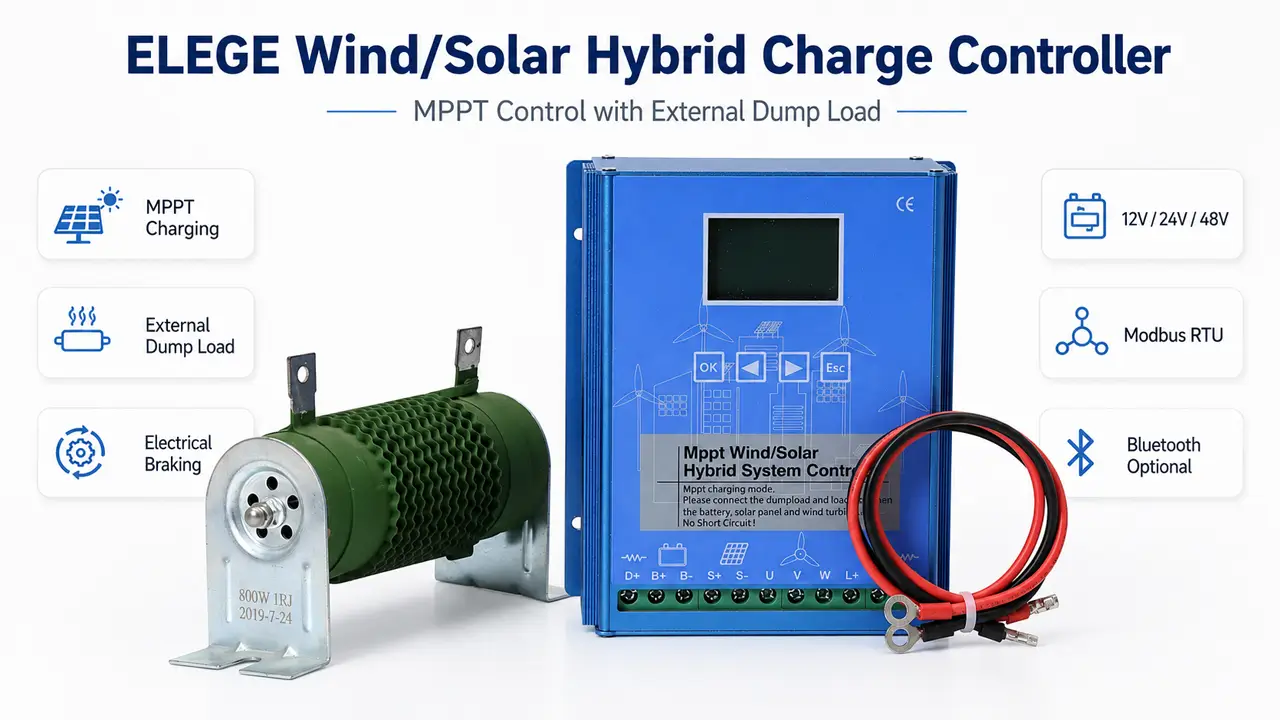
ELEGE wind turbine charge controller with external dump-load resistor.
Wind Turbine Input: U, V and W
The three generator wires connect directly to the dedicated U, V, and W wind-input terminals.
Because a rotating wind generator can produce high voltage, make electrical connections under safe conditions. Whenever possible, carry out wind-generator connection work during low-wind or windless conditions.
Battery and Dump-Load Connections
Since the dump-load resistor converts electrical energy into heat, choose the correct resistance, power rating, cable size, mounting position, and ventilation for the selected controller and turbine.
Wind-Solar Hybrid Wiring
A hybrid controller provides separate wind and solar connections. Meanwhile, both sources can charge the same battery bank through the controller.
| Terminal | Connection |
|---|---|
| D+ / D− | External dump load |
| B+ / B− | Battery |
| S+ / S− | Solar PV input |
| U / V / W | Wind turbine input |
| L+ / L− | DC load output |
For a broader system view, our guide to a wind-solar hybrid power generation system explains how wind and solar can complement each other in off-grid applications.
Can You Use a Solar Charge Controller for a Wind Turbine?
Do not assume that a conventional solar-only charge controller will work with a wind turbine.
The key point: Two controllers can both use the label “MPPT” while serving very different energy sources.
A typical PV controller follows the electrical behavior of solar panels. By contrast, a dedicated wind controller may also need to handle:
- Three-phase AC generator input
- Changing turbine RPM
- AC-to-DC rectification
- Wind-specific MPPT control
- Dump-load management
- Overcurrent limiting
- Electrical braking protection
Hybrid controllers specifically support both wind and solar inputs. Therefore, the important question is not simply whether a controller uses MPPT. Instead, check whether it specifically supports a wind generator input.
How Does a Wind Controller Match the Battery System?
A controller cannot work independently from the battery system. In particular, system voltage and battery chemistry directly affect charging and protection settings.
12V vs. 24V vs. 48V Systems
Small off-grid wind systems commonly use 12V, 24V, or 48V battery banks. In addition, some controller configurations can automatically recognize the system voltage.
If you want to understand how these voltage levels affect the turbine, controller, battery, and inverter, see our detailed guide to wind turbine voltage.
This simplified comparison ignores conversion losses and actual charging voltage. However, it clearly shows why a higher-voltage system can carry the same nominal power at a lower current.
Even so, 48V does not automatically offer the best choice for every project. The turbine, controller, battery, wiring, dump load, and inverter must work together as one system.
Supported Battery Types
Battery chemistry affects charging and protection voltage limits. Depending on the configuration, controller settings can include:
✓ Custom battery parameters
✓ Gel / lead-acid batteries
✓ Ternary lithium batteries
✓ LiFePO₄ batteries
For lithium systems, also check the battery manufacturer’s BMS limits and charging requirements. In other words, nominal voltage alone does not prove that two components are compatible.
What Can You Monitor on a Wind Turbine Controller?
Monitoring helps you see whether the turbine generates normally, charges the battery, limits output, or enters a protection condition.
LCD Monitoring
| Category | Available Information |
|---|---|
| Battery | Voltage, current, state of charge, power |
| Wind Turbine | Voltage, current, power, generation |
| Solar PV | Voltage, current, power |
| Energy | Daily, 30-day, and accumulated generation |
| System | Load information and controller temperature |
For example, these values give you a much better picture of system performance than rotor movement alone. A spinning turbine may still produce very little useful electrical power.
Bluetooth and Modbus RTU
Bluetooth monitoring comes as an optional function on supported controller configurations. When fitted, it can connect the controller to a mobile app.
In addition, supported 485 communication configurations use Modbus RTU. This protocol lets external monitoring or energy-management equipment read operating information from the controller.
Choosing the Controller as Part of the Complete Wind System
Do not select a wind turbine controller by looking only at turbine wattage. Instead, treat the turbine, controller, dump load, battery, and inverter as one electrical system.
COMPLETE OFF-GRID POWER PATH
Wind Turbine
→
Controller
→
Battery
→
Wind Turbine Inverter
→
AC Loads
Meanwhile, the dump load operates as a separate controller branch rather than as part of the battery-to-inverter power path.
When you match the system, check the following factors:
- Wind turbine rated power
- Generator electrical characteristics
- Maximum controller input voltage
- Controller power capacity
- Battery-system voltage
- Battery chemistry
- Dump-load resistance and power rating
- Braking and protection requirements
- Inverter voltage
- Monitoring requirements
For example, the controller configuration discussed here specifies a maximum wind-turbine input voltage of 80V for the stated 12/24V and 48V configurations. Therefore, a simple “48V” label does not tell you everything you need to know.
Before selecting a controller, start with the turbine rated power, system voltage, battery type, maximum generator voltage, and intended application.
FAQ
Why Does the Wind Turbine Slow Down After Connecting the Controller?
Connecting the turbine to the controller adds an electrical load. In addition, battery charging conditions, an unsuitable voltage relationship between the turbine and battery, or a problem in the dump-load circuit can cause unusually low turbine speed.
What Should I Check If the Controller LCD Does Not Turn On?
Start with the battery and its wiring. For example, a poor battery connection or a damaged battery can prevent the controller from powering up normally. Check those items before assuming that the controller has failed.
What Happens If I Connect the Battery With Reverse Polarity?
Reverse polarity prevents normal operation on this controller design. A fuse protects the internal circuit, but you should always confirm battery polarity before energizing the system.
Can the Controller Power a DC Load Directly?
Yes, supported configurations provide a separate DC load output. For example, available modes can include light-controlled operation, continuous operation, and combined light/time control. However, the connected load must remain within the rated output of the specific controller.
Where Should You Install the Wind Turbine Controller?
Choose a dry location with convenient access for wiring and maintenance. In addition, keep the controller away from corrosive gases and strong electromagnetic interference. A qualified professional should handle the electrical installation.