
Wind turbine blades often look surprisingly long and narrow. However, this shape is not simply designed to catch less wind.
Modern blade design balances aerodynamic lift, drag, rotor speed, structural strength, weight, and energy capture. For small wind turbines, blade width is only one part of the complete rotor design.
Quick Answer: Wind turbine blades are relatively narrow because efficient lift-based rotors do not need paddle-like surfaces. Engineers optimize blade length, airfoil shape, chord, twist, rotor solidity, and structural strength together to achieve useful energy production.
Wind Turbine Blades Work More Like Wings Than Paddles
Modern lift-based wind turbine blades work more like aircraft wings than flat paddles.
As air moves around the blade’s airfoil, the pressure difference across the blade creates aerodynamic lift. This lift helps produce torque and rotate the turbine.
Because the rotor relies strongly on lift, the blade does not need a very wide surface simply to push against the wind. Instead, engineers focus on the airfoil profile, chord width, twist, and operating angle.
The goal is not to create the widest blade possible. The goal is to produce useful aerodynamic force with the right amount of blade area.
Why Are Wind Turbine Blades Long but Relatively Narrow?
Blade length and blade width affect a turbine in different ways.
For a horizontal-axis wind turbine, a longer rotor radius increases the swept area available to the turbine.
Swept Area = π × Rotor Radius²
Therefore, increasing rotor radius can substantially increase the area that interacts with moving air.
Making the entire blade wider, however, also changes aerodynamic loading, rotor solidity, blade mass, structural forces, and the turbine’s preferred operating speed.
As a result, engineers normally use enough blade width to generate the required aerodynamic forces without adding unnecessary surface area and mass.
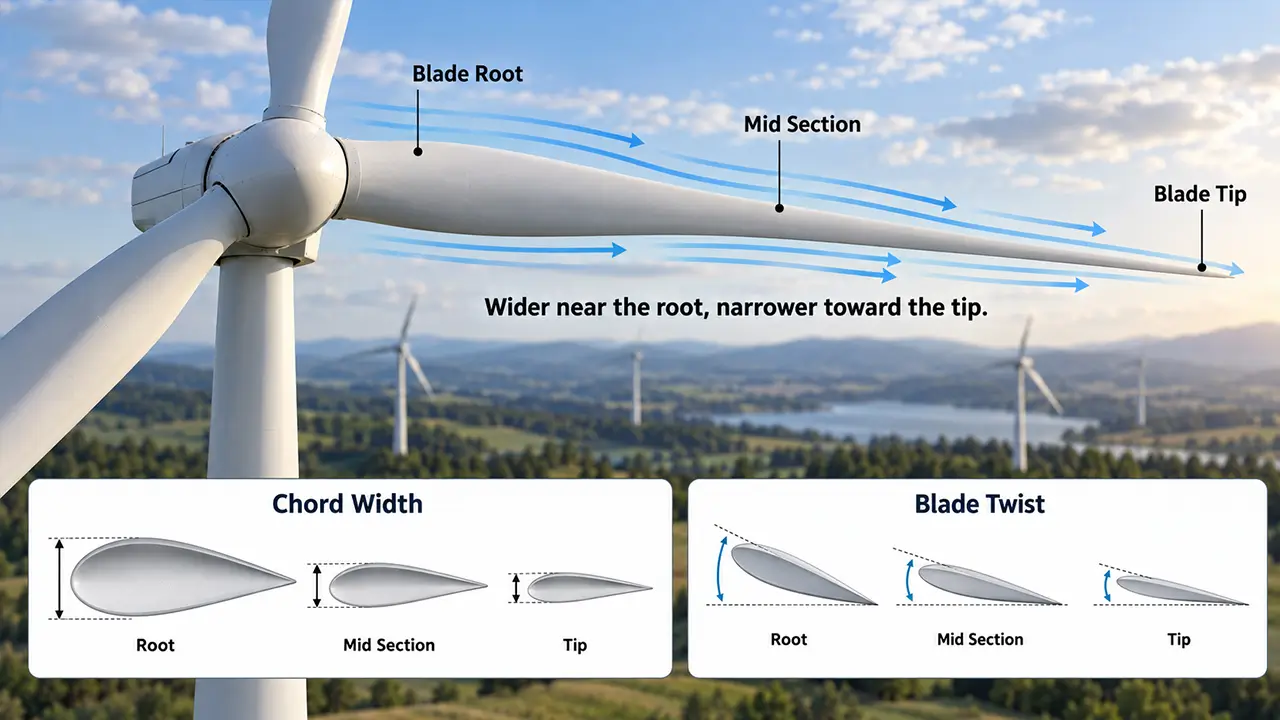
Why Does Blade Width Change from Root to Tip?
A modern wind turbine blade is usually not the same width from the hub to the tip.
The section near the hub is generally thicker and structurally stronger because it must transfer aerodynamic and mechanical loads into the rotor hub.
Meanwhile, the outer blade section travels much faster because it is farther from the center of rotation.
For this reason, designers change both the chord width and blade twist along the blade.
| Blade Section | Typical Design Requirement |
|---|---|
| Blade root | High structural strength and load transfer |
| Middle section | Balance between structure and aerodynamic performance |
| Outer section | Higher local speed and stronger aerodynamic contribution |
| Blade tip | Aerodynamic efficiency and control of tip losses |
This tapered shape explains why many wind turbine blades appear much narrower toward the tip.
Blade Width Also Affects Rotor Solidity
Rotor solidity describes how much blade area exists relative to the rotor’s swept area.
Wider blades or more blades generally increase solidity, while narrower or fewer blades reduce it.
This matters because rotor solidity influences torque, rotational speed, aerodynamic interaction, and the turbine’s preferred tip-speed ratio.
| Rotor Characteristic | Higher Solidity | Lower Solidity |
|---|---|---|
| Blade area | More | Less |
| Typical operating speed | Generally lower | Generally higher |
| Starting torque | Can be higher | Can be lower |
| Optimal tip-speed ratio | Generally lower | Generally higher |
Therefore, designers cannot select blade width independently. They must consider blade number, rotor diameter, airfoil shape, generator characteristics, and operating speed at the same time.
What Is Tip-Speed Ratio and Why Does It Matter?
The tip-speed ratio (TSR) compares the speed of the blade tip with the speed of the incoming wind.
Lift-based wind turbines normally have an operating range where their aerodynamic efficiency is highest.
If a rotor has too much blade area for its intended design, aerodynamic resistance and blade interaction can limit its operating speed. However, reducing blade area too far can also reduce torque or make starting more difficult.
Design principle: Use enough blade area to create useful torque, but not so much that the rotor moves away from its intended aerodynamic operating range.
This trade-off is one reason efficient wind turbine rotors often look slender.
Narrower Blades Can Reduce Weight and Structural Loads
Aerodynamic efficiency is only part of wind turbine blade design.
The blade must also withstand gusts, turbulence, centrifugal forces, vibration, gravity, and braking loads over many operating cycles.
Adding unnecessary blade area can increase material use, rotor mass, and aerodynamic loading. This becomes especially important toward the blade tip because material located farther from the hub has a stronger effect on rotor dynamics.
However, engineers cannot simply make the entire blade thinner. The root section still needs enough material and structural strength to carry loads into the hub.
Modern wind turbine blades therefore balance aerodynamic performance and structural durability rather than optimizing either factor alone.
Does a Narrow Blade Produce Less Power?
Not necessarily.
Blade width alone does not determine turbine output. Real power depends on the complete rotor and generator design, including rotor diameter, airfoil shape, blade number, chord distribution, twist, tip-speed ratio, generator characteristics, control strategy, and actual wind conditions.
A relatively narrow aerodynamic blade can still generate strong lift and useful rotor torque when the complete turbine is designed correctly.
Likewise, simply increasing blade width does not guarantee higher electricity production.
For buyers, the turbine’s real performance matters more than blade appearance. ELEGE explains this in more detail in our guide to small wind turbine actual power output.
Do Narrow Blades Improve Low-Wind Performance?
Not automatically.
Low-wind performance depends on the complete turbine design rather than blade width alone.
Airfoil shape, rotor solidity, blade number, rotor diameter, generator starting resistance, bearing friction, controller behavior, and installation conditions can all affect how easily a turbine starts and how much electricity it produces at lower wind speeds.
Important: Start-up wind speed is not the same as useful electrical output. A rotor can begin turning in light wind while producing only a small amount of power.
Therefore, buyers should compare output across realistic wind speeds rather than selecting a turbine only because its blades look narrow or its advertised start-up wind speed is low.
For more information, see ELEGE’s guide to choosing a small wind turbine for low wind speed.
Blade Design Is Different for HAWTs and VAWTs
Not every wind turbine should use the same blade geometry.
Horizontal-axis wind turbines and vertical-axis wind turbines can have very different aerodynamic requirements.
| Turbine Type | Typical Blade Approach | Main Design Focus |
|---|---|---|
| Horizontal-axis turbine | Long, tapered airfoil blades | Lift, chord, twist, TSR, and structural loads |
| Lift-based VAWT | Aerodynamic vertical blades | Solidity, TSR, dynamic loading, and changing wind angle |
| Drag-based VAWT | Broader curved or scoop-like surfaces | Starting torque and drag-driven rotation |
For this reason, one blade shape cannot be considered universally better. The correct geometry depends on the turbine’s operating principle and intended application.
What About Residential and Small Wind Turbines?
Small wind turbines often operate in less predictable wind conditions than utility-scale turbines.
Homes, farms, gardens, rooftops, and remote properties may experience airflow affected by terrain, trees, buildings, and changing wind direction.
Therefore, blade geometry must work together with the generator, controller, rotor size, and electrical system.
For sites where a vertical-axis design fits the project requirements, the ELEGE EV vertical axis wind turbine can support residential, agricultural, off-grid, and wind-solar hybrid applications.
The final turbine choice should still follow the site’s actual wind resource and energy demand rather than blade appearance alone.
Does Blade Design Matter in a Wind-Solar Hybrid System?
Blade geometry does not change simply because a wind turbine operates together with solar panels.
However, real turbine output becomes especially important in a hybrid system because wind and solar generation depend on different resources.
Wind Turbine + Solar Panels → Controller → Battery → Inverter → Loads
Solar mainly follows sunlight, while wind generation follows local wind availability. As a result, the turbine should deliver useful output at the wind speeds actually available at the project site.
A properly designed wind-solar hybrid system combines generation, storage, control, and power conversion as one complete energy system.
What Should Buyers Check Instead of Blade Width?
Rather than judging a turbine by appearance alone, compare the technical factors that influence real performance.
| Check | Why It Matters |
|---|---|
| Power curve | Shows output across different wind speeds |
| Rotor size | Influences the wind area available to the rotor |
| Rated wind speed | Shows the wind condition required to reach rated power |
| Generator characteristics | Affect starting torque and low-speed operation |
| Site wind conditions | Determine the energy actually available to the turbine |
| System compatibility | Ensures the turbine, controller, battery, and inverter work together |
These factors provide a much better basis for comparing small wind turbines than blade width alone.
Final Thoughts
Wind turbine blades are narrow because engineers must balance aerodynamics, rotor speed, structural loads, weight, and durability.
However, narrow does not automatically mean more efficient or better in low wind. The best blade geometry is the one designed for the turbine’s complete rotor, generator, and real operating conditions.
FAQ
Are Wind Turbine Blades Hollow or Solid?
Many turbine blades use lightweight composite structures rather than a completely solid construction. The exact internal structure depends on blade size and design.
Can Damaged Wind Turbine Blades Be Repaired?
Minor damage may be repairable. Cracks, structural damage, or severe erosion should receive professional inspection before continued operation.
What Materials Are Used for Small Wind Turbine Blades?
Fiberglass and other composite materials are common because they can combine low weight with useful strength and environmental durability.