Wind energy is becoming an important part of the global clean energy transition. However, many homeowners, distributors, and project developers still have practical concerns before choosing a wind power system.
For example, they often ask:
Are wind turbines too noisy for residential areas?
Do they need too much installation space?
Can they work in low-wind environments?
Is the investment really worth it?
These concerns are reasonable. After all, many people still associate wind power with large traditional horizontal-axis wind turbines. However, for residential, rooftop, and small off-grid applications, a vertical axis wind turbine for home can offer a more flexible and user-friendly solution.
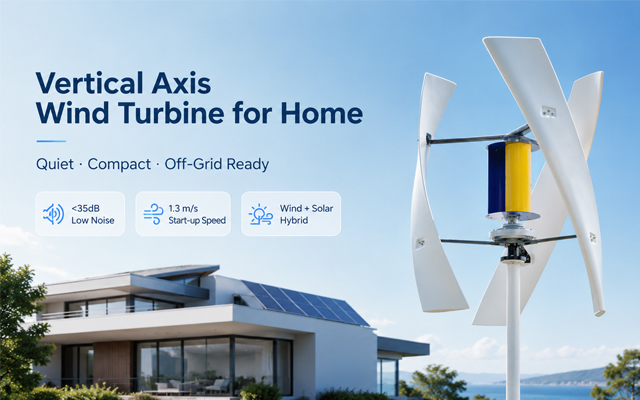
The EL-EX Series vertical axis wind turbine is designed for locations where compact structure, low noise, low-speed starting performance, and stable off-grid power support are important. Therefore, it is especially suitable for homes, villas, farms, cabins, and distributed renewable energy projects.
1. Low-Wind Performance: Helping You Capture More Usable Wind
One of the biggest challenges with small wind power systems is unstable wind speed. In many residential areas, wind conditions are affected by buildings, trees, roofs, and surrounding terrain.
As a result, traditional wind turbines may not always perform well in these environments. They often need stronger and more consistent wind before they begin rotating effectively. Therefore, daily generation time may be reduced, and the payback period can become longer.
The EL-EX Series is designed with a start-up wind speed of 1.3 m/s. This helps the turbine begin rotating under light wind conditions. For this reason, it is more suitable for residential rooftops, villas, farms, cabins, and off-grid locations where wind speed may change throughout the day.
In addition, the turbine uses a coreless disc generator, which helps reduce starting resistance and improve low-speed rotation performance. Compared with traditional generator structures, this design can help the turbine respond more smoothly to changing wind conditions.
However, it is important to understand one key point:
Start-up wind speed does not mean rated power output.
A start-up wind speed of 1.3 m/s means the turbine can begin rotating. The rated power is reached under stable rated wind conditions of 14 m/s. Therefore, actual power generation depends on local wind speed, tower height, installation environment, battery system, controller configuration, and daily wind duration.
This explanation helps customers choose a system based on real wind conditions instead of only looking at the rated power number.
2. Compact Installation: A Better Fit for Homes, Rooftops, and Small Projects
Large horizontal-axis wind turbines usually require open land, taller towers, and wider safety clearance. Because of this, they can be difficult to install in residential or semi-urban areas.
By contrast, a vertical axis wind turbine for home has a more compact structure. Since it rotates around a vertical axis, it can receive wind from different directions without requiring the same open directional space as many traditional systems.
The EL-EX Series is available from 300W to 2000W. Therefore, it can support different small-scale power needs, including:
- Residential rooftops
- Villas and private houses
- Remote cabins
- Farms and ranches
- Off-grid eco-resorts
- Telecom or monitoring stations
- Wind-solar hybrid power systems
In practical applications, its compact design makes it easier to integrate into distributed energy projects where space is limited.
In addition, the system supports guyed tower and independent tower installation options. As a result, project owners can choose a more suitable installation method based on site conditions, budget, and local wind resources.
3. Low Noise Design: Suitable for Residential Environments
Noise is one of the most important concerns for home wind turbine buyers. If a turbine generates too much sound, it may create problems with neighbors, local regulations, or long-term comfort.
Therefore, low-noise performance is especially important for residential wind power systems.
The EL-EX Series is designed for quiet operation, with a noise level of less than 35dB under normal operating conditions. As a result, it is more suitable for homes, villas, rooftops, and other noise-sensitive locations.
Its vertical rotation structure helps reduce sharp aerodynamic noise. Meanwhile, the 3-blade design provides smoother rotation, which can help lower vibration and sound during operation.
In addition, the turbine body uses glass/basalt composite material. This material provides good structural strength and helps improve durability in outdoor environments. At the same time, it gives the turbine a clean, modern appearance, making it easier to match residential buildings and green energy projects.
For customers searching for a silent wind turbine for residential use, the EL-EX Series offers a practical balance of low noise, compact size, and reliable small-scale wind power performance.
4. Safer Visual Profile for the Surrounding Environment
Environmental impact is another concern in wind power projects. Fast-spinning horizontal blades may create visual and ecological concerns in some areas.
Compared with traditional horizontal-axis designs, the EL-EX Series uses a vertical-axis structure that creates a more visible rotating profile. Therefore, the turbine may be easier to notice in the surrounding environment.
However, every project should still consider local wildlife, installation height, and site conditions. Even so, vertical axis turbines are often viewed as a more suitable option for small residential and distributed energy applications.
5. Technical Parameters of the EL-EX Series
The EL-EX Series includes multiple power options to support different residential and light commercial needs. Therefore, buyers can choose a model based on their voltage requirements, installation space, and expected energy demand.
| Technical Parameters | EL-EX-300W | EL-EX-800W | EL-EX-1000W | EL-EX-2000W |
|---|---|---|---|---|
| Rated Power | 300W | 800W | 1000W | 2000W |
| Maximum Power | 330W | 880W | 1100W | 2200W |
| Rated Voltage | 12V / 24V | 12V / 24V | 24V / 48V | 24V / 48V |
| Start-up Wind Speed | 1.3 m/s | 1.3 m/s | 1.3 m/s | 1.3 m/s |
| Rated Wind Speed | 14 m/s | 14 m/s | 14 m/s | 14 m/s |
| Cut-in Wind Speed | 3.5 m/s | 3.5 m/s | 3.5 m/s | 3.5 m/s |
| Number of Blades | 3 pieces | 3 pieces | 3 pieces | 3 pieces |
| Body Material | Glass / Basalt | Glass / Basalt | Glass / Basalt | Glass / Basalt |
| Generator Type | Coreless Disc Generator | Coreless Disc Generator | Coreless Disc Generator | Coreless Disc Generator |
| Working Temperature | -40°C ~ +80°C | -40°C ~ +80°C | -40°C ~ +80°C | -40°C ~ +80°C |
| Tower Form | guyed tower/independent tower | guyed tower/independent tower | guyed tower/independent tower | guyed tower/independent tower |
6. Built for Wind-Solar Hybrid and Off-Grid Power Systems
A home wind turbine works best when it is part of a complete energy system. In many off-grid projects, wind power can work together with solar panels and battery storage to improve overall energy stability.
For example, solar panels usually perform best during the day and in sunny weather. Wind turbines, meanwhile, may continue generating power during cloudy weather, at night, or during seasonal windy periods.
Because of this, wind and solar can form a strong combination for homes and remote power projects. As a result, users can reduce dependence on a single energy source and improve the stability of their off-grid system.
The EL-EX Series supports 12V, 24V, and 48V system configurations, depending on the model. In addition, it can be paired with wind controllers, hybrid controllers, inverters, and battery storage systems to build a more stable off-grid energy solution.
This makes it suitable for:
- Home backup power
- Rural off-grid houses
- Farms and agricultural sites
- Small commercial power systems
- Wind-solar hybrid systems
- Remote monitoring stations
- Island, mountain, and coastal projects
7. Why Choose a Vertical Axis Wind Turbine for Home Use?
A vertical axis wind turbine for home is not designed to replace large utility-scale wind farms. Instead, its value lies in distributed power generation.
In other words, it helps users make better use of local wind resources in a smaller and more flexible installation space.
The EL-EX Series helps solve several common barriers in small wind power projects:
- Lower noise for residential environments
- Compact structure for rooftops and limited spaces
- 1.3 m/s start-up wind speed for light-wind rotation
- Coreless disc generator for reduced starting resistance
- Glass/basalt composite body for outdoor durability
- Multiple voltage options for off-grid system integration
- Suitable compatibility with wind-solar hybrid systems
For homeowners, it can support energy independence and reduce reliance on the grid. Meanwhile, for distributors and project developers, it provides a practical product option for residential, rural, and small commercial renewable energy markets.
Conclusion: A Practical Home Wind Power Option for Modern Energy Needs
Wind turbines are often criticized for noise, space requirements, and unstable performance in low-wind areas. However, these problems are not reasons to avoid wind power completely. Instead, they show why choosing the right turbine design is important.
The EL-EX Series vertical axis wind turbine is designed for residential and distributed energy applications where low noise, compact installation, and hybrid system compatibility matter.
Therefore, if you are looking for a vertical axis wind turbine for home, rooftop power project, or small off-grid energy solution, the EL-EX Series can be a strong option to consider.
Explore more product details here:
https://elege-energy.com/x-wind-turbine/
For distributors, installers, and project buyers, ELEGE can also provide customized system recommendations based on your local wind conditions, voltage requirements, installation site, and battery storage plan.